
“Mere gossip.” This Thursday, the president of the Community of Madrid, Isabel Díaz Ayuso, used that adjective to refer to the prioritization of profitable patients reported by workers at the Torrejón hospital (public, but managed by the private company Ribera Salud) after the audio scandal in which a manager ordered his team to pay more attention to profit when managing, for example, waiting lists. “Any accusation of this type, which is obviously serious, must be taken through official channels,” Ayuso said in a group of journalists, diminishing the credibility of the employees’ complaint and after her Health Minister had announced two express reports that had not found any irregularities.
However, the instruction to seek profit that appears in the recordings published by The Country —expressed in a meeting by the CEO of Ribera Salud on September 25— is not new. It has been implemented for a long time, according to several health workers from various areas told elDiario.es and according to the documentation that this medium has been able to access. These practices were consolidated before the audios, when Torrejón was in charge of the Ribera Salud team, fired in October by the CEO of the recordings, who has also been removed from the management of the hospital after the publication of the scandal.
One of the profitable ways to get more money, as requested by director Pablo Gallart, is to have patients assigned to other centers go to your hospital for surgery. In that case, the Community of Madrid—thanks to the free choice that Esperanza Aguirre established and which put the health system in competition with each other—has to pay the chosen hospital for the operation or treatment performed on that outpatient.
They are the so-called “non-capita” patients. Extra payments are subject to public prices that the Ministry of Health establishes depending on the type of intervention and its complexity. For example, the implantation of a pacemaker ranges between 5,000 and 15,000 euros charged by the hospital that takes the patient. For the “capita” patients, the Ayuso Government pays Ribera Salud a fixed amount of 581 euros per inhabitant of the area, with an assigned population of 150,000 people.
That is, for those who are not from Torrejón but choose it, Ribera Salud bills. And the more you bill, the more you earn. Many of them have been offered early surgical operations, they were operated on before other Torrejón patients who had been on the waiting list for longer, according to testimonies from health workers, documents and data that elDiario.es has been able to confirm.
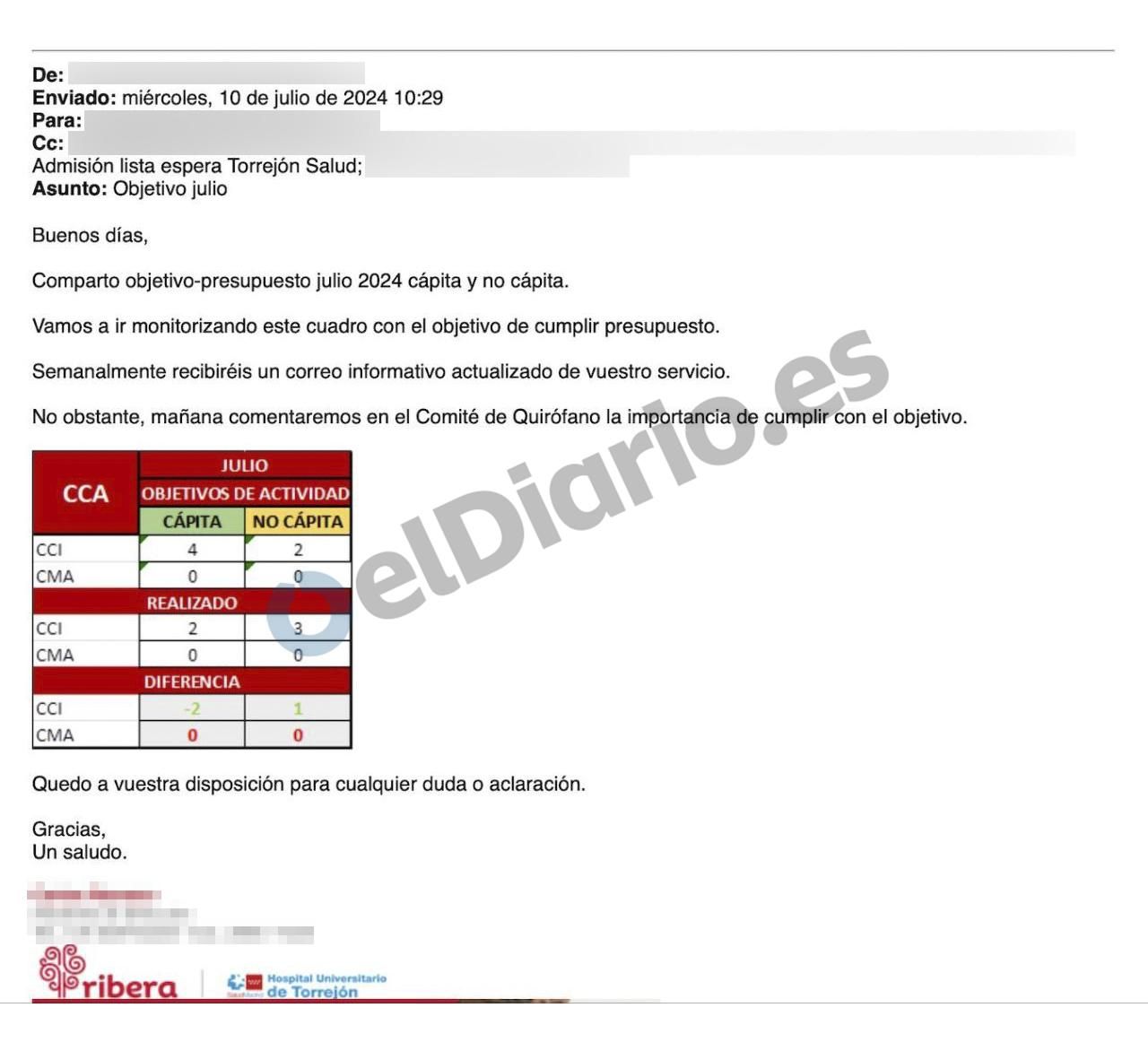
In fact, in 2024, emails and written instructions were sent to those who organize the operations (normally the heads of services) about the need to schedule interventions so that a “capita and non-capita budget objective” was met each month in the operating rooms, as stated in an email published by elDiario.es in April of this year, as reported by Sofía Pérez Mendoza. The subject of the email, dated July 2024, makes it clear that there is an economic plan linked to the waiting lists: “July Objective.” In that email, the hospital management marks the non-capita and capita that must be operated each month to meet “objectives” and “budget.” They announce to the doctors that this is going to be “monitored” and that there will be a weekly follow-up to ensure that it is fulfilled.
In the computer system of this hospital, as in that of the rest of the hospitals in the Community, patients are perfectly identified: Torrejón patients have a green tab and free-choice patients have an orange tab. The email also called for a meeting the next day in which “the importance of meeting the objective” would be explained. But, in addition, the admission service insisted to the cardiac surgery service, by message in this case, that “to meet the non-capita objective of September [sic]”a non-capita CCI (surgery with income) was to be “scheduled next week.” Although elDiario.es has asked the Ayuso Government for an explanation, alerting it that these written instructions exist and were going to be published, the Ministry of Health denies that “any type of order” has been produced. The same sources also refer to a letter signed by the heads of service in which these health workers defend that they have always acted with “ethics” and “professionalism.”
However, a manifesto signed in May by 260 hospital professionals already warned of this practice and publicly denounced it, although both the hospital and the Community of Madrid deny that it occurred: “One of the perhaps most scandalous aspects is that some service heads are pressured to prioritize in the scheduling of both outpatient consultations and surgical waiting lists patients from other health areas compared to Torrejón. This is contrary to equity, a pillar of our National System. of Health”, these health workers then lamented, a practice that, according to the data, has been softened but has not been eradicated. “Nothing out of place contemplated in the contract is occurring,” they insist from Health.
According to health sources familiar with operating room activity, “this has happened in all specialties for about three years,” when the new medical director arrived. “The orders of the new management were to meet a certain percentage of non-capita patients in the ordinary operating rooms, which reached 100% in the extra or peonadas [cuando se abren los quirófanos por la tarde o en fin de semana]. “This ended up leading to significant differences in waiting times depending on the area of origin of the patients,” says this same source, who adds that the practice has become more nuanced. The economic justification is that opening an operating room is very expensive, and if they were free to choose, it could be compensated because it would be paid as an extra by the Community of Madrid. A health worker from another specialty and professional group endorses the modus operandi, in which non-capita patients have often been prioritized. The Ministry of Health has not responded. to elDiario.es to the question of whether there have been exclusive shifts for patients from other areas.
In addition to the written instructions revealed by elDiario.es to prioritize patients from outside, this medium has been able to verify the data that shows, in another hospital service other than cardiac surgery, that the waiting list is always shorter for patients of free choice in scheduled operations of the same clinical priority (leaving aside preferential interventions, which are the most serious and urgent).

In March of this year, a patient in this specialty (which elDiario.es does not specify so as not to identify the sources) waited more than 130 days to undergo surgery in a scheduled intervention. A “non-capita” patient waited less than a month. With the precise data, six times less than one from Torrejón, as this medium has been able to verify.
In October of this year – when the Ribera Salud executive had already called for more profitability in the meeting of the audios and after a wave of protests and workers’ manifestos before the summer -, that difference was shortened, but even so the wait for someone from Torrejón was triple that of someone of free choice: more than 140 days compared to just over a month of waiting. Currently there are still fewer waiting days for the “non-capita”, but the difference between them is much smaller, about 20 days difference. Health has not responded to the request for an explanation about the differences confirmed by elDiario.es between these two types of patient.
The search for profitability has not only occurred in operating rooms, according to workers. In the maternity hospital, Torrejón has positioned itself as a reference hospital in humanized childbirth, you can give birth in a bathtub and as a consequence it has been one of the most chosen by women from other areas. “Things are done very well here,” explains a worker in that field, who at the same time denounces practices that neither she nor her colleagues agree with because they prioritize health benefits: “There is pressure not to refer anyone who enters Torrejón to another hospital, even if there are no dilation rooms available,” she says. The orders are verbal, explains this health worker, “and when women have been referred to other hospitals because we were full here, we have been asked for explanations.” In fact, in March 2024, a group of midwives sent a letter to the management complaining about “non-referral protocols” and warning of the insecurity and excess work it entailed. “Absolutely no pressure is placed on anyone in this hospital in any of the services,” they say from the Ministry of Health.
If you have information about this case or know of other similar ones, you can write to our confidential email at [email protected]
Source: www.eldiario.es