Implementation requires approval from the European Parliament and the congresses of the four South American countries. To enter into force definitively, approval is still needed from the national parliaments of each of the EU states. Agreement integrates market that brings together 720 million people
After dragging on for more than a quarter of a century, the soap opera that could create the largest free trade zone in the world has reached the final stretch, at least in part.
This Saturday (17/01), the president of the European Commission, Ursula von der Leyen, arrives in Asunción, the Paraguayan capital, to finally sign, alongside representatives from Brazil, Argentina, Paraguay and Uruguay, the trade agreement between Mercosur and the European Union (EU).
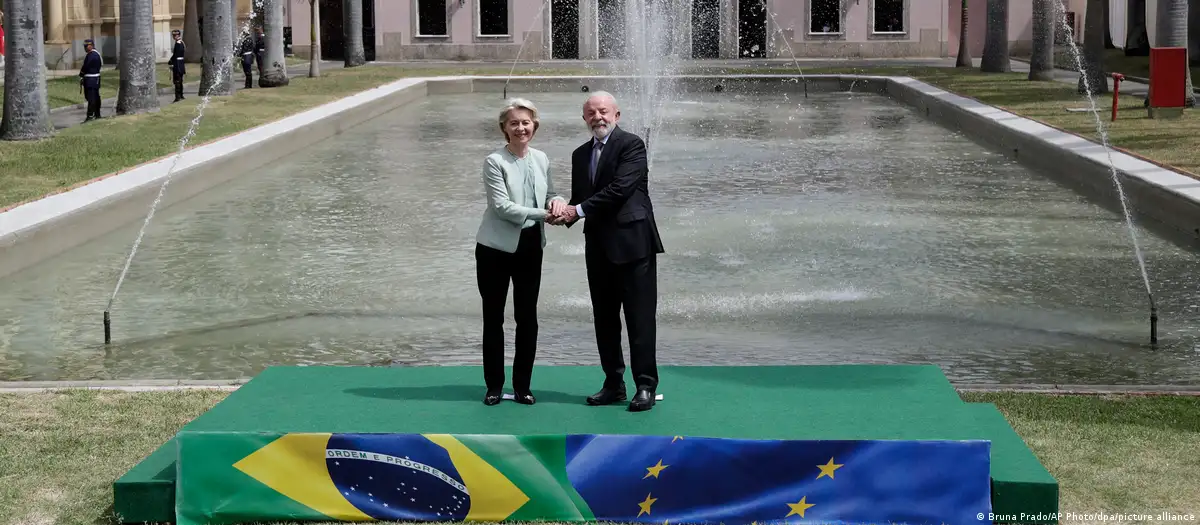
For scheduling reasons, President Luiz Inácio Lula da Silva will not travel to Paraguay. Brazil will be represented at the signing ceremony by the Minister of Foreign Affairs, Mauro Vieira. The day before (16), Lula received Ursula and Costa in Rio de Janeiro, where they discussed the implementation of the trade agreement and other topics on the international agenda.
The treaty that will facilitate the transit of goods and services between the 27 Member States of the EU and the countries of the South American economic bloc began to be negotiated in 1999, but only reached an understanding between the parties in 2019. Since then, the formal partnership has been forged politically and legally, despite resistance mainly from French farmers, who fear losing the market for Mercosur products.
The agreement will create a common market that covers around 720 million people and will represent a Gross Domestic Product (GDP) of more than 22.4 trillion dollars (around R$118 trillion). According to the Ministry of Foreign Affairs (MRE), the treaty is expected to inject, in around ten years, R$37 billion into the Brazilian economy.
What are the next steps?
After signing in Paraguay, the agreement must be approved by the European Parliament and the congresses of the four South American countries.
The process, however, is more complicated than it seems. This is because those involved will actually sign two documents instead of one: the Interim Trade Agreement (ITA), which covers only trade, and the EU-Mercosur Partnership Agreement (EMPA), which covers political and sectoral cooperation, in addition to trade and investments.
For the ITA, this process should be a mere formality, at least for the deputies from Brazil, Argentina, Uruguay and Paraguay; but it will take time. In Brasília, for example, Planalto must send a bill, which will be submitted to specific committees before going to the plenary of the Chamber and Senate to receive final approval and be ratified by the President of the Republic. According to the vice-president, Geraldo Alckmin, this should happen in the second half of 2026.
In Europe, however, the process may face obstacles, mainly from MEPs from countries such as France, Hungary and Poland, even if only votes from a simple majority of parliamentarians are required. This instrument does not need to go through the national parliaments of each of the European Union countries and already provides a reduction in tariffs between both blocs.
But discussions could still last for months before a consensus is reached. According to the Reuters news agency, the final vote is expected to take place by May. If the ITA is approved, the Mercosur-EU agreement will come into effect in practice.
Much longer path
However, for the complete treaty provided for in EMPA to be implemented, the route will be much longer. This instrument will only be implemented permanently after approval by all national parliaments of the 27 Member States of the European Union, in addition to the four Mercosur nations. In some countries, such as Belgium, the agreement will also have to be voted on by regional parliaments.
In this case, doubts about when and if EMPA will come into force increase. To give you an idea, a free trade agreement between the European Union and Canada, signed in 2016 and which came into force with a similar provisional instrument the following year, is still awaiting approval by the national parliamentarians of ten members of the European bloc.
Free trade agreement should boost Brazilian exports and inject, over ten years, R$37 billion into the country’s economy | Pablo Porciuncula/AFP
But the provisional agreement may still face other obstacles, more specifically in legal territory. A group of 145 deputies says that the terms of the ITA need to be submitted for an opinion by the Court of Justice of the European Union before the project goes to plenary. The European Parliament will vote next week on the resolution for this request for analysis of the treaty to be sent to the court. If approved, the process could even delay the implementation of the provisional instrument of the agreement.
Opponents criticize the so-called “compensation mechanism”, which would allow, for example, Mercosur countries to demand changes to the agreement if EU policies affect their exports and ask that the trade agreement not enter into force before full ratification by all EU countries.
Support from Europe’s largest economy
On the other hand, in Germany, the third largest economy in the world and the richest country in Europe, the agreement has been defended practically without reservations by the government of Federal Chancellor Friedrich Merz. According to him, the treaty is a “milestone in European trade policy and an important sign of our strategic sovereignty and capacity for action”.
The German Finance Minister, Lars Klingbeil, used the advances in the agreement with Mercosur to criticize the surcharge policy of the president of the United States, Donald Trump. “While others close down and pursue an increasingly aggressive commercial policy, we are betting on new partnerships.”
According to a study by the Ifo institute, commissioned by the New Social Market Economy Initiative (Initiative Neue Soziale Marktwirtschaft), the economic treaty with South American countries should generate an increase of 4.1% in German exports and an increase of up to 0.5% in GDP in Germany.
Check out the main points of the agreement:
1. Elimination of customs duties
- Gradual reduction of tariffs on most goods and services;
- Mercosur: will eliminate tariffs on 91% of European goods within 15 years;
- European Union: will eliminate tariffs on 95% of Mercosur goods within 12 years.
2. Immediate gains for the industry
Zero tariff from the beginning for various industrial products.
>> Sectors benefited:
- Machines and equipment;
- Cars and auto parts;
- Chemicals;
- Aircraft and transport equipment.
3. Expanded access to the European market
- Mercosur companies gain preference in a market with high purchasing power;
- EU has GDP estimated at US$ 22 trillion;
- Trade tends to be more predictable and with fewer technical barriers.
4. Quotas for sensitive agricultural products
- Products such as beef, chicken, rice, honey, sugar and ethanol will have import quotas;
- Above these quotas, a fee is charged;
- Quotas grow over time, with reduced fares, rather than allowing unrestricted entry;
- Mechanism seeks to avoid abrupt impacts on European farmers;
- In the EU, quotas are equivalent to 3% of goods or 5% of the value imported from Brazil;
- In the Brazilian market, they reach 9% of goods or 8% of the value.
5. Agricultural safeguards
>>EU may temporarily reintroduce tariffs if:
- Imports grow above defined limits;
- Prices are well below the European market;
- Measure applies to chains considered sensitive.
6. Mandatory environmental commitments
- Products benefiting from the agreement cannot be linked to illegal deforestation;
- Environmental clauses are binding;
- Possibility of suspending the agreement in case of violation of the Paris Agreement.
7. Health rules remain strict
- EU does not relax sanitary and phytosanitary standards;
- Imported products will follow strict food safety rules.
8. Trade in services and investments
>>Reduction of regulatory discrimination against foreign investors.
>>Advances in sectors such as:
- Financial services;
- Telecommunications;
- Transport;
- Business services.
9. Public procurement
- Mercosur companies will be able to compete for public tenders in the EU;
- More transparent and predictable rules.
10. Intellectual property protection
- Recognition of around 350 European geographical indications;
- Clear rules on brands, patents and copyrights.
11. Small and medium-sized enterprises (SMEs)
- Specific chapter for SMEs;
- Customs facilitation measures and access to information;
- Reduction of costs and bureaucracy for small exporters.
12. Impact for Brazil
- Potential to increase exports, especially in agriculture and industry;
- Greater integration into global value chains;
- Possible attraction of foreign investments in the medium and long term.
With information from DW and Agência Brasil on 01/17/2026
Source: https://www.ocafezinho.com/2026/01/17/quando-o-acordo-ue-mercosul-comecara-a-valer-na-pratica/