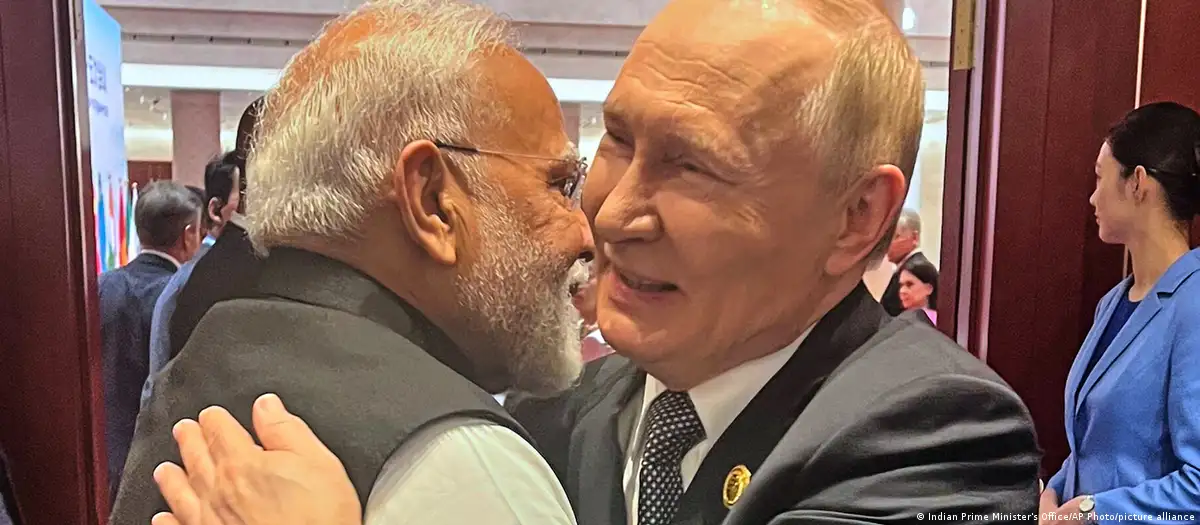
Despite a decades-long partnership, focused mainly on the military sector, this is the Russian president’s first trip to the country since the invasion of Ukraine. The relationship is a counterweight to pressure from the US and proximity to China.
The President of Russia, Vladimir Putin, arrived in India this Thursday (04/12) for a two-day visit with the aim of strengthening the partnership between the two countries, a relationship that has lasted for almost eight decades of geopolitical turmoil.
The Kremlin chief was invited by Indian Prime Minister Narendra Modi to the 23rd annual India-Russia summit, held in the Asian country’s capital. It is Putin’s first visit to India since the start of the War in Ukraine in 2022.
Both countries have already signaled their intention to strengthen the “Special and Privileged Partnership” – a term officially adopted for Russian-Indian relations in 2010 – and “exchange views on regional and global issues of mutual interest”, the Indian Foreign Ministry said in a statement.
Before Putin’s arrival, Putin’s spokesman and chief of staff Dmitry Peskov highlighted the importance of defending relations and trade between India and Russia. The statement comes at a time when India has been suffering surcharges from the United States due to the purchase of Russian oil.
Russia is already facing an increasing number of Western sanctions over its invasion of Ukraine. “We have to protect our trade from external pressure,” Peskov told the press. According to Putin’s spokesman, there are ongoing discussions about payment alternatives to circumvent these sanctions.
Worker exchange is also on the agenda, as more and more Indians seek employment in Russia. To reporters, Peskov also cited Russia’s defense deals, including the sale of S-400 air defense systems, Sukhoi-57 fighter jets and small modular nuclear reactors.
India is, by far, the country that buys the most weapons from Russia. Furthermore, Moscow accounts for more than 35% of India’s crude oil imports – before the War in Ukraine, it was just 2%. However, US sanctions have forced Indian refineries to diversify their suppliers, indicates maritime intelligence company Kpler.
Tariffs ‘push’ India towards Russia
Even so, experts consulted by DW say that ties between India and Russia have proven resilient to Western pressure, including tariffs imposed by American President Donald Trump.
“Putin’s visit to India sends a clear message to the Western bloc that Russia is not isolated globally,” says researcher Rajan Kumar, from the Center for Russian Studies at Jawaharlai Nehru University. India still considers relations with Russia strategically important and a way to balance relations, at a geopolitical level, with both the West and China, he adds.
“Trump’s policies generated a loss of trust in the United States and increased the importance of Russia. Likewise, isolating Russia would mean bringing it closer to China, something that India would not want to happen”, analyzes the researcher.
Although Russia maintains a solid relationship with China, the Kremlin, on the other hand, views Beijing’s growing geopolitical influence with suspicion. According to Kumar, this is the reason why Russia has been encouraging India’s participation in Eurasian geopolitics, through platforms such as the Shanghai Cooperation Organization (SCO) and the BRICS.
Furthermore, says the researcher, unlike Western nations, Russia does not seek to teach “lessons” about internal affairs, nor does it impose conditions for bilateral cooperation. “Putin’s visit reinforces this ‘special and privileged’ partnership that is based on common interests, historical trust and shared geopolitics”, adds Kumar.
Why are Russia and India allies?
Relations between Moscow and New Delhi were established shortly after India gained independence in 1947. The now-defunct Soviet Union gained India’s trust by supporting the Asian country’s industrial development and providing diplomatic support in the dispute with Pakistan over the Kashmir region.
In 1971, Moscow openly supported India in the war with Pakistan, which, in turn, received support from the United States and China. Furthermore, New Delhi began acquiring large quantities of Soviet-made weapons and producing some of them, such as the T-72 tank, locally under Soviet license.
These close ties in the defense sector survived the end of the Cold War, when the Kremlin, seeking investment in the 1990s, helped India produce largely Russian-designed missiles and fighter jets and, later, the development of India’s Arihant nuclear submarine.
India and Russia have close military ties | Debajyoti Chakraborty/NurPhoto/ IMAGO
In 2002, both countries signed an agreement on space exploration, which provided for Russia to assist India in launches and satellite technology. Other agreements were signed after Modi took power in 2014, including treaties on nuclear energy and uranium sales.
Regarding the War in Ukraine, which was started by the Kremlin in 2022, India has been cautious. In order not to anger either Russia or Western countries, the Asian country called for an end to the war, but did not directly condemn the Russian invasion.
“As long-time partners, India and Russia have built up a lot of mutual trust, which has been fruitful at a time when both countries are facing geopolitical challenges – not only from the US, but also from China”, highlights former diplomat D. Bala Venkatesh Varma, who served as Indian ambassador to Russia. “It is expected that, during the summit, the two leaders will reinforce investment in this bilateral strategic partnership”, he adds.
Strategic autonomy
According to Harsh Pant, program coordinator at the Indian think tank Observer Research Foundation (ORF), Washington’s “unpredictable” diplomacy makes India more careful when entering into partnerships.
“The United States can pressure India to reduce contact with Moscow, but India values its relations with Russia too much, especially in the areas of defense and energy, to compromise them,” says the researcher. “This balance allows India to maintain strong relations with Russia while managing the broader strategic partnership with the US,” he adds.
With Russia and India seeking mutual interests and “strategic autonomy”, the analyst recalls that the roots of this partnership go “beyond the immediate pressures from the Trump administration”.
Putin’s visit should also give clues about the foreign policy priorities of India and Russia, in a context in which power dynamics have been changing across the planet. “The timing of the visit highlights New Delhi’s approach to foreign policy: that strategic partnerships are not zero-sum games,” explains Kanwal Sibal, former Indian Foreign Secretary and Ambassador to Russia.
“The US cannot dictate what India’s foreign policy should be. We need to adapt and resist”, he adds.
This argument is illustrated by India’s careful stance towards the Trump administration. Currently, India and the US are negotiating a trade agreement focused on reducing tariffs and Washington’s concerns about the trade deficit with New Delhi. Furthermore, India is promoting a historic 1 billion dollar (R$5.31 billion) agreement between the American GE Aerospace and the Indian Hindustan Aeronautics Limitied, for the acquisition of American jet engines for the Indian Teja fighters.
But that doesn’t stop India from rolling out the red carpet for Vladimir Putin. According to Sibal, defense cooperation with Washington continues, “but this in no way diminishes Russia’s strategic importance.”
“India welcomes the US relationship when it is advantageous, while resisting pressure to abandon Moscow. Putin’s visit demonstrates that Indian foreign policy works autonomously, and not according to Washington’s preferences”, he concludes.
Originally published by DW on 12/04/2025
By Murali Krishnan
Source: https://www.ocafezinho.com/2025/12/04/o-que-esta-em-jogo-na-visita-de-putin-a-india/