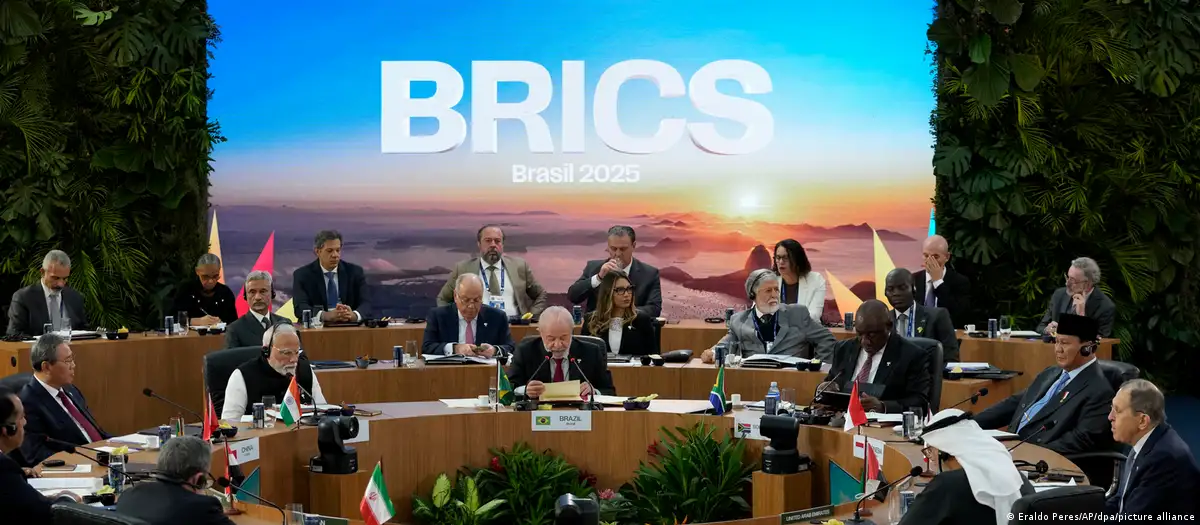
Divided and with different interests at stake, the bloc’s countries are unable to issue a joint position on the conflict. Lack of unity contrasts with response to the 2025 conflict.
The offensive launched by the United States and Israel against Iran and the Tehran regime’s subsequent retaliation against Gulf countries exposed an internal split in the Brics, which not only failed to issue a joint statement to date but also showed divergent public positions among its members.
Currently, Brics is made up of ten countries: Brazil, Russia, China, India, South Africa, Egypt, Ethiopia, United Arab Emirates, Iran and Indonesia. Saudi Arabia is usually listed as a member, but has not yet made its membership official.
While countries such as Brazil, Russia and China issued statements condemning the joint offensive by Israel and the US against Iran, other members such as the United Arab Emirates and India focused on condemning Iran’s retaliations. South Africa, in turn, tried to balance itself by expressing concern about the escalation of the conflict.
The lack of cohesion and joint positioning contrasts with the joint reaction observed in June 2025, in the 12-day war initiated by Israel against Iran and which also included US participation.
At the time, when the presidency was held by Brazil, the ten countries in the bloc released a joint note classifying the Israeli attacks as a “violation of international law and the Charter of the United Nations”. The same text also called for the opening of “dialogue channels” with the aim of “de-escalating the situation and resolving differences through peaceful means”.
The 2026 conflict has differences with last year’s 12-day war. Eight months ago, Iran also retaliated against the Israeli offensive, but its military actions did not hit targets in the United Arab Emirates and Saudi Arabia as happened this time.
Officially, Iran says it has only targeted US bases in Middle Eastern countries. “We are not attacking our neighbors in the Persian Gulf countries, we are attacking the US presence in these countries,” said Iranian Foreign Minister Abbas Aragchi. However, damage was recorded at targets with no direct connection to the US military, such as civilian airports, refineries and even luxury buildings.
In response, Saudi Arabia warned that it “reserves the right” to react to what it called “Iran’s cowardly attack.” On the other hand, the United Arab Emirates said it ruled out military action against Iran and called on the United Nations to seek a solution to the conflict.
For experts, Iran’s strategy of taking the conflict to Gulf monarchies aims to pressure these countries to demand a ceasefire from the US. In addition to Saudi Arabia and the United Arab Emirates, Iranian missiles and drones also hit targets in Bahrain, Qatar, Oman, Jordan, Syria, Iraq and Kuwait.
United Arab Emirates suffered damage caused by Iran | Reuters
Post-expansion crack
In 2001, economist Jim O’Neill coined the term Bric to identify Brazil, Russia, India and China as rapidly growing economies that had the potential to become global economic powers by 2050.
Despite differences in political ideologies and social structures, policymakers from the four countries began to work together, initially through informal conversations.
With the consolidation of negotiations, the countries’ first summit was held in Yekaterinburg, Russia, in 2009. A year later, South Africa was invited to join the emerging bloc, adding the “S” to the Brics acronym.
Between 2023 and 2025, the bloc underwent a major expansion, gaining six new members: Egypt, Ethiopia, United Arab Emirates, Iran and Indonesia. (The Saudis were invited, but began to avoid making their entry official after their US allies began threatening countries that aligned themselves with the bloc with tariffs.)
At the time, the expansion was largely the result of pressure from China, while Brazil tried to resist for fear of losing leadership in the group. After the expansion, President Luiz Inácio Lula da Silva’s special advisor for international affairs, Celso Amorim, also stated that the group “could not expand indefinitely”, at the risk of losing “cohesion”.
In April 2025, a Brics meeting that brought together foreign ministers from the bloc’s countries had already ended without the release of a joint statement, but later, in July, at the leaders’ meeting, members reached a consensus on issues such as United Nations reform and a two-state solution for the Palestinian territories and Israel, resulting in an official declaration.
Divergent positions on the current conflict
At the moment, the rotating presidency of the BRICS is held by India, which maintains close relations with the United States and Israel. Among Brazilian diplomats, there is no expectation that the Indians will call a meeting to articulate a common position in relation to the current conflict.
Among the four founding members of BRICS, the Indian position is the one that has contrasted the most. Indian Prime Minister Narendra Modi initially avoided commenting on the Israeli attack that killed Iran’s “supreme leader”, Ali Khamenei, preferring to publicly condemn the Iranian retaliation that caused damage in Saudi Arabia, the United Arab Emirates and Bahrain, in addition to denouncing what he called a “violation of the sovereignty and territorial integrity” of Kuwait, Qatar and Oman. No similar statement regarding Iran was released by the prime minister.
Last Sunday (03/01), Modi also reported that he had a telephone conversation with Israeli Prime Minister Benjamin Netanyahu and said he had conveyed “India’s concerns” and reiterated “the need for a rapid end to hostilities”. Modi also did not report contacting any Iranian officials. Modi’s stance provoked criticism from members of the Indian opposition.
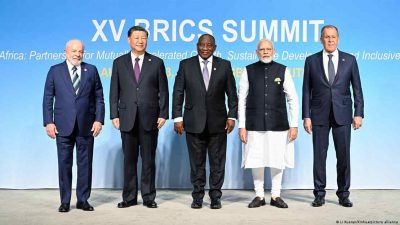 Brazil tried to resist the expansion that expanded the group to ten members | Li Xueren/Xinhua/picture alliance
Russia and China were explicit in positioning themselves against the Israeli-American action against Iran.
Just hours after Israeli and American bombs began hitting Tehran, Russia’s representative to the United Nations, Vassily Nebenzia, classified the attack as an “unprovoked act of armed aggression against a sovereign and independent member state of the UN.”
In a statement, the Russian government also called the action of the US and Israel “irresponsible”, “premeditated” and violating “the fundamental principles and norms of international law”. Russia is one of the few allies of the Tehran regime and in recent years has depended on the Iranians to supply military drones for use on the Ukrainian war front.
China, a buyer of Iranian oil, in turn, expressed itself in similar terms to Russia, with a spokeswoman stating that “the attacks by the US and Israel were not authorized by the UN Security Council and violate international law”.
However, neither Moscow nor Beijing have signaled that they intend to go beyond verbal condemnations of the actions of Israel and the US, signaling that they will not rush to the aid of the Iranians.
South Africa, which has hostile relations with Israel and is simultaneously trying to find some balance with Donald Trump’s USA, released a more generic position. On the one hand, in a statement, South African President Cyril Ramaphosa stated in relation to the Israeli-American offensive that “early self-defense is not permitted under international law”, but focused on arguing that “military confrontation has never brought sustainable peace” and asking for a diplomatic solution. The statement does not mention the countries involved and generally uses less direct language than China and Russia.
Brazil and remaining members
Among the original members of Brics, Brazil was the only democracy that issued an explicit condemnation of the US and Israel offensive, directly mentioning the two countries.
“The Brazilian government condemns and expresses serious concern about the attacks carried out by the United States and Israel against targets in Iran. The attacks occurred in the midst of a negotiation process between the parties, which is the only viable path to peace, a position traditionally defended by Brazil in the region”, stated Itamaraty, in a statement released last Saturday (28/02).
On Monday, it was Itamaraty’s turn to release a new note, condemning Iran’s retaliation against Gulf countries. “Brazil urges all parties to respect international law and condemns any measures that violate the sovereignty of third states or that may escalate the conflict, such as retaliatory actions and attacks against civilian areas. Brazil stands in solidarity with Saudi Arabia, Bahrain, Qatar, the United Arab Emirates, Iraq, Kuwait and Jordan — objects of Iran’s retaliatory attacks on February 28.”
Among the other new BRICS members, Indonesia used generic language in its position, “regretting the failure of negotiations between the US and Iran” and calling on the parties to prioritize diplomacy. The country also offered to act as a mediator.
Ethiopia, for its part, remains discreet, and has publicly expressed solidarity with Kuwait, the target of Iran’s retaliation. An ally of the US, but fearful of the increase in Israel’s strength in the Middle East, Egypt avoided commenting on the initial Israeli-American offensive, preferring to urge Iran to stop launching attacks on targets in Gulf countries and asking all sides to show restraint.
Originally published by DW on 03/06/2026
Por Jean-Philip Struck
Source: https://www.ocafezinho.com/2026/03/06/guerra-no-ira-expoe-racha-no-brics-expandido/