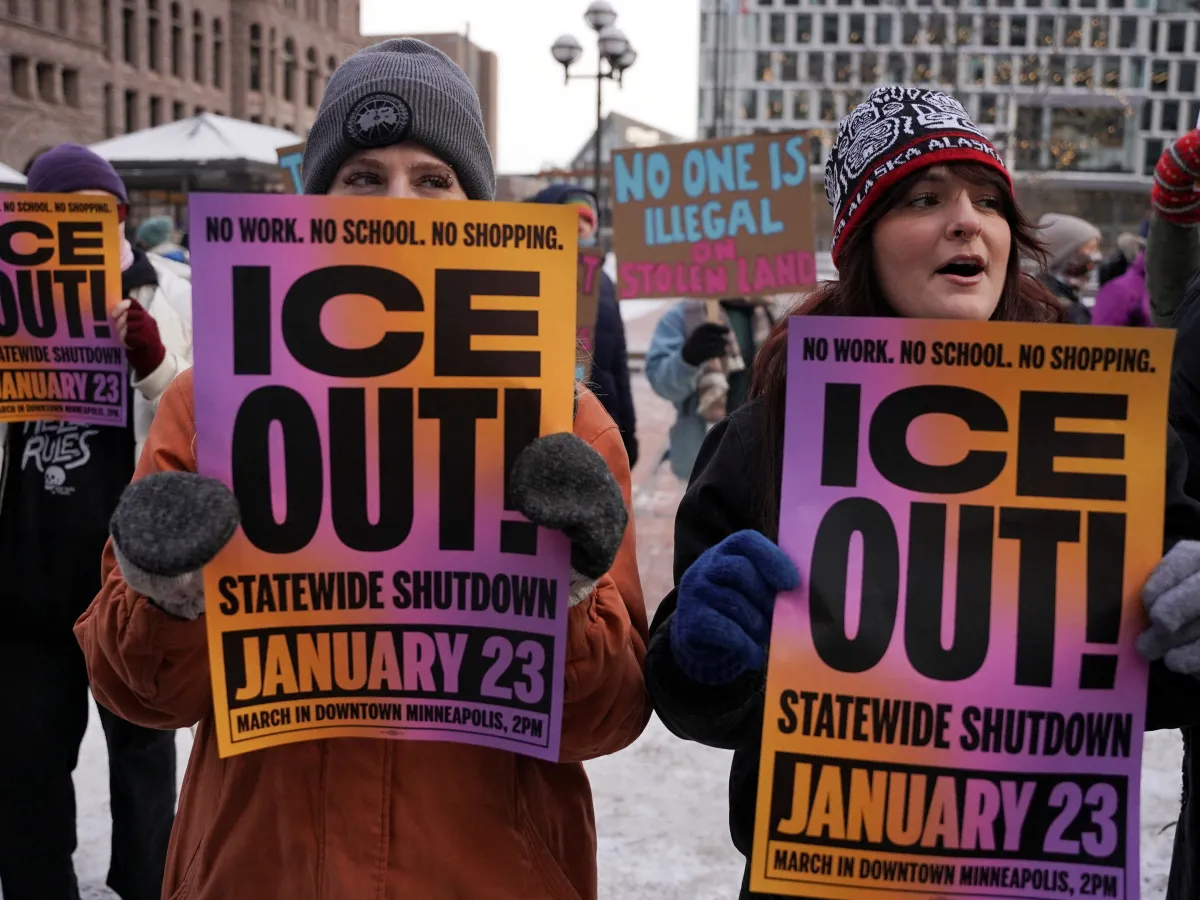
Approval of United States President Donald Trump’s immigration policy fell to its lowest level since his return to the White House, according to a Reuters/Ipsos poll released this Monday (26). The survey indicates that the majority of Americans consider that the government’s offensive against immigration has exceeded acceptable limits.
The survey was carried out across the country between Friday and Sunday and collected responses before and after a new episode of violence in Minneapolis, where federal agents shot dead an American citizen during clashes with protesters opposing the presence of immigration forces in the city. It was the second death recorded in the municipality in actions involving federal agents this month.
According to the survey, only 39% of respondents approve of the way Trump conducts immigration policy, a drop from the 41% recorded at the beginning of January. 53% said they disapproved. The topic had boosted the president’s popularity shortly after his inauguration, when, in February, 50% approved of his performance and 41% rejected it.
Trump won the 2024 presidential election with the promise of promoting a historic intensification of deportations. Since then, masked immigration agents equipped with military-style tactical gear have become a frequent presence in several cities across the country, triggering protests in different regions. In Minneapolis, these operations resulted in violent clashes and deaths.
Trump administration officials said that 37-year-old nurse Alex Pretti, who was shot dead during a protest in the city, had attacked federal agents before being shot. However, videos recorded by witnesses contradict this official version. Weeks earlier, also in Minneapolis, another American citizen, 37-year-old Renee Good, was shot dead by an immigration agent during an operation.
The perception that the repression was excessive is shared by 58% of respondents, who said that Immigration and Customs Enforcement (ICE) went too far in its actions. Another 12% stated that the action was not sufficient, while 26% considered that the approach was adequate. Among Democrats, around nine in ten assessed that the agents went overboard, a proportion that drops to two in ten among Republicans and rises to six in ten among independents.
The images of the clashes, widely circulated on social media, also caused discomfort within the Republican Party, at a time when parliamentarians from the party face growing dissatisfaction among voters with rising prices, on the eve of the November legislative elections, which will define control of Congress and state governments. In Minnesota, the main Republican candidate for governor of the state, Chris Madel, withdrew from the race this Monday, saying that immigration repression made a Republican victory unfeasible.
Although he held Democrats responsible for the deaths, Trump adopted a more moderate tone this Monday when commenting on the case. The president said he was “on the same wavelength” as the Democratic governor of Minnesota, Tim Walz, and said they had a “very good connection.”
In addition to the drop in the evaluation of migration policy, the survey also showed a decline in the president’s general approval. The index fell to 38%, tying the lowest level of his current term, after scoring 41% in the previous survey, carried out between January 12th and 13th.
Despite the deterioration in the indexes, Trump continues to perform better in the area of immigration than his predecessor, Democrat Joe Biden. The survey also shows that Americans continue to trust Republicans more than Democrats to deal with the issue: 37% said they prefer the Republican approach, compared to 32% who opt for Democrats, while the rest said they were unsure or did not see a difference between the parties.
The Reuters/Ipsos survey interviewed 1,139 adults across the country, online, and has a margin of error of approximately three percentage points.
Source: https://www.ocafezinho.com/2026/01/27/violencia-em-minneapolis-derruba-apoio-a-politica-de-imigracao-de-trump/