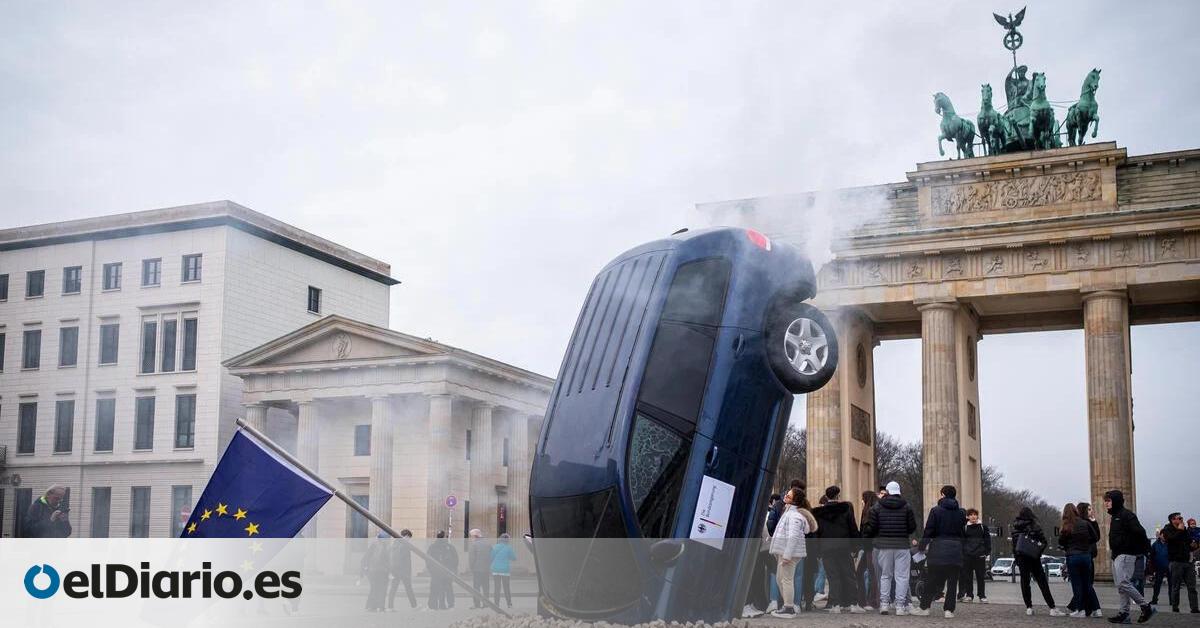
In the wake of the anti-ecological wave that the extreme right has inoculated, the fossil car is in full and successful counterattack. Despite being one of the most powerful sources of CO₂ emissions causing the climate crisis, the industry has seen the deadline for selling its combustion engines reversed, the circulation of the most polluting models extended and the traffic restrictions that were supposed to entail the low emissions zones provided for in the Climate Change law being deactivated.
In Brussels and Spain, policies to reduce automobile gas emissions are breaking down. The European Commission has given in to the automobile industry and will allow gasoline and diesel engines to be sold beyond 2035. In Madrid, the City Council extends the circulation of the most polluting cars for another year. By the end of 2025, only a third of the low-emission zones mandated by law from 2023 are operational.
The attempt to slow the transition to zero-emission mobility is the result of a combination of right-wing political trends and resistance to change by the oil industry and certain car manufacturers.
Isabell Büschel
— Director in Spain of Transport&Environment
Given this panorama, the director in Spain of the Transport&Environment organization, Isabel Büschel, reflects that “the attempt to stop the transition towards zero-emission mobility is the result of a combination of the right-wing political trend and the resistance to change of the oil industry and certain automobile manufacturers.”
What happened this Tuesday is that the European Commission watered down its own plan to veto combustion engines. The pressures in the automobile sector sustained by Germany, Italy or Poland have expired and these cars will be able to be sold beyond 2035. The President of the Government, Pedro Sánchez, called it a “historical mistake.”
As a backdrop to this issue, there are two curves that collide: that of greenhouse gas emissions coming out of the exhaust pipes and that of the registrations of gasoline and diesel cars. The first one goes up. The second low.
Emissions from road transport in Spain are 30% of the national total. Last year they rose 2%. In the European Union, passenger cars alone release 12% of all the new CO₂ injected into the atmosphere. The latest report on emissions in Spain from the Center for Climate Change of the Basque Country (BC3) – published this Thursday – indicates that, in 2025, the level of emissions “remains stable” – when it should go down – and points out as the “most urgent challenge” the “decarbonization of transport”, that is, for cars, motorcycles, vans or trucks to reduce the CO₂ they release when burning fossil fuels to zero.
On the other hand, registrations of diesel cars in the European Union will decrease by 25% year-on-year in 2025 and that of gasoline cars has gone from representing 34% of the market share to 27%, according to data from the European automobile association ACEA. The same organization that, after Tuesday’s decision in Brussels, said: “First important step to amend the CO₂ legislation for cars and vans.” And he used the argument about “creating a more pragmatic and flexible path that aligns decarbonization and competitiveness.”
This is bad news for air quality and climate, as well as for employment because it puts millions of lives and jobs in Europe at risk, although it generates millions of short-term benefits for the automobile industry.
Cristina Aroja
— Greenpeace Mobility Program Manager
This victory for thermal cars “undermines efforts to put CO₂ emissions from transport on a reduction path to limit climate change,” says the head of Greenpeace’s mobility campaign, Cristina Arjona. “So this is bad news for air quality and climate, as well as for employment because it puts millions of lives and jobs in Europe at risk, even if it generates millions of short-term benefits for the automotive industry.”
Just a few days before the Brussels decision, the mayor of Madrid, José Luis Martínez Almeida (PP), decided that the most polluting cars in the most populated city in Spain would have a second extension to continue circulating.
Cars without an environmental label were supposed to be off the road on January 1, 2026, but the local government has chosen to give them another 12-month grace period that joins the one they had already enjoyed during 2025. The measure to prevent these cars from continuing to pollute thus suffers a second delay. The person responsible for the Environment in the capital, Borja Carabante, has justified that the impact “will be low” because he estimates that there are 15,000 vehicles.
All these delays in the transition towards cleaner mobility mean that “thousands of people will continue to get sick every year, as long as pollution is not reduced,” adds the coordinator of Ecologists in Action, Carmen Duce. “It is true that nitrogen dioxide (NO2) pollution is reducing, but we are still far from the recommendations of the World Health Organization,” he recalls.
All this is a flight forward with very little meaning and no vision of the future.
Carmen Duce
— Coordinator of Ecologists in Action
The ZBE “fiasco”
Flying over these two recent decisions is what Carmen Duce herself describes as a “total fiasco, with exceptions” that the implementation of the low emission zones (ZBE) mandated by the Climate Change law has entailed. This tool was designed to “contribute to improving air quality and mitigating climate change.”
The idea was to “reduce the use of private vehicles” to cut emissions and they were to be operational on January 1, 2023. However, currently, only about 57 of the more than 150 that should already be operating are in force. The law obliges, at least, municipalities with more than 50,000 inhabitants and the islands.
Duce explains that “they are not going to be able to reduce emissions of any kind. We have analyzed the ZBEs of more than 50 cities, and only in two of them the area protected by the ZBE exceeds 5% of the total surface of the city.”
Because, added to the low level of implementation in terms of number of cities or proportion of space dedicated to the measure, in many cases the designed areas are a make-up as this research by Ballena Blanca revealed. There are cases in which amusement parks have been included in the ZBE, historic centers that have been pedestrianized for years have been labeled as low-emission zones, or traffic has been disturbed as little as possible. There are cases of all kinds.
It must be taken into account that, in Spanish cities, the use of a private car is a small proportion compared to traveling by public transport, but even so, it is granted the occupation of approximately 80% of the space in the municipalities.
“All this is a flight forward with very little meaning and no vision of the future,” summarizes Carmen Duce. For her part, Cristina Arjona recalls that “the rapid transition towards zero-emission mobility is not only about protecting the health of citizens and being consistent with the fight against climate change, but also about avoiding the collapse of the European automobile industry.”
Because, as Isabell Büschel emphasizes, “while Europe hesitates, China accelerates in electric cars and leaves us, little by little, as a lagging continent that leads us to the loss of direct competitiveness and the threat to factories and employment.”
Source: www.eldiario.es