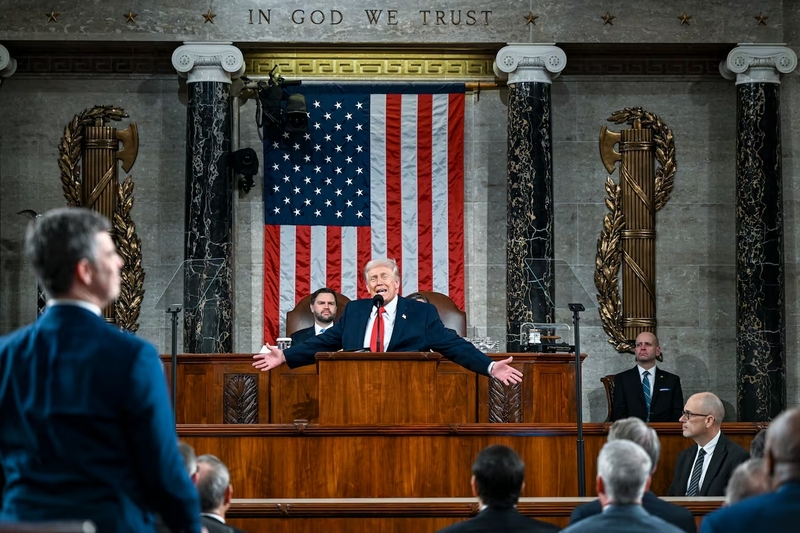
The speech did not lack attacks on his rivals, the manipulation of economic data, the glorification of internal repression and the staunch defense of American nationalism, all while polarization and the deterioration of living conditions affect the working class and the popular sectors.
Congress was the scene of a postcard of the American political crisis: Republicans haranguing with hats that read “Trump is right about everything,” Democrats resisting with signs and gestures of repudiation, and an atmosphere of maximum tension. Democrat Al Green was expelled for holding up a banner that said “Blacks are not monkeys,” in response to a racist video spread by the artificial intelligence of Trump’s entourage, in which Barack and Michelle Obama appeared offensively characterized. Meanwhile, a Republican with his pro-Trump hat did not receive any sanctions, exposing the impunity and double standards that reign in American politics under the current government.
Fantasy narrative and empty promises
Trump tried to sell a golden age narrative, presenting the United States as “bigger, better, richer and stronger than ever,” on the occasion of the 250th anniversary of independence. He appropriated the revolutionary feat of 1776 to reinforce his nationalist message and speak of an “unprecedented transformation.” However, the economic reality is quite far from this idealized picture. Trump’s approval numbers are at the lowest levels since his return to the White House, and neither the economy nor the standard of living of the majority of the population keeps up with him.
With grandiloquent phrases like “tonight, after only one year, we can say with dignity and pride that we have achieved a transformation like never before seen,” Trump sought to cover under a cloud of propaganda the evidence of economic stagnation, persistent inflation and growing inequality. According to recent polls, only 39% of voters view his administration favorably, and the majority disapprove of him on key issues such as the economy and immigration.
Economy: marketing and adjustment for those below
Trump’s economic policy follows the classic script of American capitalism in decline: tax cuts for the rich, more budget for the security forces and the military, and a cynical use of tariffs as a tool of blackmail and international pressure. During the speech, Trump celebrated supposed achievements such as the reactivation of the manufacturing industry and the reduction in inflation, although reality shows that the factories did not return and the wages of the working class remain stagnant. The “Big Beautiful Law” of his second term, far from improving people’s lives, involved cuts in key areas such as Medicaid, leaving millions without health coverage. All this while military spending and subsidies to large corporations continue to increase the national debt.
Trump insisted that the new tariffs he intends to impose on dozens of trading partners will replace the income tax, although he did not explain how he plans to achieve this. The Supreme Court, in a landmark decision, struck down most of those tariffs, sparking a global trade war in 2025, affecting entire industries and leaving thousands of workers hanging in the balance. Far from stopping, the president redoubled the bet, threatening to use international trade as a weapon of imperialist discipline: “I can destroy trade, I can destroy the country,” he even said on other occasions, laying bare the brutal and decadent logic of his administration.
Relationship with Democrats: “polarization” and impotence
Trump’s speech spared no insults and contempt for the Democratic Party, accusing his predecessor Joe Biden of leaving “a nation in crisis.” However, the polarization with the Democrats does not hide the fact that both parties represent the interests of big capital and US imperialism. While the Democrats try to capitalize on social discontent with gestures and statements, they do not offer any fundamental solution for the workers and the oppressed sectors, limiting themselves to parliamentary struggles and cosmetic maneuvers. The official Democratic response, led by Abigail Spanberger, barely reproached Trump for his tariff policies and immigration repression, but without questioning the pillars of the system that both defend.
Anti-immigrant policy: repression and resistance
One of the darkest chapters of the speech was the one dedicated to immigration, presented by Trump as his greatest achievement and priority. In a threatening tone, he stated that “the first duty of the American Government is to protect American citizens, not illegal immigrants,” and asked congressmen to stand up to endorse his tough policy. Only the Republicans did so, while the Democrats cynically remained in their seats.
Since his return to the White House, Trump unleashed an unprecedented offensive against migrant communities, especially in large cities governed by Democrats such as Chicago, Los Angeles and Washington. Mass raids, doubling of ICE personnel, and militarization of the border have spread terror, with 2.2 million people self-deported and more than 675,000 officially expelled in a single year. Detention centers are overflowing, and deaths caused by repression continue to grow. In Minneapolis, the epicenter of the immigration offensive, the death of Renee Good and Alex Pretti – both American citizens murdered by immigration police – sparked a wave of protests throughout the country. It is here where Trumpism was defeated and as a result of the mobilization and organization from the bases they had to withdraw the ICE forces.
Far from acknowledging these crimes, Trump deliberately omitted them from his speech, while using cases of crimes committed by immigrants to reinforce his xenophobic rhetoric and justify even harsher measures, such as the so-called “Dalilah Law” to restrict access to commercial driver’s licenses to undocumented migrants. At the same time, he accused Democrats of “cheating” by allowing immigrants to vote and defended the need for proof of citizenship to vote, fueling the narrative of electoral fraud and the persecution of migrant communities.
The brutality of ICE, which operates as a parapolice force without judicial control and with total impunity, has also generated a wave of solidarity and resistance in neighborhoods and popular organizations, which denounce the racist and anti-worker character of Trump’s immigration policy. “The unbridled raid of ICE parapolice forces, which detain any migrant and in any circumstance, has unleashed a wave of solidarity that included neighborhood organizations confronting immigration police in the streets, warning systems or even boycotts and sabotage of ICE units,” recent reports point out.
Religion, family and conservative crusade
The speech was not only a compendium of nationalism and xenophobia, but also of moral conservatism. Trump celebrated the “great moment” that Christianity and faith are experiencing in the country, especially among young people, and accused the Democrats of being “crazy” for defending LGBTI+ rights and gender diversity. He attacked the so-called “social transition” of gender in minors, presenting the case of a young woman from Virginia to attack inclusive education and the autonomy of families. The message is clear: the Trumpist agenda is not only anti-immigrant and anti-working class, but also reactionary in terms of rights and freedoms.
Venezuela and Latin America: undisguised imperialism
In international politics, the Venezuelan issue occupied a symbolic place in the discourse. Trump presented the release and presence of the opponent Enrique Márquez as an achievement, and congratulated himself for the capture of Nicolás Maduro on January 3, during a military operation that left people injured and dead. According to Trump, Venezuela has already provided 80 million barrels of oil to the United States since then, showing the logic of recolonization and plunder that characterizes Trump’s foreign policy towards the region.
This offensive against Venezuela and other Latin American countries is part of a strategy of imperialist pressure that combines economic sanctions, military threats and covert operations. The objective is clear: to discipline the governments of the region, subject them to Washington’s designs and guarantee the flow of resources.
Iran: threats and imperialist war
The relationship with Iran was not left out of the bellicose tone. Trump reaffirmed that “I will never allow the number one state sponsor of terrorism to have a nuclear weapon,” openly suggesting that the United States could go to war against Iran without even asking Congress for permission. The military deployment around the Persian country, its relationship with Israel and the confrontational rhetoric confirm that the imperialist and warlike agenda continues to be one of the main cards of Trumpism, with the concrete risk of a military attack that would endanger millions and could unleash a regional and international catastrophe.
The sanctions, threats and military aggression against Iran hide the imperialist logic of domination under the pretext of defending democracy or human rights, and that the defense of Iran against US imperialism is a first-order internationalist task, without failing to denounce the internal repression of the Iranian regime.
Tariffs: the great scam of economic nationalism
One of the axes of the speech was the defense of tariffs as an “engine” of economic recovery and restoration of American power. Trump insisted that tariffs will replace the income tax and bring back factories, but the reality is that they have only served to deepen the industrial crisis, generate chaos in global value chains and fuel a trade war that hits workers in all countries. The annulment of the tariffs by the Supreme Court exposes the internal contradictions of Trumpism and the inability to offer a real solution to North American industrial decline.
Trump’s tariff policy, far from “protecting” workers, is part of an imperialist strategy of blackmail and global discipline, which uses trade as a weapon to subdue rivals and allies. Meanwhile, the big winners remain corporations and the military-industrial complex, at the expense of jobs and the rights of the working class, both in the United States and around the world.
A speech for reaction, a reality of crisis
Trump’s 2026 State of the Union speech was a stark demonstration of what Trumpism represents: authoritarianism, imperialist offensive, internal repression and growing inequality. Behind the nationalist pyrotechnics and attacks on Democrats, there are no real answers to the problems of the majority, but more adjustment, more repression and more looting. The working class, the youth and the oppressed sectors of the United States and the world have the task of organizing resistance, building alternatives from below and confronting the barbaric policy embodied by the current occupant of the White House.
Source: www.laizquierdadiario.com