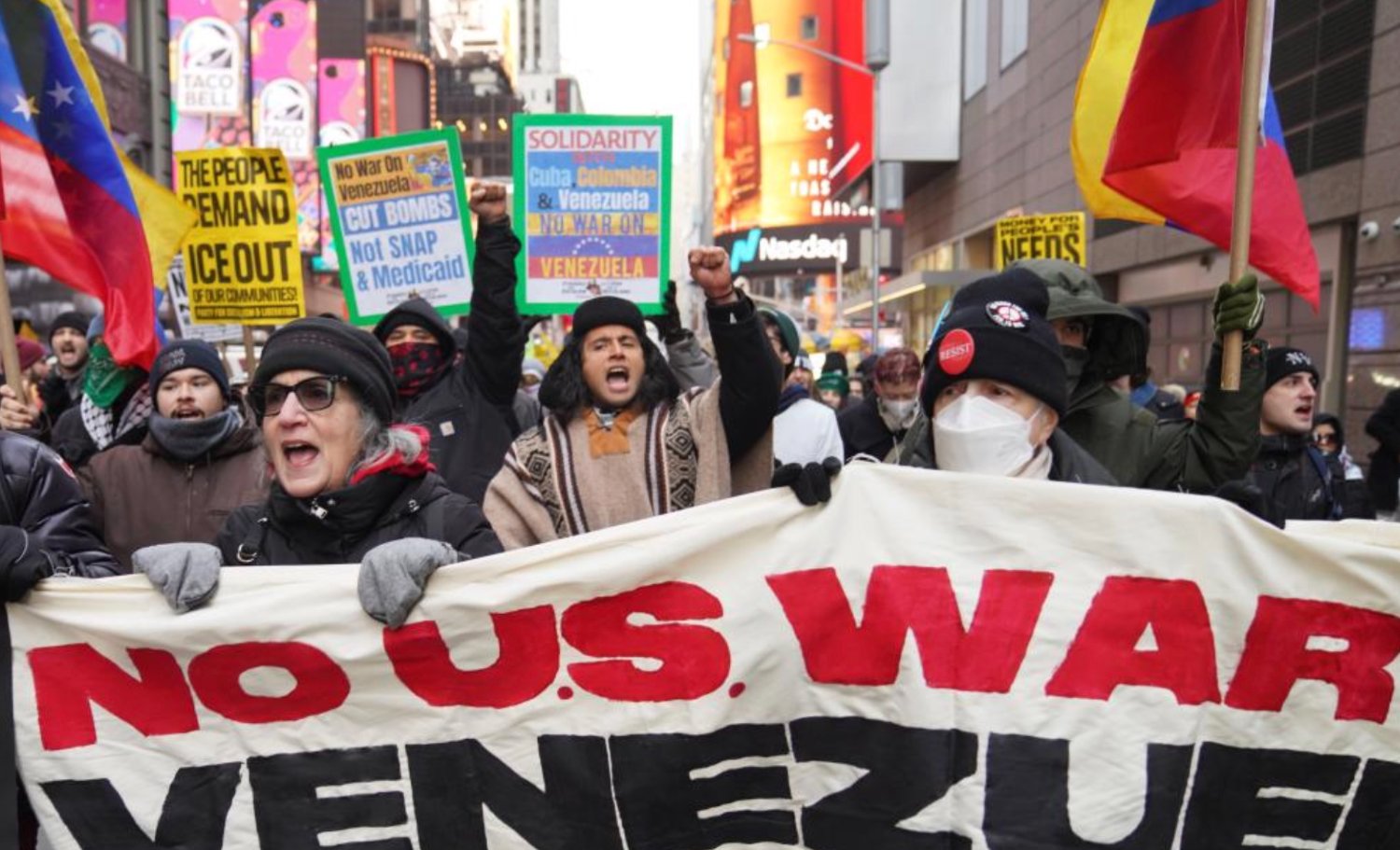
On December 4, just four weeks before the US assault on Caracas, the Professional Staff Congress union at the City University of New York (PSC CUNY) passed a resolution opposing US aggression against Venezuela. In that resolution, approved by more than one hundred delegates from more than 26 different campuses, the PSC agreed that it would “oppose any US military intervention, coercive action or aggression against Venezuela and any regional expansion of the conflict.” More recently, on January 3, United Auto Workers 4811 (UAW 4811), which represents nearly 50,000 University of California workers, also issued a statement critical of Trump’s attacks on Venezuela, correctly describing how every dollar spent on regime change is a dollar that could have been spent on education.
These statements are a positive development and yet another sign of the growing anger and growing resistance of the American working class, which has been catalyzed by the pandemic, the Black Lives Matter movement, the brutal US-backed genocide in Gaza, Trump’s authoritarian excesses at home, and now his attacks on Venezuela.
Unfortunately, despite the growing anger of millions of union members across the country, most unions and labor leaders have remained silent on the issue of American foreign policy, and even those who have passed resolutions have largely failed to back them up with action. With the rare exception of the International Longshoremen and Warehousemen Union (ILWU), which closed West Coast ports over George Floyd and has blocked weapons shipments to Israel, and UAW 4811, which called for a wildcat strike against the university’s crackdown on pro-Palestine student protesters, workers have not led a single political strike in the United States in decades. Just as they did in 2003, in the run-up to the Iraq war, most union leaders in the United States, including Shawn Fain and Sean O’Brien, leaders of two of the country’s largest unions, are turning a blind eye, pretending that what is happening in Gaza and Venezuela has nothing to do with working conditions at home.
But we know that is a lie. We know that attacks on workers abroad are part of a larger attack on workers around the world; we know that Gaza and Venezuela are training grounds for attacking American workers; and we know that every dollar spent on the imperialist war machine is a dollar taken from the working class of the United States and the world.
The media is already treating Trump’s outrageous attack on Venezuela and kidnapping of President Nicolás Maduro as a fait accompli, as if there was nothing that could be done except sit back and watch the trial and intrigue unfold.
But as he made clear in his Saturday press conference, Trump believes he and his criminal gang of Cabinet members and advisers are running Venezuela, and the U.S. military remains on high alert, prepared to unleash new levels of violence if Venezuela does not meet Trump’s demands to open the country to American capital. In other words, this is a conflict that is probably far from over. Just as the war in Afghanistan eventually spread to Iraq, Iran and Libya, the attack on Venezuela may lead to greater conflict in Latin America and the entire world.
While what happens next will have a lot to do with how the Venezuelan masses respond, the American working class and unions also have the power to play a decisive role in this conflict. But this will require huge protests, demonstrations, and, most importantly, massive labor strikes like those that paralyzed Italy and Spain, and helped end or reduce those countries’ military aid to Israel.
Putting his words into practice, unions like the PSC-CUNY and UAW 4811, along with social movements, particularly the Palestine Movement, the Democratic Socialist Movement of America, and labor activists and union allies across the country, must act now to build a labor movement against the war and against U.S. imperialism.
Trump’s war is widely unpopular—nearly 70% of Americans opposed attacking Venezuela—and a massive strike by millions of workers has the power to significantly weaken or even overthrow the Trump government. Some might say such an action in the United States is unprecedented, but so was Trump’s tactical kidnapping and extradition of a sitting foreign leader. Extraordinary times require extraordinary measures, and strong denunciations, however important, are not enough. Shawn Fain has already laid out plans for a general strike in 2028 that would prioritize important basic worker demands. But why not act now for our brothers in Venezuela? If Trump reaches 2028 strengthened by his triumphs abroad against the international working class, he will be in a better position to defeat us at home, with repression if necessary, as he has already been doing with immigrants and pro-Palestine activists.
Even without a major strike, unions have the power to make a real impact, especially in New York City, where Maduro is currently detained. The Transportation Workers Union (TWU), which runs the buses and trains, the PSC-CUNY and the United Federation of Teachers (UFT), which run the schools, and the Service Employees International Union (SEIU) and District 37 (DC37) workers, who staff the offices, have the power to shut down the city if they wanted to. Even a small portion of those hundreds of thousands of anti-war union members have the power to organize massive demonstrations, threatening a citywide general strike, something that could empower and embolden New York workers for decades.
Our union leaders will tell us that their hands are tied and that such actions are illegal. But there is no reason we should settle for nothing more than bureaucratic diplomacy and well-formulated resolutions when we are literally the ones who make this city and this country run.
Whether Democrats or Republicans, those in power seek to divide us. They want us to focus exclusively on our own interests. They want our horizon to be limited to the next contractual battle. They want us to donate, vote, demonstrate, and then go home, all so we forget where our power as workers really comes from: our mutual solidarity. Therefore, the future of the labor movement must be anti-imperialist.
Source: www.laizquierdadiario.com