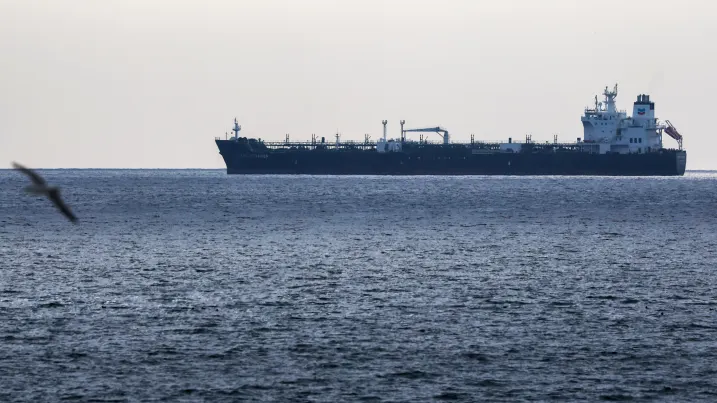
Ship traffic remains paralyzed in the Persian Gulf after attacks and security fears, while oil soars and puts pressure on the global market
The escalation of military tensions between the United States and Iran reached a new level of global economic impact this week. In an attempt to contain the paralysis in energy supply, the Trump administration announced the launch of a massive reinsurance program worth US$20 billion. The measure seeks to offer coverage for losses of oil tankers and other vessels that risk sailing through the dangerous waters of the Persian Gulf, currently blocked by the war.
The announcement comes at a desperate time for financial markets. Last Friday, crude oil prices in the US registered a significant increase of 12%, breaking the psychological barrier of US$90 per barrel. When we look at the accumulated result for the week, the scenario is even more alarming, with an appreciation of 35%. This jump reflects the real fear of a global shortage, as traffic in the Strait of Hormuz remains virtually halted.
Read also: Persian Gulf blocks routes and oil reacts strongly
The US International Development Finance Corporation (DFC) took the lead in this economic rescue operation. According to the published guidelines, the DFC will ensure losses of up to US$20 billion on an ongoing basis. To ensure the plan’s viability, the agency and the Treasury Department work closely with US Central Command (CENTCOM), integrating military logistics and financial support.
The administration’s central objective is to resume the flow of essential commodities that support the modern economy. Ben Black, CEO of DFC, expressed optimism in an official statement about the effectiveness of state intervention in the maritime freight market. According to the executive:
“We are confident that our reinsurance plan will ensure that oil, gasoline, LNG, jet fuel and fertilizers can pass through the Strait of Hormuz and flow back into the world.”
The relevance of the Strait of Hormuz to global stability is difficult to overestimate. Currently, this narrow passage drains around 20% of the world’s crude oil consumption and an equal share of global liquefied natural gas (LNG) exports. When this flow stops, the impact not only affects American gas stations, but compromises agricultural and industrial production on a planetary scale.
Consequently, the geographic isolation caused by the attacks already forces changes in production. Some Gulf countries, unable to export their main wealth, began to reduce oil extraction. Without ships to load the product and with storage tanks reaching their limit, the regional economy enters a dangerous recessive cycle, exacerbated by the violence of air strikes coordinated by the US and Israel against Iranian territory.
Despite the billion-dollar contribution from the American government, experts in the maritime sector are skeptical about the speed of the recovery. The main criticism lies in the nature of the risk. Although money offers a cushion against material losses, it does not protect the lives of crews or the physical integrity of ships in the face of missiles and drones.
Matt Wright, senior freight analyst at consultancy Kpler, highlights that the current problem goes beyond the issue of insurance premiums. According to the analyst, shipowners are not leaving ports for fear of real destruction, and not just because of the financial cost of the risk. In an interview with CNBC, Wright was emphatic in stating that the resumption depends on a change in the military scenario:
“There needs to be some confidence that Iran’s ability to continue to wage war has diminished.”
Therefore, the market observes a disconnect between the solution proposed by Washington and the reality experienced at sea. As the government tries to inject liquidity to calm investors, sailors await clear signs that the attacks have stopped.
Donald Trump’s decision to offer insurance for commercial vessels and Navy escort ships represents a profound state intervention in the free market. Historically, sectors that defend deregulation resort to public money when crises generated by aggressive foreign policies knock on the door. In this case, the American taxpayer assumes the risk of a war that the US itself helped to escalate.
Furthermore, the presence of the American Navy as an “escort” for commercial ships signals a total militarization of commercial routes. Trump stated last Tuesday that this protection will be guaranteed “if necessary”. However, this promise may not be enough to convince private insurers, who have already withdrawn from the region after last weekend’s massive attacks.
In short, the US$20 billion program acts as a palliative on a wound opened by arms diplomacy. Until the security situation shows tangible improvements, it is unlikely that large tankers will cross the Strait of Hormuz regularly again. The world is now witnessing a tug of war between brute military force and the attempt at financial stabilization.
Until a diplomatic solution or definitive military victory occurs, the global cost of living will continue to rise. The price of a barrel above US$90 is just the beginning of a chain reaction that affects everything from the price of bread to the freight of basic inputs. The Trump administration’s reinsurance strategy may guarantee the profits of large corporations, but it will hardly bring the peace necessary for global trade to breathe again.
With information from CNBC*
Source: https://www.ocafezinho.com/2026/03/07/plano-dos-eua-tenta-destravar-petroleo-no-ormuz/