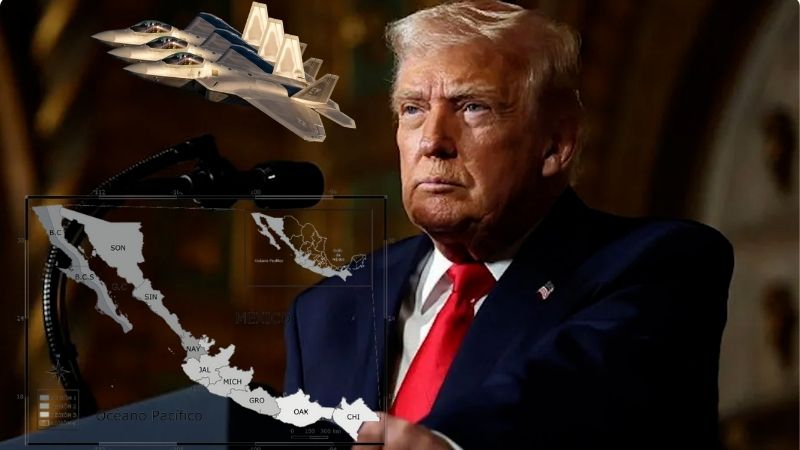
This Friday, the United States Federal Aviation Administration (FAA) issued a warning to civilian pilots from multiple countries regarding the conduct of “military operations” in large areas of the Mexican Pacific and Latin America. The advisory, valid for at least 60 days, covers areas near Mexico, Central America, Panama, Colombia and Ecuador, and includes a specific alert for the Gulf of California and off the coast of Sinaloa.
According to the NOTAMs (notices to aviators), “potential risks exist for aircraft at all altitudes,” due to the presence of US military aircraft that could operate without prior notice, even without active transponders or identification systems, and at normal civil aviation altitudes. The statement also warns of possible interference in satellite navigation systems (GNSS) whose effects could extend throughout the entire journey of commercial flights.
Far from being a simple technical communication, the warning is part of an escalation of imperialist militarization in the region, promoted by the government of Donald Trump, which has once again put on the table the possibility of carrying out direct military actions in Mexican territory. The pretext is once again the same as always, the “war on drugs”, re-editing the rhetoric of the so-called “war on drugs”, a historically failed policy that has only served to justify armed interventions, strengthen repressive apparatuses and deepen US domination over Latin America.
But this policy is not new, since the FAA had already issued similar notices in 2024 in areas near Venezuela and the Caribbean, coinciding with covert military operations by the United States against vessels identified as alleged smugglers. More recently, the agency itself launched alerts during the US attempt to capture Nicolás Maduro, confirming that these communications usually precede or accompany direct military actions.
In Mexico, the official response was predictable. The Ministry of Infrastructure, Communications and Transportation was quick to minimize the situation, ensuring that the alert “does not affect Mexican aviation” and described it as a “preventive measure.” This position reveals the submission of the Mexican State to Washington’s unilateral decisions, even when they imply specific risks to the security of the population in its own territory and airspace.
The administration of Claudia Sheinbaum, despite formally rejecting the entry of US troops, maintains intact the “security cooperation” framework inherited from previous governments. This framework has been the vehicle of imperialist interference for almost two decades, deepening internal militarization and normalizing the presence of armed forces in civilian tasks.
Faced with this scenario, the answer cannot come from above. There are important antecedents of organization and struggle of the working class in Mexico, which show the way to confront these attacks. From the strikes and strikes of the combative teachers of the CNTE against neoliberal policies, to the mobilizations of health workers who face precarious conditions imposed by policies dictated by international organizations, through the recent workers’ struggles in the automotive and maquiladora industries, such as 20/32 in Matamoros with thousands of workers on strike who challenged both the transnational employers and union charrism.
To these experiences we must add the student mobilizations against the militarization of public life, the struggles of indigenous communities against territorial dispossession and the strikes of transportation workers, sectors that know first-hand the weight of the security policies imposed from Washington. These processes show that there is a force capable of confronting imperialist interference.
The threat of new US military operations demands that unions take to the streets, breaking the passivity of bureaucratic leadership and creating a national and continental action plan. The working class, which already faces job insecurity, violence, daily militarization, and neoliberal plans holding the capitalist crisis on its shoulders, must also take the lead in this fight to stop any attempt at foreign intervention that will only deepen these conditions.
This mobilization must be developed without placing any trust in multilateral organizations such as the UN or in impotent diplomacy, nor in the Mexican government, which has not shown any willingness to break with the scheme of subordination to the United States. On the contrary, it has maintained security agreements and internal militarization that today serve as a basis for these new threats and confronting them requires the independent and conscious organization of the working class and popular sectors coordinating the struggles throughout Latin America to establish a common response against militarization, interference and the capitalist system that produces them.
Source: www.laizquierdadiario.com