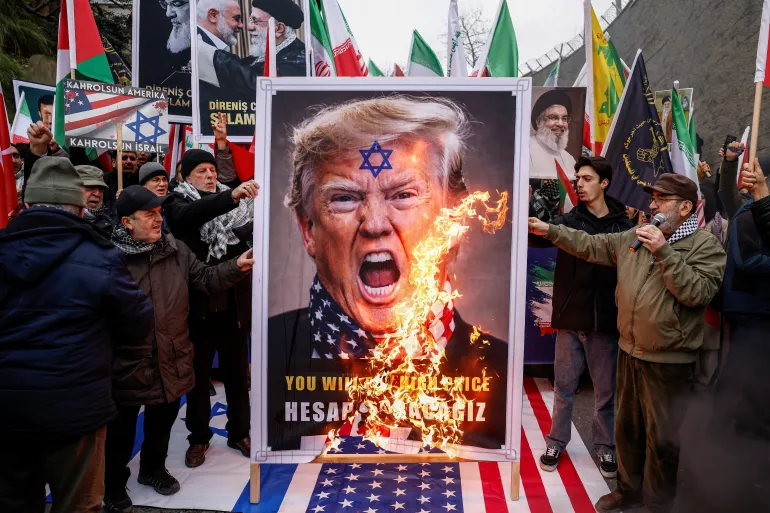
In a startling admission, US Treasury Secretary Scott Bessent said Washington orchestrated a dollar shortage to send the Iranian rial into free fall, which culminated in street protests.
US Treasury Secretary Scott Bessent said Washington orchestrated a dollar shortage in Iran to send the rial plummeting and cause street protests.
In December and January, Iran faced one of the largest anti-government protests the country has seen since the 1979 Islamic revolution, motivated by the serious economic crisis.
Protests against rising prices in Iran began with shopkeepers in Tehran, who closed their stores and began demonstrations on December 28, 2025, after the rial plummeted to an all-time low against the US dollar in late December. The protests then spread to other provinces in Iran.
The government of Supreme Leader Ayatollah Ali Khamenei responded with force. More than 6,800 protesters, including at least 150 children, are estimated to have been killed in a widespread government crackdown on the protest movement.
So how did Washington create a “dollar shortage” in Iran that ultimately caused the rial to plummet? And what effect did this have on the Iranian people?
What is a “dollar shortage”?
A “dollar shortage” occurs when a country does not have enough US dollars to pay for the things it needs from the rest of the world.
The US dollar is the main currency used in global trade, especially for oil, machinery and loan payments, which means countries need a constant supply of this currency.
If exports fall and sanctions block access to the US financial system, dollars could become scarce. As a result, the local currency depreciates, the prices of imported products increase and inflation worsens.
In Iran, a “dollar shortage” was created by simultaneously blocking the two main foreign exchange inflow channels: oil exports and access to the international banking system, said Mohammad Reza Farzanegan, an economist at the University of Marburg in Germany. The US did this by imposing sanctions on Iranian oil, meaning anyone buying or selling the product would be subject to punitive measures.
Given Iran’s dependence on oil to generate revenue, economic sanctions on its oil could create a severe foreign exchange constraint.
“By using secondary sanctions to threaten any global entity that trades dollars with Iran, the US locks up Iran’s existing reserves abroad and prevents new dollars from entering the domestic market,” Farzanegan told Al Jazeera.
US Treasury Secretary Scott Bessent at the 56th annual meeting of the World Economic Forum (WEF) in Davos, Switzerland on January 20, 2026 | Denis Balibouse/Reuters
What did US Treasury Secretary Scott Bessent say?
Responding to a question about how to deal with Iran at a congressional hearing last week, Treasury Secretary Bessent described the U.S. strategy to trigger a sharp devaluation of Iran’s currency.
“What do we [fizemos] in the Treasury was to create a shortage of dollars in the country,” said Bessent, adding that the strategy reached its “great peak in December, when one of Iran’s largest banks went bankrupt… the Iranian currency went into free fall, inflation exploded and, consequently, we saw the Iranian people on the streets.”
“We have seen the Iranian leadership transferring money out of the country unrestrainedly,” Bessent added. “So the rats are abandoning ship, and that’s a good sign that they know the end may be near.”
Previously, in an interview with Fox News at the World Economic Forum in Davos last month, Bessent explained the role that American sanctions played in fueling the recent protests across the country.
“President Trump ordered the Treasury Department… to exert maximum pressure on Iran, and it worked,” he said. “Because in December, their economy collapsed. They can’t import anything, and that’s why people took to the streets.”
On both occasions, Bessent referred to previous statements made at the Economic Club of New York in March last year, when he described how the White House would use President Donald Trump’s “maximum pressure” campaign to collapse Iran’s economy.
In his speech, Bessent stated that the US “has intensified a campaign of sanctions against export infrastructure [do Irã]targeting all stages of the Iranian oil supply chain”, along with “vigorous government engagement and strong private sector action” to “prevent Iran’s access to the international financial system”.
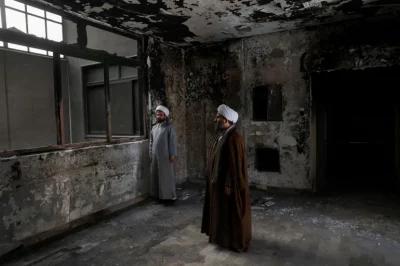 Iranian academics stand in front of the Islamic seminary that was set on fire during the Iran protests, in Tehran, Iran, January 21, 2026 | Majid Asgaripour/West Asia News Agency (WANA) via Reuters
What effect did the dollar shortage have on Iran?
In January, the Iranian rial was trading at 1.5 million to the dollar – a sharp drop from around 700,000 in January 2025 and around 900,000 in mid-2025. The currency’s devaluation triggered runaway inflation, with food prices, on average, 72% higher than the previous year.
In 2018, during his first term as president, Trump withdrew the United States from the 2015 Joint Comprehensive Plan of Action, an agreement between Iran and global powers that limited Tehran’s nuclear program in exchange for sanctions relief.
Since his re-election last January, President Trump has intensified his so-called “maximum pressure” to harm Iran’s economy and pressure Tehran to renegotiate its nuclear and regional policies. Last month, Trump threatened to impose a 25% tariff on countries doing business with Iran.
By strictly blocking Iran from the global financial system, creating a dollar shortage, the US has pushed Tehran into severe “import compression, [e, como resultado, o Irã] cannot pay for the intermediate goods and machinery needed for domestic production,” said Farzanegan, the economist.
According to him, the US strategy “is particularly devastating because it uses commercial risk management to the detriment of humanitarian needs”. In short, Washington’s strategy “turns the small Iranian market into a commercial liability” for any company, even if it only deals in medicines, for example, Farzanegan added.
A study published by Farzanegan and Iranian-American economist Nader Habibi last year concluded that the size of the Iranian middle class would have grown on average by about 17 percentage points per year between 2012 and 2019 if not for U.S. intervention.
In 2019, research estimated that the loss in the middle class share of Iran’s population was 28 percentage points.
“People lost their purchasing power and their economies were decimated,” the economist told Al Jazeera. “This represents a long-term destruction of the country’s human capital.”
In addition to the US action, there is the vulnerability that already exists in Iran’s economic structure, with factors such as long-standing mismanagement, high levels of corruption and excessive dependence on oil revenues, which make it fragile.
Although US sanctions generated an external shock, the lack of internal structural reforms left the government with “no fiscal space to cushion the impact”.
What is the US’s ultimate goal here – and will it succeed?
Bessent’s admission that Washington deliberately created a “dollar shortage” signals the U.S. shift toward an all-out economic war narrative.
“This is a diplomatic economic strategy; without armed confrontations,” Bessent said at the World Economic Forum in Davos last month.
“This admission could complicate the US diplomatic position as it confirms that humanitarian channels for food and medicine often become useless if the entire banking system is being targeted for collapse,” Farzanegan said.
Bruce Fein, a former US deputy attorney general who specializes in constitutional and international law, told Al Jazeera that this type of economic coercion is “as common as the sun rising in the east and setting in the west,” citing economic sanctions against Russia, Cuba, North Korea, China and Myanmar.
However, unlike other cases in which the US has applied economic pressure, Farzanegan said the Iran case is “a unique experiment because of the duration and intensity of the pressure.”
Unlike Russia, which has a more diversified export base and larger reserves, Iran has faced various forms of sanctions for decades, since the supreme leader took power in 1979.
“Iran has a sophisticated internal mechanism to circumvent sanctions, which makes the ‘dollar shortage’ a game of cat and mouse, rather than a one-off shock,” said the economist.
With an American naval fleet currently stationed in the Arabian Sea, the United States and Iran are in talks to reduce tensions. The US wants three main things from Iran: to stop enriching uranium as part of its nuclear program, to get rid of its ballistic missiles and to stop arming non-state actors in the region.
Ultimately, according to observers, the US wants regime change in Iran.
But Fein said his experience shows that economic sanctions alone “rarely, if ever, topple regimes… Regime change occurs externally only with the use of military force.”
“The dollar shortage in Iran will not bring down the ayatollahs or the Revolutionary Guards,” he said, referring to Iran’s current administrative structure.
The impoverishment of Iranians will decrease, Fein told Al Jazeera, “rather than increasing the likelihood of a successful revolution, because the priority will be daily survival.”
Originally published by Al Jazeera on 02/13/2026
By Yashraj Sharma
Source: https://www.ocafezinho.com/2026/02/13/eua-afirmam-que-causaram-a-escassez-de-dolares-que-desencadeou-protestos-no-ira/