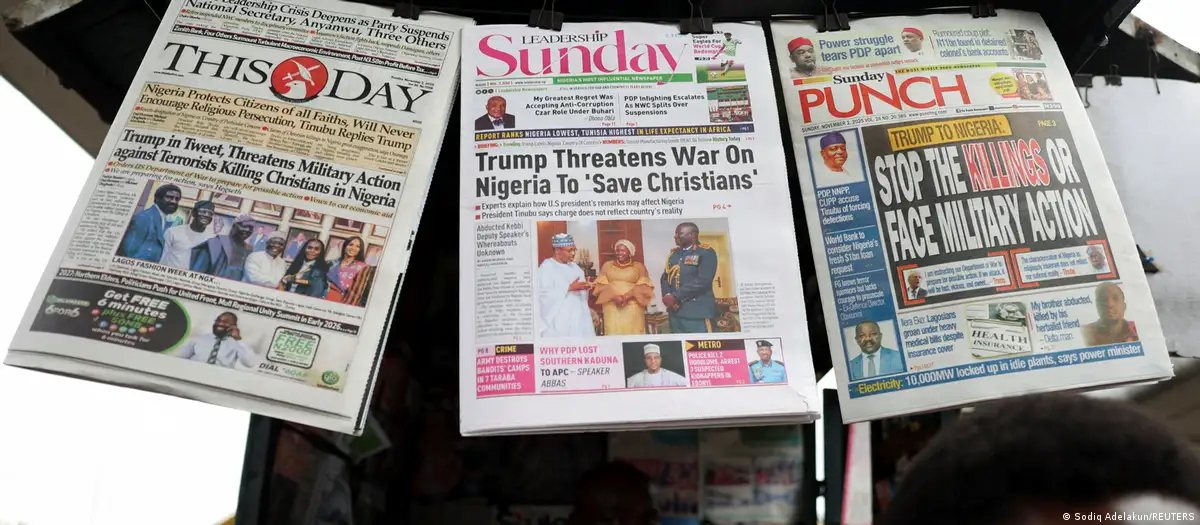
Extremism also affects Muslims, and is one of several sources of conflict in the African country. Nigerian government cooperated with counter-terrorism operation.
The United States launched an air strike on Thursday (12/25) against Islamic State forces in Nigeria. For weeks, President Donald Trump has accused the African country’s government of not containing what he interprets as the persecution of Christians. The extent of the damage caused in Sokoto State is unclear.
Secretary of Defense Pete Hegseth posted on the social network X: “The president was clear last month: the killing of innocent Christians in Nigeria (and elsewhere) must stop,” highlighting that the attack took place on Christmas Day.
Trump declared that the airstrikes were directed against Islamic State militants “who have targeted and brutally killed, mainly, innocent Christians.”
The security crisis in Nigeria affects both Christians, predominantly in the South, and Muslims, the majority in the North. The Nigerian government has previously criticized the US for framing the security crisis as a specific threat to Christians.
Multiple security challenges
Nigeria’s Foreign Ministry said Thursday’s airstrikes were a joint counter-terrorism operation. The cooperation included intelligence exchange and strategic coordination in a manner “consistent with international law, mutual respect for sovereignty, and shared commitments to regional and global security,” according to a spokesperson.
This week, armed men invaded a Catholic school and captured 303 students and 12 teachers, in yet another mass kidnapping of students in the country. Both the US and Nigeria have signaled that there could be new attacks.
The country is home to multiple armed groups, including at least two affiliates of the Islamic State — an offshoot of the Boko Haram extremist group known as Islamic State West Africa Province in the northeast, and the lesser-known Lakurawa group, present in northwestern states such as Sokoto.
These groups use vast areas of forests that connect states as hideouts. Security analysts believe the target of the US strikes was Lakurawa, which over the past year has become increasingly deadly in the region, often attacking remote communities and security forces.
The incursion of extremists in northwestern Nigeria is attributed by experts to the near absence of the State and security forces, allowing these armed groups to exercise de facto control over the territory.
Country of “special concern”
The American president had already ordered the Pentagon last month to begin planning possible military action in Nigeria. The State Department recently announced that it would restrict visas for Nigerians and their families involved in the deaths of Christians.
The US also recently designated Nigeria a “country of special concern” under the International Religious Freedom Act.
Nigeria’s population of 220 million people is almost equally divided between Christians and Muslims, and both suffer from religiously motivated attacks. The extremist group Boko Haram, for example, seeks to establish its radical interpretation of Islamic law and also targets Muslims it considers insufficiently religious.
Farmers and pastoralists are in conflict over scarce resources, adding to community rivalries, actions by separatist groups and ethnic tensions.
With a reduced presence in Africa today, US military forces would probably have to be relocated from other parts of the world for a possible larger-scale intervention in Nigeria.
Originally published by DW on 12/26/2025
Source: https://www.ocafezinho.com/2025/12/26/eua-atacam-estado-islamico-por-matanca-de-cristaos-da-nigeria/