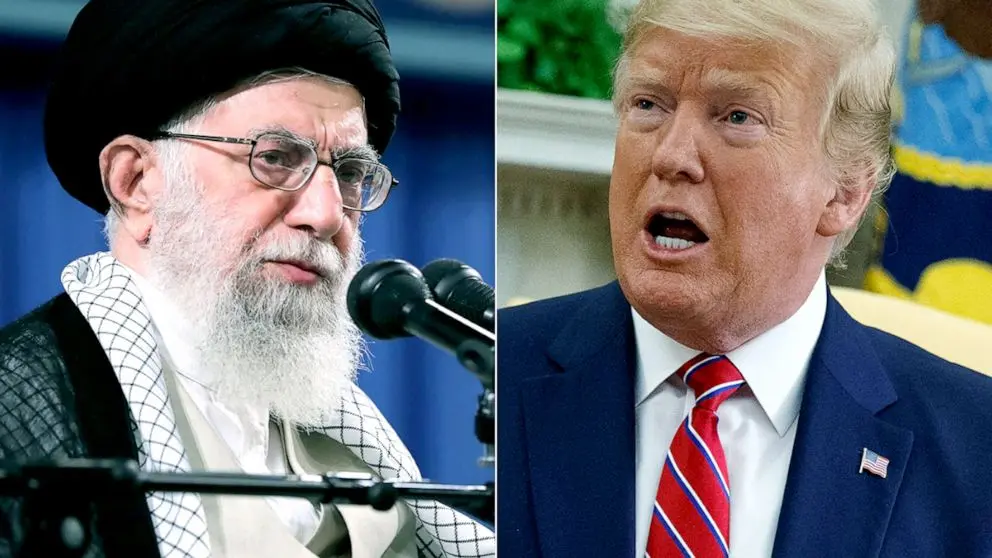
The United States Armed Forces announced the carrying out of air readiness military exercises in the Middle East amid an escalation in tensions with Iran and the deployment of US warships to the Persian Gulf. The movement takes place in a sensitive regional context, marked by recent clashes, internal protests in Iran and harsh statements from President Donald Trump’s government.
According to information published by the newspaper The GlobeIranian authorities reacted sharply to the North American initiative, stating that Washington’s actions increase instability in the Middle East. Tehran warned that any country that allows the use of its territory, airspace or territorial waters in a possible offensive against Iran will be considered hostile.
The statement was made by the deputy political head of the Islamic Revolutionary Guard Corps, Mohammad Akbarzadeh, who stated that neighboring countries traditionally considered friends could lose this status if they cooperate with military actions against Iran. “Neighboring countries that are our friends, but that allow their soil, sky and waters to be used against Iran, will be considered hostile,” said the leader, according to the Iranian press.
Military exercises and air force demonstration
The announcement of the exercises was made by the United States Central Command (Centcom), the body responsible for North American military operations in the Middle East and parts of Asia. In an official statement, Centcom said it will conduct “a multi-day readiness exercise to demonstrate the ability to deploy, disperse and sustain combat air power” across a wide area of operations.
According to the command, the maneuvers aim to strengthen regional partnerships, test flexible responses to different crisis scenarios and validate integrated command and control strategies, including in multinational environments. The statement, however, did not specify whether armed forces from other countries will directly participate in the exercises nor did it detail the specific bases or regions where the operations will take place.
The lack of more precise information fueled speculation about the scope of the military mobilization and its real political significance, especially given the moment of heightened tension between Washington and Tehran.
Regional context and recent war
The exercises take place in one of the most delicate periods in the region in recent years, following the 12-day war initiated by Israel against Iran. The conflict resulted in unprecedented attacks by the United States on Iranian nuclear installations, an episode that marked a significant change in Washington’s direct involvement in the confrontation.
Since then, Iran has faced protests in large cities, driven by economic difficulties, international sanctions and criticism of the country’s political conduct. In this scenario, recent statements by Donald Trump drew attention. The American president stated that he could “help” the Iranian protesters, a statement interpreted by analysts and regional authorities as a possible sign of support for a change of regime or even military intervention.
Diplomatic sources interviewed by the international press indicate that Trump had decided on a direct attack on Iran, but retreated after appeals from leaders of Qatar, Oman and Saudi Arabia. These countries warned of the risks of an uncontrolled military escalation and the impact that an open conflict would have on regional security and the global energy market.
Aircraft carriers and strategic pressure
Despite the momentary setback, the plans would not have been completely abandoned. Last week, after participating in the World Economic Forum in Davos, Trump stated that he “was watching Iran” and mentioned “a great force heading towards” the country. The statement was interpreted as referring to the strike group led by the aircraft carrier USS Abraham Lincolndisplaced from the South China Sea to the Middle East.
Analysts assess that the reinforced naval presence and aerial exercises could have a dual objective: preparing the ground for possible military action and, at the same time, increasing pressure on Tehran to force diplomatic concessions.
Negotiation or confrontation
Before the war launched by Israel, Iranian representatives maintained direct channels of dialogue with the United States government. However, the impasse over the nuclear program persists. In his first term, Trump withdrew the US from the international agreement that limited Iran’s uranium enrichment in exchange for relief from economic sanctions. Now, the American president defends the total suspension of Iranian nuclear activities, a position rejected by Tehran, which insists on its right to the peaceful use of nuclear energy.
Despite the harsh rhetoric, Trump recently stated that Iran would be interested in negotiating. “They want to close an agreement. I know that. They called on several occasions. They want to talk”, said the president in an interview with the portal Axiospublished on Monday (26).
Regional dialogue and Saudi caution
Amid tensions, Iranian President Masoud Pezeshkian spoke by telephone with Saudi Arabia’s Crown Prince Mohammad bin Salman. According to Pezeshkian, “American threats and psychological operations want to disrupt regional security and will have no other result than instability for them.”
Bin Salman, in turn, stated that Saudi Arabia is willing to cooperate with Iran and other countries to promote peace and security in the Middle East. He declared that he did not consider “any aggression, threat or creation of tension” against Tehran acceptable, signaling a cautious stance in the face of the possibility of a new regional conflict.
Meanwhile, the military exercises announced by the United States continue as another element of pressure on an increasingly unstable geopolitical board, in which demonstrations of force, threats and negotiations go hand in hand.
Source: https://www.ocafezinho.com/2026/01/27/eua-anunciam-exercicios-militares-no-oriente-medio-e-ira-fica-em-alerta-maximo/