
Even if an attack on the autonomous island of Denmark does not materialize, the alliance’s fragility has been exposed. Experts and politicians argue that NATO countries should take a more emphatic stance on Trump’s threats.
NATO has hundreds and hundreds of pages of detailed military plans on how to protect itself from attack by an external adversary. There is, however, no manual on how to deal with an internal threat, as is the case of American President Donald Trump, who wants to take over Greenland, an autonomous island from Denmark, by any means necessary. NATO Secretary General Mark Rutte’s strategy so far has been to remain silent, which will not work for long.
Danish Prime Minister Mette Frederiksen sought to curb US appetite, warning on Monday that “if the US decides to militarily attack another NATO country, everything will be disrupted, including NATO itself and, consequently, the security that has been established since the end of the Second World War.”
NATO’s credibility in check
Before any eventual military move, the impact of the escalating rhetoric itself cannot be underestimated.
“It’s a big victory for [o presidente russo Vladimir] Putin that we are having this discussion,” noted Patrik Oksanen, a senior fellow at the Stockholm Free World Forum, adding that the current situation within the alliance would have been the Soviet leaders’ golden dream.
“We are taking this very seriously here in the far north, that is, the combination that these statements came so quickly after Venezuela and were reinforced first by President Trump, and then also by his advisor [Stephen] Miller”, which questioned Denmark’s sovereignty over Greenland and whether European troops would oppose the US.
A social media post by Miller’s wife, Katie, on Saturday, showing a map of Greenland covered in the U.S. flag with the word “COMING SOON,” amplified the feud.
Ed Arnold, a former official at NATO’s military headquarters and a fellow at the Royal United Services Institute, a British security think tank, agrees that the damage to NATO goes beyond the tension in the air.
“It’s an alliance built on values and trust,” Arnold told DW, so “getting to this stage has already weakened the alliance.” The idea of holding consultations within NATO itself on the topic would also give a negative impression, he added, with “32 allies sitting at the table while the main challenge and threat comes precisely from someone around the table.”
Does the response involve strong measures?
Some observers suggest that one solution could be for NATO allies to send troops to Greenland to show Trump that they are taking his defense seriously and that any unilateral U.S. deployment would be unnecessary. Steven Everts, director of the European Union’s Institute for Security Studies, agrees with this line of thinking.
“Europeans must take Arctic security seriously,” he said. “And if there are gaps, we should try to fill them.”
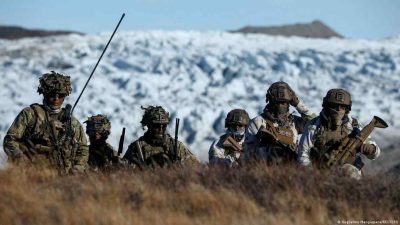 Last September, Danish troops joined Allied troops in military exercises in Greenland | Guglielmo Mangiapane/Reuters
But he warned that this should not be approached as a way to appease Trump, because it has been proven by previous attempts that “it doesn’t work.”
“This is not training, guys. It’s not something you can just hope will go away and get better,” he said.
“The situation will only change if we take strong action to maintain our position, not aggressively — we are not going to fight the American military for Greenland if it comes to that — but we have to be very, very clear about how we see the future of Greenland and the future of the alliance and everything that comes with it.”
Danes take a stand
Anders Vistisen, a Danish member of the European Parliament, agrees with Everts, saying Europe should “stop playing diplomatic games, giving in, trying to persuade the US to be more reasonable or trying to appease them by spending more on the military in the Arctic region or giving them mining concession rights in Greenland or whatever else has been discussed.”
While Vistisen’s political leanings as a member of the right-wing Danish People’s Party might lead one to believe he would align with Trump on some issues, the lawmaker actually made headlines — and caused controversy — a year ago when he used profanity to tell the American leader what he could do with his intention to buy Greenland.
He told DW that he promised not to repeat the phrase publicly, but stands by the sentiment and his tactic of using frank language to convey to Washington the unacceptability of his position. “We are at such a serious point that there can be no room for doubt or room for interpretation in our communication,” Vistisen said.
“We must react very strongly and very clearly and say to the American government and President Trump: ‘No, you will not have any rights over Greenland, you will not persuade, pressure or intimidate us into doing differently.’”
Vistisen said that while he appreciates statements of support from other European leaders, he does not believe they would actually send troops to Greenland. He hopes his own prime minister mounts a strong enough defense.
“This is something that must be resolved between the Kingdom of Denmark and the US government,” he said.
Other avenues for negotiation
Per Clausen, a Danish member of the European Parliament, but from the left-wing group, believes that economic pressure would be more effective in deterring the US. Clausen sent a letter to his colleagues proposing that legislative approval of last year’s deal on transatlantic tariffs, widely seen as favorable to the United States, be suspended until Washington leaves Greenland alone.
“If we accept this agreement while Trump threatens the international order and makes direct territorial claims against Denmark, this will be seen as a reward for his action and will only serve to add fuel to the fire,” Clausen’s letter states.
“We have a lot of things we could do that would hurt the U.S. a lot, if you’re talking about the economy,” Clausen said. “And I think we should make it completely clear to the United States that we want to use this weapon if they don’t stop their aggression against Greenland.”
Encouraging sign from the EU
Clausen, who spoke to DW from Denmark, highlighted that his fellow citizens are “very, very angry”, more than afraid. He hopes his proposal will gain enough political weight for the U.S. to take notice, to “see that Denmark is not isolated in this situation and that European leaders are not just talking about solidarity with Denmark and Greenland, but are also willing to act.”
 Pituffik Air Base is the only US military installation in Greenland | Jim Watson/AFP
Steven Everts believes there is at least one encouraging sign in the situation. During a meeting on Ukraine on Tuesday in Paris, the leaders of Germany, Italy, Poland, Spain and the United Kingdom joined the Danish prime minister in a joint statement stressing that “it is up to Denmark and Greenland, and them alone, to decide on matters concerning Denmark and Greenland.”
They issued the note shortly before meeting with American emissaries Steve Witkoff and Jared Kushner, Trump’s son-in-law, without shying away from the confrontation that could have been created or its impact on US support for European efforts in relation to Ukraine. For Everts, it is a step that may seem small, but that “demonstrated how seriously” leaders view the threat.
However, Patrik Oksanen from the Stockholm Free World Forum thinks the gravity of the situation calls for even more firmness. If the US forces its way into Greenland, the end of NATO would be the least of its problems. It would be nothing less than the “end of times as we know them”, he points out.
Originally published by DW on 01/08/2026
By Teri Schultz – Brussels
Source: https://www.ocafezinho.com/2026/01/08/falas-de-trump-sobre-a-groenlandia-ja-abalam-a-otan/