Greenland has been a turning point for Europe. Transatlantic relations will no longer be the same after Donald Trump’s threats to seize an island that belongs to Denmark, a country in the European Union and a member of NATO. If ties between the EU and the US Administration had already been shaken by Trump’s belligerent imposition of trade tariffs, his foreign policy has ended up increasing misgivings on this side of the Atlantic. The EU has managed to stop, at least temporarily, the US president’s obsessions with Greenland, but doubts about the EU’s military dependence on an ally whose foreign policy clashes with European interests have grown more than ever. As the EU diplomatic official, Kaja Kallas, commented, “The United States will continue to be an ally, but we must adapt to the new reality: Europe is no longer Washington’s main center of gravity.” So, is Europe capable of creating an Army with sufficient deterrent capacity to not depend on the US? Is a NATO without the US credible? Can a new military alliance be created without the US that is capable of confronting Russia?
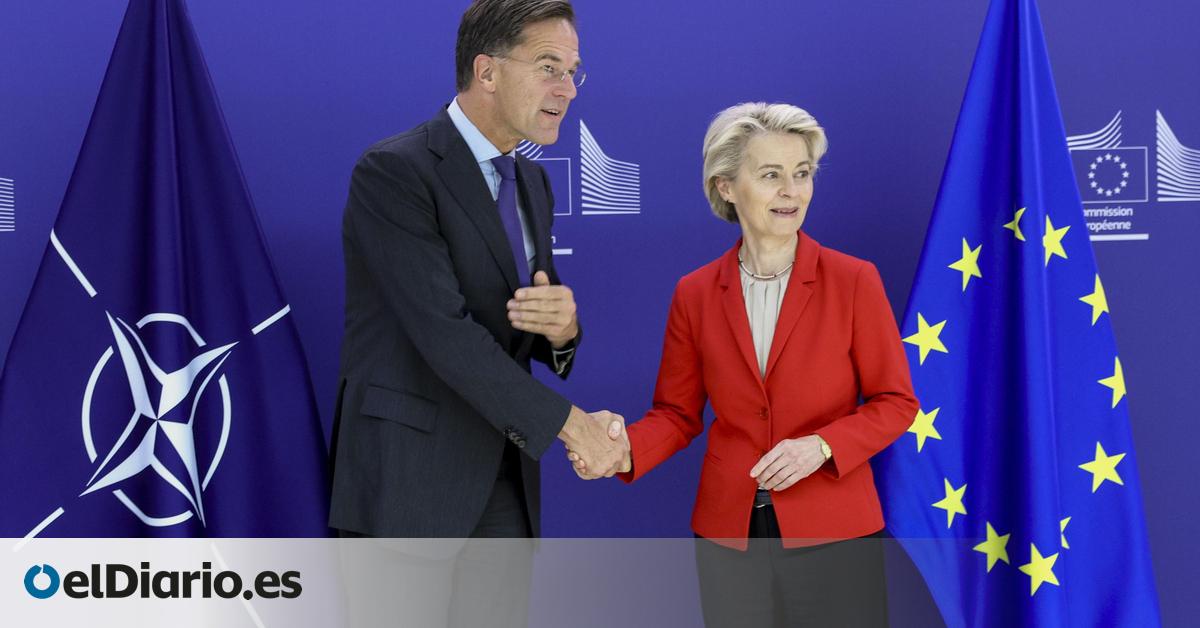
If we look at the position of NATO Secretary General Mark Rutte, it is not a viable option. This week Rutte once again made an apology in defense of Donald Trump and the role of the US in the defense of the West during an appearance in the European Parliament. Furthermore, the Secretary General of NATO assured that “the European pillar of defense is nothing” and that “if anyone thinks that the European Union, or Europe as a whole, can defend itself without the United States, let them continue dreaming.” Rutte was thus responding to the words of the European Commissioner for Defense, Andrius Kubilius, who stressed that “the answer to dealing with this dangerous world… is European independence. More European responsibility in our own defense with the construction of a European pillar in NATO.”
In European capitals, the words of the NATO Secretary General were annoying. The Minister of Foreign Affairs, José Manuel Albares, rejected Rutte’s position by pointing out that “it is necessary for Europe to develop authentic sovereignty of security and deterrence so that the protection of European citizens is in our own hands. If we do not want to be subjected to the brutality and coercion of the world, a European Army is necessary.” His French counterpart, Jean-Noël Barrot, responded that “Europeans can and must take control of their security. This suits even the United States. It is the European pillar of NATO.”
The director of the EU Institute for Strategic Studies, Steven Everts, explained to the Financial Times that a phase has been entered where “people are being forced to think the unthinkable, it is no longer about changing the security agreement between the US and Europe. Now it is about Europe essentially finding itself alone with a partially hostile America.”
It is think tank based in Paris does a study every year with 400 geopolitical specialists on the main conflict threats for Europe: one of those that would have the most impact would be “a retreat by the United States in security guarantees to European allies. This scenario remains strategically seismic and plausibly imminent for experts, as was the case in 2025. Experts perceive that such a development would have as serious a political impact on Europe’s security as the use of a nuclear weapon by Russia, although it is significantly more likely than the latter. Europe’s main military alliance is now a preeminent source of risk.”
“Europe is forced to face a harsher reality: deterrence depends on credibility and credibility depends on political commitment. If US commitment is less certain, the edifice of deterrence becomes more unstable. A US-backed NATO still has deterrent power, but the EU is far from being able to replace US guarantees in the short term,” notes the report by the EU Institute for Strategic Studies.
The EU is taking steps to reaffirm its security. Brussels presented its plan to mobilize 800 billion euros to revitalize European defense companies. In addition, the SAFE program was approved, with loans worth €150 billion for weapons, although most spending remains a decision by national capitals. The European Union also remains one of the world’s largest arms exporters — €60 billion in 2024 — underscoring the bloc’s industrial capacity and technological depth.
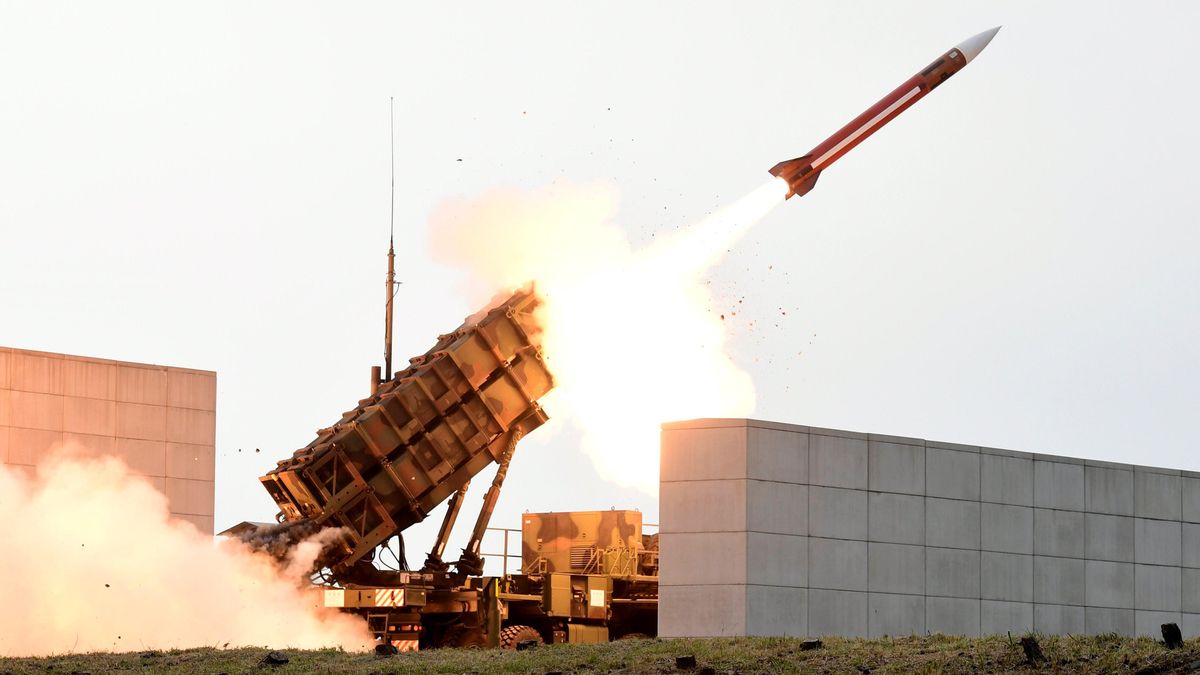
“Europe spends 280 billion euros on Defense every year, more than Russia and is getting closer to China. The Europeans are supporting Ukraine against Russia with a loan. We have nuclear weapons in France and the United Kingdom. We are 450 million inhabitants in the largest market in the world. What does Rutte not understand? We do not need the lessons of anyone like Mr. Rutte, who has forgotten that he works for Europe and not for Washington. Europe can defend itself, we have everything we need except leaders who believe it,” claims Alberto Alemanno, professor of EU Law at HEC Paris.
The problem is that the EU is still the sum of 27 States. Oleksiy Honcharuk, former prime minister of Ukraine and researcher at the Atlantic Council’s Eurasia Center, points to “fragmentation” as one of the EU’s main strategic weaknesses and the “strong dependence on foreign suppliers, especially the United States,” which “restricts Europe’s strategic autonomy and slows down the development of its own industrial and technological base.”
In fact, although Europe has increased defense spending since 2022, it remains dependent on the United States for fundamental military factors such as intelligence, surveillance and reconnaissance, strategic transportation, missile defense or space assets. In the first year of the Russian war in Ukraine, about 78% of defense procurement by EU member states was sourced outside, with about 63% coming from American suppliers.
“A new West”
Ruth Deyermond, a researcher in the department of war studies at King’s College London, argues the need for “a new West”, based on an “alliance of security, economic ties and shared values”, which can include both “non-European allies such as Canada and the eastern partners of the EU and NATO in Moldova and Ukraine”. Indeed, Deyermond highlights that “these two states have defended themselves against hybrid attacks on democracy and, in the case of Ukraine, against a full-scale invasion; that experience will likely be vital for the rest of Europe and Canada. Partnerships with states such as Australia and New Zealand, Japan and South Korea are also important.”
In the same sense, Nathan Decety, macroeconomic and geopolitical strategist and captain in the US Army Reserve, carries out an analysis for the Center for European Policy Analysis in which he proposes a “new alliance” that would be called the North East Atlantic Treaty Organization (NATO), a “new power bloc”, which includes the EU countries plus Canada and the United Kingdom, and that would share interests “in resisting the hostility of Russia and in maintaining a safe Mediterranean. Europe will then have a cohesive defensive alliance to protect its interests in the world, a liberal democratic counterweight to China and Russia, and much more powerful than its near neighbors.”
Now, diplomatic sources familiar with the functioning of the Atlantic Alliance admit that “the creation of a European Army is feasible and could be compatible with the commitment of the 23 EU member countries that belong to NATO. The dismantling of the Atlantic Alliance would not be so easy, it is not something that can be improvised, but the reality is that, in the short term, without the US, Europe’s military deterrence is hardly credible. Only two countries, France and the United Kingdom, have nuclear military capacity.”
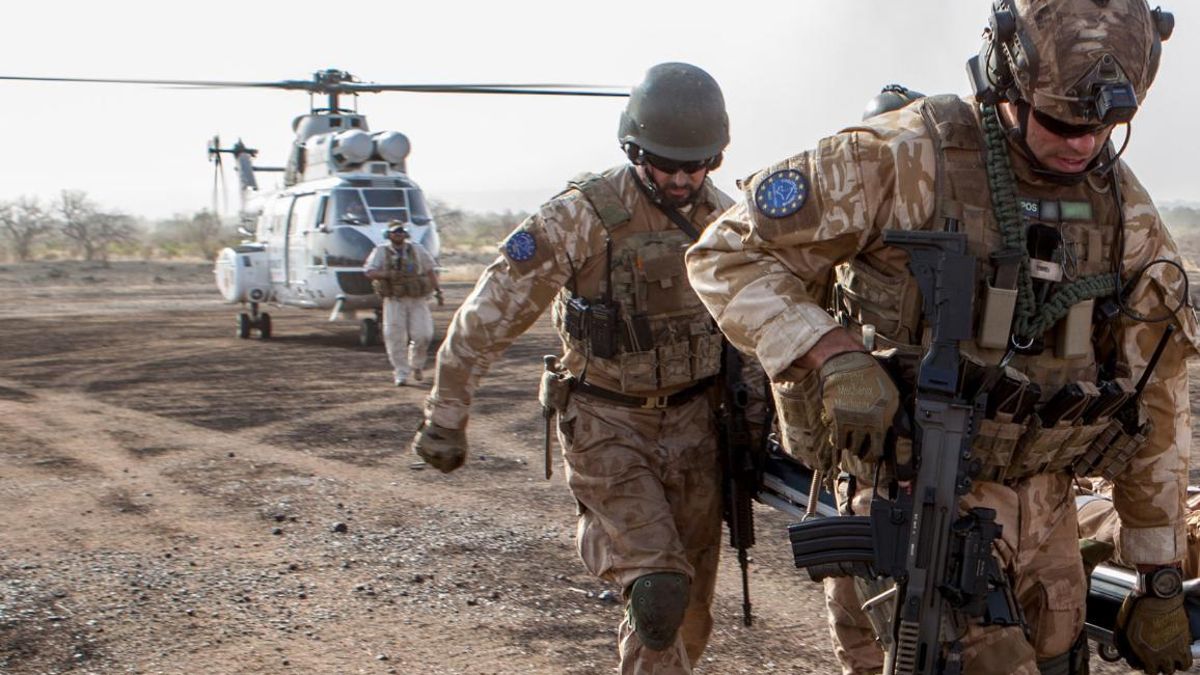
It is one thing to propose a European Army and another for the response to have sufficient deterrent capacity against Russia. Darya Dolzikova, a nuclear policy and proliferation researcher at the Royal United Services Institute for Defense and Security Studies, argues that “although NATO maintains considerable conventional superiority over Russia, it benefits from quantitative advantages over Europe in personnel and ground forces and is learning lessons from the war in Ukraine to further strengthen its ground forces. Europe also suffers from a shortage of long-range fire compared to Russia’s long-range strike capabilities.”
French President Emmanuel Macron has expressed willingness to share France’s nuclear deterrent. Like the United Kingdom, France has confirmed the extranational role of its nuclear deterrents, intending to rely on its nuclear weapons not only to prevent attacks on its respective territories, but to contribute to the security of European allies. While the United Kingdom has an arsenal of approximately 225 nuclear warheads and France has 290 nuclear warheads, Russia has a nuclear potential of more than 4,300 nuclear warheads.
“Russia will remain the main threat to European security and the main focus of European defense and nuclear deterrence planning in the short and medium term. Any perceived asymmetry between Russian and European land conventional capabilities in favor of Russia may encourage Moscow to conclude that it could carry out a successful incursion into European NATO territory, as long as the United States refuses to actively contribute to European defense,” adds Darya Dolzikova.
“Bigger European nuclear forces”
Trump’s new position leads us to propose that “the residual risk of the US helping to defend Europe against an attack is enough to stop Russia. But if not, the Europeans would face a Russian threat backed by hundreds of tactical nuclear weapons,” says Rafael Loss, researcher at the European Council on Foreign Relations.
Loss emphasizes that given “Trump’s structural and specific changes in US defense strategy will require European nuclear forces that are larger in size and different in composition.”
Already in 1962, French President Charles de Gaulle defined European integration: “Europe must be organized in such a way that it does not depend on anyone.” Grégoire Roos, director of Chatham House’s Europe and Russia programme, argues that “history suggests that alliances endure when partners maintain their autonomous capacity. In their absence, cooperation gradually takes on hierarchical characteristics. In this new era of geopolitical Darwinism, those at the base of the pyramid are first trampled, then dispossessed. Autonomy offers no guarantee of power, but its absence offers the certainty of weakness. The new geopolitical era now forces the continent to rise to the challenge. that de Gaulle identified: how to adapt his structures to the realities of power as they are, rather than as he would like them to be.
Source: www.eldiario.es