The President of the United States, Donald Trump, stated this Monday (23) that countries that try to “play” with the recent decision of the United States Supreme Court could face even higher trade tariffs. The statements were published on the social network Truth Social and intensified the US government’s reaction to the judgment that limited the use of emergency powers to impose import duties.
In one of the messages, the president wrote: “Any country that wants to ‘play’ with the Supreme Court’s ridiculous ruling, especially those that have been ‘exploiting’ the US for years — and even decades — will face a much higher tariff, and something even worse, than the one they recently agreed to. BUYER BEWARE!!! Thank you for your attention to this matter.” In another post, he added that he would not need authorization from Congress to impose new tariffs: “This approval was already granted, in many ways, a long time ago! They were also recently reaffirmed by the ridiculous and poorly drafted decision of the Supreme Court!”
Direct criticism of the court
Earlier, Trump had criticized the judicial understanding that restricted the use of the national emergency justification for adopting tariffs. In an ironic tone, he declared: “The supreme court (I will use lowercase letters for a while, based on a total lack of respect!) of the United States has accidentally and inadvertently given me, as President of the United States, far more power and strength than I had before its ridiculous, stupid and very internationally divisive decision.”
In the same publication, he stated that he could use licensing mechanisms to adopt severe trade measures against other countries. “On the one hand, I can use Licenses to do absolutely ‘terrible’ things to foreign countries, especially those countries that have been EXPLOITING US for many decades, but, incomprehensibly, according to the ruling, I cannot charge them a License fee – BUT ALL LICENSES CHARGE FEES, why can’t the United States do it? You issue a license to charge a fee! The opinion doesn’t explain this, but I know the answer!”
Origin of the controversy
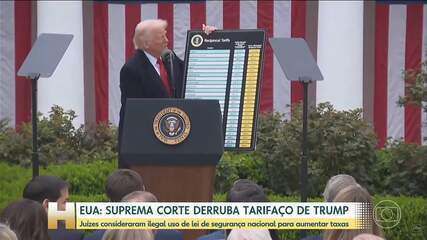
The tension began after the Supreme Court ruled on Friday (20) that the president could not apply customs tariffs based on the International Emergency Economic Powers Act as a generic justification for broad trade measures. The decision annulled part of the tariffs that had been used under this argument.
On the same day, Trump announced a new 10% global tariff on imported goods. On Saturday (21), the rate was raised to 15%, applied temporarily and comprehensively to several countries. The White House argues that the measure seeks to correct historic trade imbalances and protect national industry.
International trade experts note that the adoption of global tariffs, even if temporary, can provoke reactions from trading partners and open space for diplomatic disputes or questions in multilateral organizations. At the same time, the uniformity of the rate tends to reduce accusations of discrimination between countries.
Government tries to calm allies
Despite the president’s tough tone, members of the government stated that trade agreements already signed will not be affected. In an interview shown on Sunday (22) on the program Face the Nationfrom CBS broadcaster, the United States trade representative, Jamieson Greer, declared that understandings with partners such as China, the European Union, Japan and South Korea remain valid.
“We want them to understand that these agreements will be good agreements,” he said. “We’re going to keep them. We hope our partners keep them too.”
According to American officials, the global tariff does not replace already established bilateral or multilateral agreements, but functions as a transitional measure while the government evaluates new legal instruments to support its trade policy.
Impact and upcoming developments
Analysts assess that the episode highlights an institutional clash between the Executive and Judiciary over the limits of presidential power in tariff policy. The court decision restricts the use of broad emergency justifications, while the president’s statements indicate a willingness to seek other legal mechanisms that allow commercial pressure to be maintained on foreign partners.
The international reaction is still uncertain. Affected countries may opt for direct negotiations, legal challenge or retaliatory measures. The outcome will depend on the interpretation of legal experts, the reaction of the American Congress and ongoing diplomatic negotiations.
The episode reinforces the centrality of tariff policy in the United States’ economic strategy and suggests that the issue will continue to be at the center of global trade disputes in the coming weeks.
Source: https://www.ocafezinho.com/2026/02/23/trump-ameaca-o-mundo-com-novo-tarifaco-apos-decisao-da-suprema-corte/