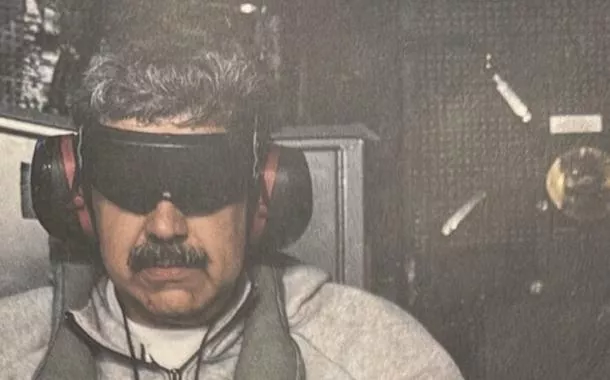
An image shared on social media by the President of the United States, Donald Trumpintensified the international repercussion surrounding the military offensive announced against Venezuela. In the photograph, the Venezuelan president Nicolas Maduro appears in military custody, blindfolded, wearing headphones and holding a bottle of water. According to the caption published by Trump, Maduro would be “on board the USS Iwo Jima”, US Navy warship.
The release of the image followed a series of statements made by Trump in telephone interviews with Fox Newsin which the President of the United States detailed, from his perspective, the behind-the-scenes of the operation and the ongoing discussions within his government about the next political steps in Venezuela.
Presidential image and narrative
In the published photograph, Maduro appears seated, with his hands free, but under clear military control. Trump has not presented official documents, military records or independent confirmations proving the authenticity of the image, the exact location where it was recorded or the circumstances under which it was taken. Still, the publication was interpreted as an attempt to publicly reinforce the success narrative of the operation announced by the US government.
Until the last update, Venezuelan authorities had not officially confirmed Maduro’s capture nor recognized the veracity of the image released by the President of the United States. There was also no formal statement from the White House, the Pentagon or the Department of Justice with technical or legal details that support the version presented by Trump.
Monitoring the operation from Mar-a-Lago
In interviews, Trump stated that he followed the operation in real time from a room set up in his private club, Mar-a-Lagoin Florida. According to him, the monitoring took place alongside generals from the US Armed Forces and involved monitoring “every aspect” of the action.
“I have been told by real military people that there is no other country on Earth capable of carrying out a maneuver like this,” Trump declared. The president said he watched the offensive unfold “literally, as if he were watching a television program”, emphasizing the unprecedented and highly coordinated nature of the operation.
Speed and use of force
Trump has repeatedly highlighted the speed of military action. “If you had seen the speed, the violence — they use that term, the speed, the violence — it was just incredible,” he said. According to his report, the operation involved quick incursions into difficult-to-access locations, with the disruption of security structures designed to prevent invasions.
“They just walked in, broke into places that weren’t easy to access, broke down steel doors that were put there for exactly that purpose, and everything was resolved in a matter of seconds,” he said. The American president added that he had never seen anything similar in terms of military execution.
Aerial apparatus and logistics
According to Trump, the offensive included extensive aerial apparatus. He mentioned the use of a “massive number” of aircraft, including helicopters and fighters, to support the action. In the presidential report, Maduro and his wife would have been removed from Venezuelan territory by helicopter before being taken to the warship.
Trump also stated that Maduro and the Venezuelan first lady were in custody in USS Iwo Jimaheading to New York. “They will be going to New York. The helicopters took them away,” he said, without clarifying the legal basis for the transfer, the couple’s legal status or which authorities handle custody.
Next steps and political scenario
Asked about Venezuela’s political future, Trump stated that decisions are still being evaluated by his administration. “We are making this decision now. We cannot run the risk of letting someone else govern and simply take over what he left,” he declared. According to him, the United States intends to have direct involvement in the process and defends “freedom for the Venezuelan people”.
The North American president also commented on the internal reaction in the South American country. According to Trump, the Venezuelan population would be satisfied with the president’s capture. “Venezuelans are very happy with Maduro’s capture because they love the United States,” he said, classifying the Venezuelan government as a dictatorship. These statements have not been corroborated by independent surveys or international organizations.
Negotiation attempts and previous contacts
Trump also reported that there had been attempts at negotiation by Maduro in the final moments of the operation. “He was trying to negotiate at the end,” he said. The president stated that he refused any agreement and once again associated Maduro with drug trafficking, without presenting additional evidence during the interviews.
Elsewhere, Trump stated that he spoke directly with Maduro about a week before the military action. “I actually spoke to him personally, but I said: you have to give up. You have to surrender,” he concluded.
Lack of confirmations and international tension
Despite the release of the image and detailed statements by the President of the United States, the episode remains surrounded by uncertainty. To date, there is no official confirmation from Venezuela nor technical communications from US government bodies that independently validate the version presented by Trump.
The combination between the image released, the presidential reports and the lack of formal confirmations keeps the episode at the center of international debate, increasing diplomatic tension and expectations for official clarifications on the legality, scope and consequences of the announced operation.
Source: https://www.ocafezinho.com/2026/01/03/trump-divulga-primeira-imagem-de-maduro-preso-e-diz-ter-acompanhado-captura-em-tempo-real/