It is not yet clear how the US will enforce the measure against sanctioned ships. American company Chevron says that operations in the country will not be interrupted. Siege increases pressure on Maduro.
The President of the United States, Donald Trump, ordered this Tuesday (16/12) “the total and complete blockade of all sanctioned oil tankers entering and leaving Venezuela”, which represents another step in the escalation of pressure from the White House on the government of Venezuelan President, Nicolás Maduro.
Trump stated on his Truth Social account that Venezuela “is surrounded” by “the largest armada ever assembled in the history of South America” and that it “will only continue to grow” until Venezuela returns “to the United States all the oil, land and other assets they previously stole from us.”
The American president thus announced the siege of the country, in an important escalation of the military operation that began in the international waters of the Caribbean Sea and which allegedly had as its main objective to combat drug trafficking organizations operating in the region.
It is unclear how Trump will enforce the measure against the sanctioned ships, nor whether he will call on the Coast Guard to intercept vessels, as he did last week.
While many ships carrying oil in Venezuela are under sanctions, others carrying the country’s oil and crude oil from Iran and Russia have not been sanctioned, and some companies, particularly the U.S. Chevron, transport Venezuelan oil on their own authorized vessels.
A spokesperson for Chevron, which still operates in Venezuela under a special authorization, said Tuesday that its operations “continue without interruption and in full compliance with the laws and regulations applicable to its business.”
China is the biggest buyer of Venezuelan oil, which represents about 4% of its imports, with shipments in December projected to average more than 600,000 barrels per day, according to analysts.
“Regime finances narcoterrorism”
In his message, he added that “Maduro’s illegitimate regime is using the oil from these stolen oil fields to finance itself, in addition to financing narcoterrorism, human trafficking, murders and kidnappings.”
Trump did not specify which land or oil he was referring to, but Venezuela nationalized its oil industry in the 1970s. Later, under Maduro’s predecessor, Hugo Chávez, the companies were forced to cede majority control to Venezuela’s state-owned PDVSA.
Caracas criticized Trump’s announcement on Tuesday, saying it was aimed at “stealing the riches that belong to our homeland.”
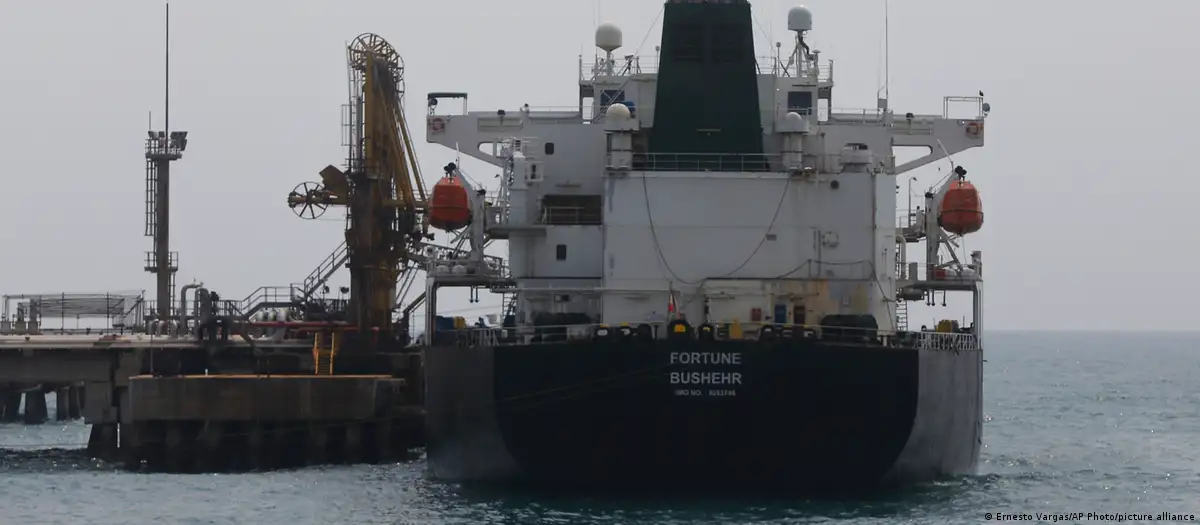
Last week, the United States Southern Command, which since August has attacked more than 30 vessels allegedly linked to drug trafficking in the Caribbean and the Eastern Pacific, took a turn in its actions in international waters by seizing the tanker Skipper, which was transporting Venezuelan oil near the coast of the South American country.
The ship, sanctioned by Washington since 2022 for its links to a so-called “ghost fleet” for oil transport and accused of violating sanctions rules, was transferred to a US port to begin legal proceedings to confiscate its cargo.
“Grotesque threat”
The seizure of the oil tanker, accused by Maduro of being a “blatant robbery” and an act of piracy, further strained relations between the US and Venezuela and contributed to a reduction in Venezuelan oil shipments. Washington imposed sanctions against six companies in the crude oil transportation sector and six tankers.
Internationally isolated, Venezuela is forced to use these “ghost” ships, which carry Venezuelan crude oil at a price well below market value, to be able to market it and, at the same time, circumvent the financial sanctions imposed on the country.
Caracas classified the blockade of oil tankers announced by Trump this Tuesday as “irrational” and a “grotesque threat”.
“The President of the United States intends to impose, in an absolutely irrational manner, an alleged military naval blockade on Venezuela with the aim of stealing the wealth that belongs to our homeland,” the Venezuelan government said in a statement, adding that Trump is violating the right to “free trade and freedom of navigation” by launching “a reckless and serious threat” against Venezuela.
Venezuela is estimated to have oil reserves of around 303 billion barrels, according to the Organization of Petroleum Exporting Countries (OPEC) – more than any other nation.
Blockade puts Caracas in difficulties
A blockade of its ports to oil traffic would mean enormous difficulties for the regime, analysts agree.
The inclusion of these shipping companies and vessels directly on a sanctions list “is a very significant escalation,” Francisco Monaldi, director of the Latin American Energy Program at the Baker Institute (Texas), told the AFP news agency when the announcement was made.
These six ships were in Venezuelan ports when the measure was announced, the expert explained. “The US is hoping that [cada navio] leave the country to stop it,” he explained.
“That, combined with the fact that some ships may literally say ‘I’m not going back to Venezuela,’ could lead to a drop in both the price and volume of exports. If exports also drop, Venezuela’s problem is that it doesn’t have much capacity to store crude oil. So it has to stop production or shut down some of it,” he explained.
“If there are no oil exports, this will affect the foreign exchange market, the country’s imports. There could be an economic crisis,” Elias Ferrer, from Orinoco Research, a Venezuelan consultancy, told AFP. “Not just a recession, but also a shortage of food and medicine, because we wouldn’t be able to import.”
Legal issues
American presidents can mobilize forces abroad, but the blockade announced by Trump represents a new test of presidential authority, international law expert Elena Chachko of the UC Berkeley School of Law told Reuters news agency.
Blockades have traditionally been treated as permissible instruments of war, but only under strict conditions, Chachko said. “There are serious questions under both domestic and international law,” he added.
Representative Joaquin Castro, Democrat of Texas, called the blockade “an act of war.” “A war that Congress never authorized and that the American people do not want,” he added.
There was already an effective embargo in place after the US seized a sanctioned oil tanker off the coast of Venezuela last week, with ships loaded with millions of barrels of oil remaining in Venezuelan waters to avoid seizure.
Since the seizure, Venezuela’s crude oil exports have fallen drastically, a situation worsened by a cyber attack that took down the administrative systems of state-owned PDVSA this week.
For now, the oil market is well supplied and there are millions of barrels in tankers off the coast of China waiting to unload. If the embargo remains in place for some time, the loss of nearly a million barrels per day of oil supply will likely drive up prices.
Originally published by DW on 12/17/2025
Source: https://www.ocafezinho.com/2025/12/17/trump-ordena-bloqueio-naval-de-petroleiros-da-venezuela/