With the reopening of the financial markets this Monday, the first economic contradictions of the imperialist aggression against Iran began to emerge. While the announcement of France, Germany and the United Kingdom joining the imperialist escalation and Israel’s brutal attacks on Lebanon constitute a new extension of the war, Iran has expanded and escalated its response.
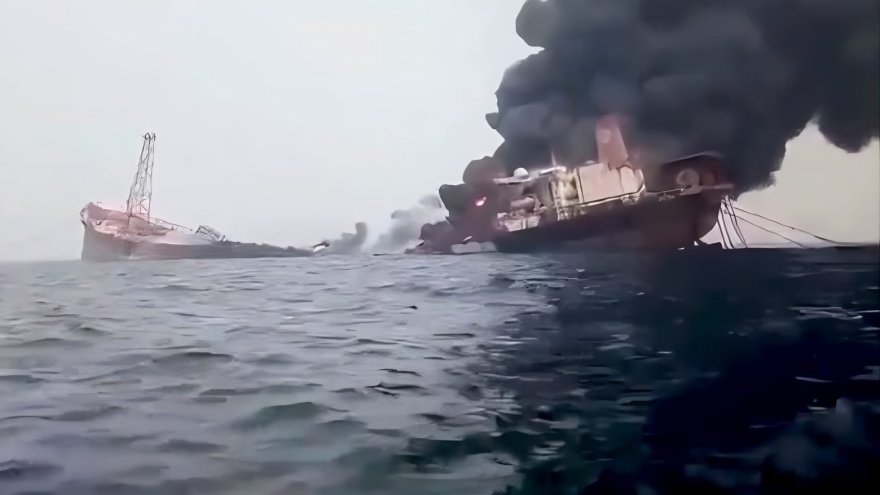
Since this weekend, traffic in the Strait of Hormuz has been practically paralyzed. Although Iran has not mined the strait, the attacks on several oil tankers on Sunday, March 1, and the exposure to costs, as insurers have withdrawn policies in the event of attacks resulting from the war, have discouraged shipping companies from transiting its waters. The price of Brent crude oil now exceeds $80, seven dollars more than before the attacks on Iran. This is the highest in eight months, but for now, it remains lower than the disruption to energy value chains caused by the COVID-19 crisis.
However, the situation could deteriorate quickly. As part of its strategy to internationalize the costs of imperialist aggression, in order to force Trump to back down, Iran has decided to expand its attacks on the oil infrastructure of the Gulf monarchies. The remains of an intercepted missile caused a fire at the Ras Tanura refinery, one of the largest in the Middle East, with a production capacity of 550,000 barrels per day. In Kuwait, the Mina al-Ahmadi refinery was hit, but without major damage.
In Qatar, attacks on a power plant in Mesaieed and another facility in Ras Laffan have forced LNG producer QatarEnergy to suspend its production of liquefied natural gas (LNG). The price of natural gas futures contracts has already risen by 50% in European markets.
As Michael Roberts points out, while global oil production still exceeds real consumption and the entry into the market of Venezuelan oil stolen by the United States could contain the increase, the expansion of the Iranian response could cause a global inflationary shock and accelerate recessionary trends.
Rising energy prices are already starting to have a limited impact on financial markets, with a flight to safe haven assets (dollar, gold, etc.). As the Financial Times summarizes, “S&P 500 futures indicated the index would fall 1.6% at the open on Wall Street. Those following the tech-heavy Nasdaq index were down 1.9%. In European markets, International Airlines Group, owner of British Airways, was down 10%, while Air France-KLM fell 7%. The French hotel chain Accor was down 8.5%.” In European bond markets, the risk of an inflationary shock also impacted interest rates. In such a volatile situation, tensions could rise quickly.
This “globalization” of the effects of imperialist aggression presents a new contradiction for Trump, who launched his attack after the closure of financial markets last Friday. Elected by a segment of the MAGA movement’s base for presenting himself as the anti-war candidate, particularly in the face of the social consequences of the war in Ukraine and the genocide in Gaza, Trump could, in his “neocon kidnapping,” precipitate a division within an ultra-nationalist sector of his base. This group, opposed to the ongoing wars and which had already demonstrated deep discontent during the Twelve Day War, could further radicalize its opposition to the war due to the impact of inflation on the cost of living.
In fact, a Reuters/Ipsos poll published yesterday shows that only 27% of Americans support the US attack on Iran, and even among Republicans, who today support it at 55%, the numbers would drop sharply to 42% if the war involves American casualties, which has already begun to happen.
Finally, while this situation could put Washington in a difficult position and make it difficult to continue the offensive, it could also push the imperialist coalition bombing the country into escalation. Indeed, Europe is structurally dependent on the Red Sea trade routes, and the blockade of the Strait of Hormuz and the interruption of oil production are aggravating the economic crisis. In this situation, the risk of an even more violent campaign cannot be ruled out.
Above all, the United States’ virtually unlimited borrowing capacity depends in part on the stability of the Gulf monarchies and their oil revenues. In this situation, the economic contradictions of imperialist aggression could be resolved in either direction, resulting in a retreat in the face of the increasing cost of the offensive, or in a further escalation of the ongoing imperialist offensive.
Faced with the rain of bombs falling on Beirut and Tehran, it is urgent to create a powerful anti-imperialist movement and oppose the imperialist aggression of Iran and Lebanon. No to imperialist massacres! Imperialist troops out of the Middle East!
Source: www.laizquierdadiario.com