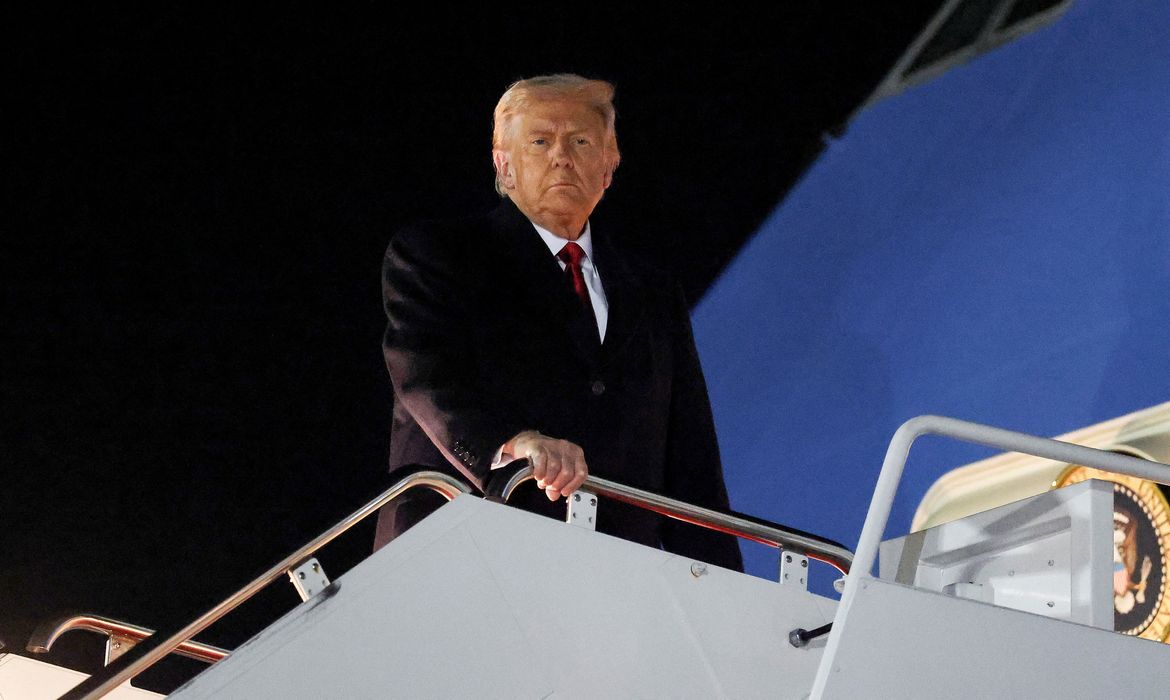
A series of opinion polls reveals that the popularity of United States President Donald Trump has faced a volatile trajectory since the beginning of his second term in January 2025, with approval ratings frequently below 50% and registering moments of decline throughout the year. Data obtained through national surveys shows that Trump began the new term with about 47% approval, measured shortly after his inauguration, but faced setbacks in later months, reflecting the polarization of American society and the reaction to his most controversial policies, including decisions on immigration, the economy and pardons related to the January 6, 2021 attack on the US Capitol.
The survey carried out in January 2025 by Reuters in partnership with the Ipsos institute indicated that Trump’s approval rating was at 47% when he returned to the White House, a level considered low by the historical standard for newly inaugurated presidents, and already showed deep divisions along party and ideological lines. Part of the measures taken in the first days, such as the pardon of a large number of people convicted of participating in the attack on the Capitol — an action disapproved by 58% of those interviewed — contributed to the critical assessment of its performance.
Over the following months, polls continued to record negative changes in support for the president. In April, surveys showed additional drops in Trump’s approval rating, with ratings at or below 43%, as many Americans expressed dissatisfaction with policies and initiatives, including trade tariffs and the expansion of executive power. Mid-year surveys also revealed that approval has stabilized around historically low levels, with around 40% of respondents approving of his administration in July 2025.
Public opinion experts emphasize that this oscillation reflects both the sustained political polarization in the United States and the electorate’s sensitivity to issues that affect daily life, such as the economy and security. Studies have indicated that in times of economic concern or internal political controversies, such as immigration actions carried out in several cities, there was a noticeable impact on the president’s evaluation.
At the end of the year, other polls maintained the trend of modest ratings, with approvals around 39% to 41%, suggesting that a significant portion of voters remain dissatisfied with Trump’s performance in areas central to his agenda, including the economy and immigration. The evolution of these indices throughout 2025 shows a president facing constant challenges in expanding support beyond his party base, amid a highly fragmented political environment.
Source: https://www.ocafezinho.com/2026/01/27/trump-enfrenta-queda-e-estabilizacao-de-apoio-em-meio-a-debates-sobre-economia-e-imigracao/