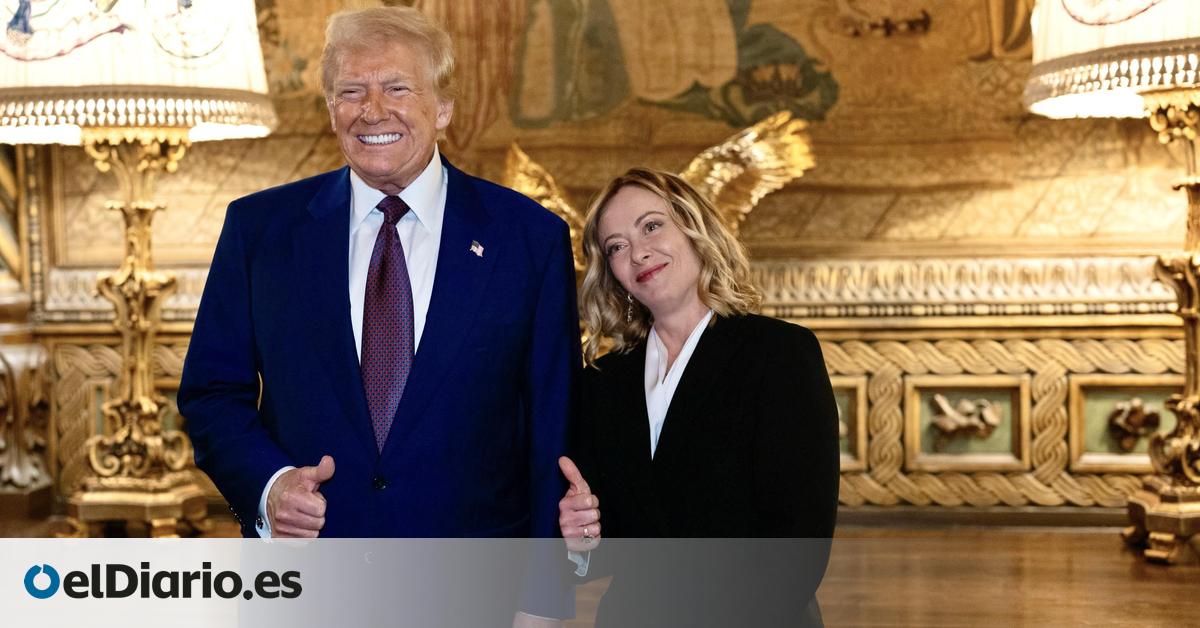
US President Donald Trump is clear about who shares his ultra agenda. And he wants to strengthen alliances with them, whether on the American or European continent. Thus, in a 33-page document on the national security strategy, he celebrates “with great optimism” the “growing influence of European patriotic parties.” That is, the push of Giorgia Meloni, Viktor Orbán and the ultra leaders who are achieving good results in other countries in northern and central Europe such as Sweden, Finland, the Netherlands and Germany.
According to Trump, Europe’s “economic decline” “is overshadowed by the real and starker prospect of the disappearance of civilization. Among the most serious problems facing Europe are the activities of the European Union and other transnational organizations that undermine political freedom and sovereignty, immigration policies that are transforming the continent and creating conflict, the censorship of freedom of expression and the repression of political opposition, the precipitous decline in the birth rate and the loss of national identity and self-confidence.”
“If current trends continue,” Trump says, “the continent will be unrecognizable in 20 years or less. Therefore, it is far from obvious that some European countries will have economies and militaries strong enough to remain reliable allies. Many of these nations are currently redoubling their efforts on the current path. We want Europe to remain European, to regain its civilizational confidence, and to abandon its failed approach of regulatory asphyxiation.”
In this sense, he maintains: “American diplomacy must continue to defend authentic democracy, freedom of expression, and the unapologetic celebration of the individual character and history of European nations. The United States encourages its political allies in Europe to promote this revival of the spirit, and the growing influence of European patriotic parties is, without a doubt, cause for great optimism.”
“As a result of Russia’s war in Ukraine,” says Trump, “European relations with Russia have deteriorated deeply, and many Europeans consider Russia an existential threat. Managing European relations with Russia will require significant diplomatic engagement on the part of the United States, both to restore conditions of strategic stability throughout the Eurasian continent and to mitigate the risk of conflict between Russia and European states. It is essential for the United States to negotiate a rapid cessation of hostilities in Ukraine, in order to stabilize European economies, avoid an involuntary escalation or expansion of the war and restore strategic stability with Russia, as well as allow the reconstruction of Ukraine after hostilities so that it can survive as a viable state.
Trump acknowledges that he is at odds with European leaders “who have unrealistic expectations about war, trapped in unstable minority governments, many of which trample the basic principles of democracy to repress the opposition. A large European majority wants peace, but that desire is not translated into policy, largely due to the subversion of democratic processes by those governments. This is strategically important for the United States precisely because European states cannot reform if they are trapped in a political crisis.”
Thus, he affirms his support for “allies in preserving the freedom and security of Europe, while restoring the self-confidence of European civilization and Western identity. We reject the disastrous ideologies of ‘climate change’ and ‘Net Zero’, which have so harmed Europe, threaten the United States and subsidize our adversaries.”
Return to the Monroe Doctrine
“Our objectives for the Western Hemisphere [es decir, América Latina] They can be summarized as ‘recruit and expand’, the document states in a clear strategy that is reminiscent of moments in history in which the US has wanted to intervene in the policies of Latin American countries, to the point of encouraging coups d’état, dictatorships and civil wars.
“We will recruit established friends in the hemisphere to control migration, stop the flow of drugs, and reinforce stability and security on land and sea,” the document continues: “We will expand by cultivating and strengthening new alliances, while reinforcing the attractiveness of our own nation as the hemisphere’s preferred economic and security partner.”
Security for economy
“The days when the United States held up the entire world order like Atlas are over,” the document states: “Among our many allies and partners we have dozens of wealthy nations that must assume responsibility for their regions and contribute much more to our collective defense.”
The strategy highlights that Trump “has set a new standard with the Hague Commitment, which requires NATO countries to spend 5% of GDP on defense and which our NATO allies have endorsed and must now comply with.”
Thus, “The United States will organize a burden-sharing network, with our Government as coordinator and sponsor. This approach ensures that burdens are shared and that all such efforts benefit from greater legitimacy. The model will consist of specific partnerships that use economic tools to harmonize incentives, share burdens with like-minded allies, and insist on reforms that enhance long-term stability. This strategic clarity will allow the United States to efficiently counter hostile and subversive influences, while avoiding time the overextension and dispersal of efforts that undermined previous efforts. The United States will be willing to help—possibly through more favorable trade treatment, technology sharing, and defense procurement—those countries that are willing to assume greater security responsibility and harmonize their export controls with ours.”
“In the long term, it is more than likely that, in a few decades at most, some NATO members will have a non-European majority. Therefore, the question remains open as to whether they will see their place in the world, or their alliance with the United States, in the same way as those who signed the NATO charter,” the document states, showing its rejection of migration.
Source: www.eldiario.es