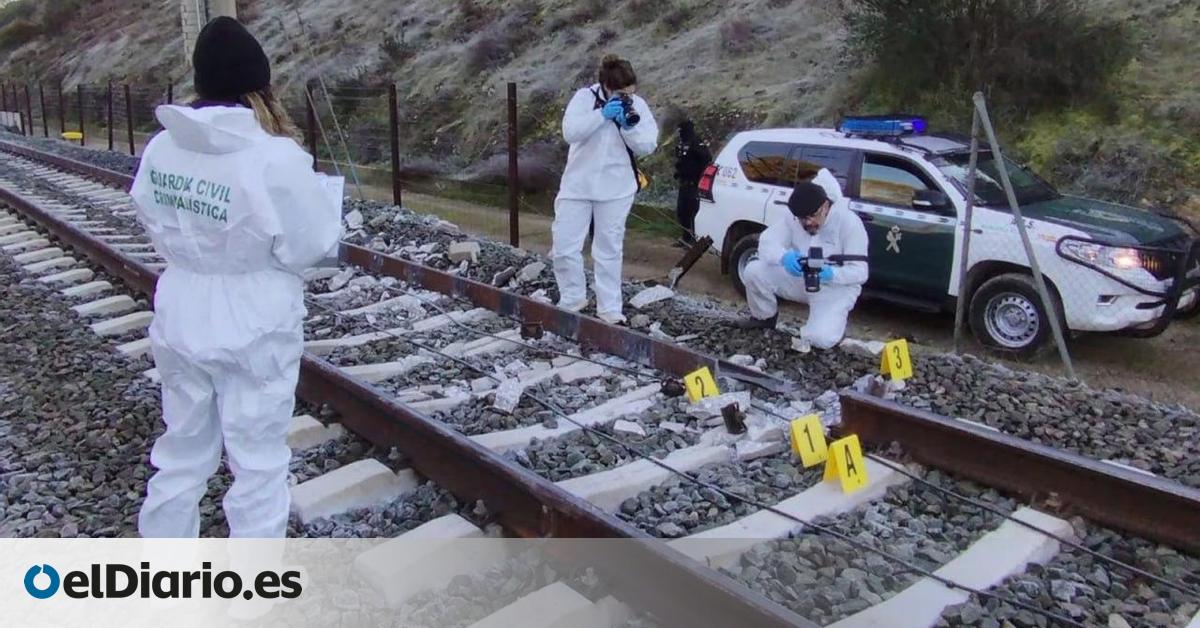
The Ministry of Transportation believes that the “first technical indication” of the very serious train accident this Sunday in Adamuz (Córdoba) “points to a breakage or alteration of the rail, but it has yet to be determined whether this breakage is a cause or consequence of the derailment. This causal relationship is not established and will require time.”
Sources from the Ministry headed by Óscar Puente explain that “the Railway Accident Investigation Commission is in the data collection phase and any hypothesis about welding or other defects requires laboratory analysis.” “Therefore, advancing a definitive thesis now would be speculative and the published version of an alleged welding error is not, for the moment, part of the confirmed investigation. It is not feasible to conclusively attribute the incident to welding at this stage,” the aforementioned sources assure. The accident has resulted, so far, in a provisional toll of 40 dead and 152 injured in the accident.
Transport has released a brief statement after denying this afternoon that the breakage of the track was being investigated as the cause of the accident. A Ministry spokesperson said the road broke after the crash.
Several breaks in 200 or 300 meters of track
Minutes before the Ministry confirmed this “break” or “alteration” of the road, the Minister of Transport and Sustainable Mobility, Óscar Puente, explained in an interview in ‘La Sexta’ that the breakage of the lane of the road on which the accident took place is not limited to just one section, but there are many more breaks along 200 or 300 meters of infrastructure.
Puente has explained that the image of the Civil Guard that has emerged is only the first in a series of track breaks and that it is not yet known if it is a cause or a consequence of the accident. Regarding the thesis that the reason could be a failure in the rail welding, the minister has assured that attributing this possible problem to the accident is currently “unfeasible.” At the same time, Puente has ruled out that excessive speed or human error is behind the causes, while reiterating that the Iryo train was new and had recently been inspected.
The minister has defended that rail transport is safe, recalling that this is the first major high-speed accident, excluding that of Angrois in Galicia, although that line was not high-speed. He has also detailed that, in the 20 minutes prior to the Córdoba accident, up to three other trains passed through that section of track and no incident was reported. “If the Alvia had passed twenty seconds earlier or a minute later, we would probably not even be talking about deaths, we would be talking exclusively about injuries,” Puente assured.
The conclusions of the first investigations
Following Puente’s statements, the Railway Accident Investigation Commission (CIAF) has published its first conclusions. It points out the “derailment of the last three cars in the composition of the Iryo 6189 Málaga – Madrid high-speed train.” “The derailed cars moved laterally, invading the clearance of track 2, along which at that moment the Renfe Alvia train 2384 Madrid – Huelva was arriving, in the opposite direction.”
“At that time, both trains were traveling at speeds of around 200 km/h (the exact figure is pending confirmation), causing a very violent collision between the derailed cars at the tail of the Iryo train and the head of the Alvia train,” the Commission indicates. “As a result of the collision, the first two cars of the Alvia train fell down a side embankment four meters high.”
In the hours after the accident “the CIAF team inspected the point where the derailment began, the infrastructure of rails, sleepers and platform at that point and the damage caused.”
And more actions will be necessary. “After the on-site inspections, the CIAF has determined that it will be necessary to analyze the rails at the starting point of the derailment in the laboratory, as well as inspect the running of the Iryo train in the workshop. The data will also be extracted from the legal recorders on board of both trains. The CIAF has held a meeting with the judicial police, criminalistics of the Civil Guard, the judge on duty, Adif, Adif AV [Alta Velocidad]Renfe and Iryo, to coordinate the extraction and custody of these elements, which will take place in the next 48 hours. The material will be provisionally transferred to offices attached to the CIAF in Madrid, with a view to being transferred shortly to a competent laboratory.”
In addition, the Commission indicates that “it has requested from Adif information on the traffic records through Adamuz in the two days prior to the event.” Inspections will also be carried out on the running of other trains that previously circulated through that point, a task for which two other CIAF investigators will be mobilized in Madrid in the next 24 hours.
The Commission also points out that all hypotheses remain open. The CIAF “is, at this moment, in the phase of collecting information on site and compiling documentation and data from the different records. In the following phases of the investigation, laboratory analyzes are planned on the material and depending on how the investigation progresses, other actions will be carried out as necessary (such as interviews, inspections of other facilities or rolling stock, etc.). At the moment, being in an initial phase, all hypotheses regarding the possible causes of the event are open.”
In addition, he emphasizes that he has, in principle, a period of one year to publish the final report of the investigation.
At the moment it is too early to know when traffic will recover on the affected road. Óscar Puente has pointed to February 2 as the possible date from which it will be possible to circulate normally on the trains that connect Madrid and Andalusia. Until then, Adif hopes to be able to recover at least one of the tracks, along which the trains would pass at very low speed, while the other is recovered and freed.
Source: www.eldiario.es