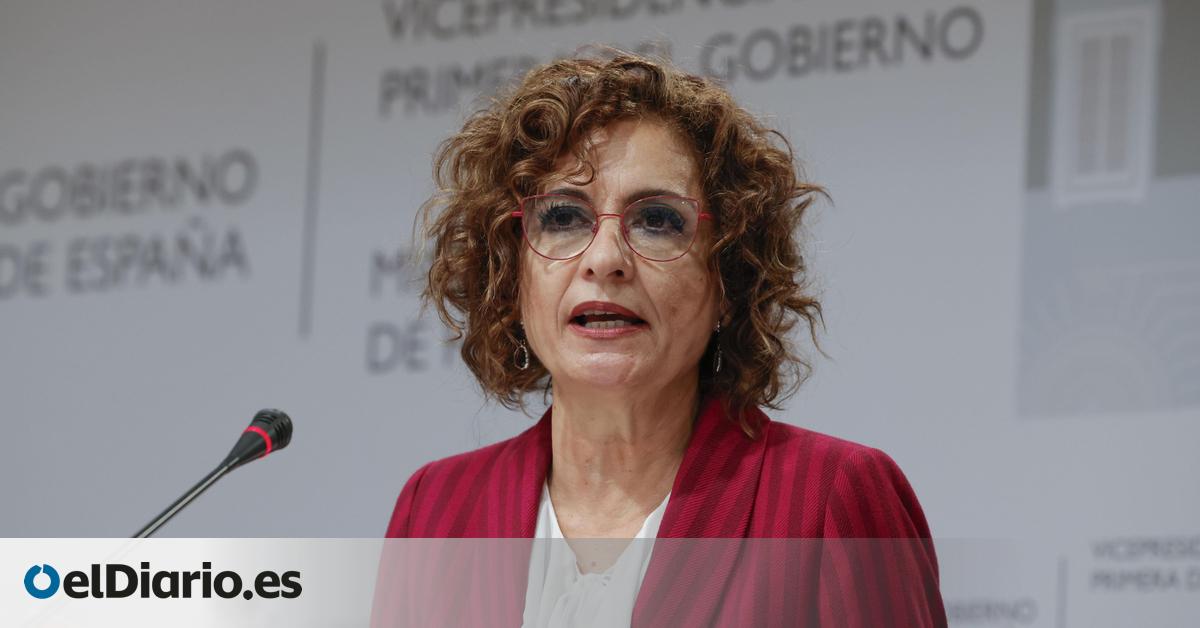
The vice president and Minister of Finance, María Jesús Montero, has presented the new regional financing system that will increase the resources that the territories will receive by around 21,000 million euros, according to the Government’s calculations thanks to “economic dynamism.” One of the main novelties is that the percentage of transfer of some taxes is increased, such as personal income tax, which goes from 50% to 55%, and VAT (from 50 to 56.5%), which would mean an increase in financing of 16,000 million euros. Despite this greater transfer, which represents a greater collection capacity for the communities with more income, Montero explained that there will be a mechanism of “interterritorial solidarity.” “To the extent that collection increases due to the transfer of more taxes, territorial solidarity also increases. This model is more supportive than the current model in force,” he assured.
The interterritorial solidarity mechanism supposes a leveling of 75% of the distance of each community with respect to the adjusted average resources per inhabitant. “Communities with an adjusted per capita tax capacity below the average will receive resources and those above will be net contributors,” says the Treasury. The calculations of the increase in financing are based on estimates for 2027, which is when the new regional financing system would come into force, which has a tortuous path ahead due to the rejection that PP and Junts have expressed for now. In total, it would mean regional financing of 224,507 million euros next year. The minister recalled that, in 2023, the last year liquidated, the communities received 152,484 million euros.
Aware that it is not going to rain to the liking of all the autonomies, the vice president has said “there cannot be a model tailored to an autonomous community” and that there “lies the difficulty”, but has assured that the new system aims to reduce “the current differences”, respect the “territorial uniqueness” while being “more transparent and simple than the current one”. The Treasury will convene a Fiscal and Financial Policy Council next Wednesday to present the new model to the regional governments, although Congress has the last word.
“The one who votes on the financing system is the PP, so if the PP does not have a single position, it is not possible to agree on the system with the PP,” Montero said about the discrepancies between his regional governments: “Feijóo does not have enough leadership to put a proposal on the table.” The Government’s strategy is to transfer all the pressure to Feijóo, given that 70% of the extra 21,000 million go to communities where their barons govern.
By community, Andalusia is the one that would receive the most income with the new system (4,846 million), followed by Catalonia (4,686 million), the Valencian Community (3,669 million) and Madrid (2,555 million). On the contrary, Cantabria and Extremadura would lose resources, but Montero has assured that they will be compensated with the compensation fund.
Regarding the ordinality that Oriol Junqueras took for granted as part of the Government’s agreement with ERC, Montero has said that “the construction of the model tends to the principle of ordinality, but it depends on each autonomous community whether this principle of ordinality is present or not.” “The final result of what they contribute versus what they receive is not homogeneous for all the autonomous communities,” explained the vice president, who has assured that this is true in the case of Catalonia. The head of the Treasury has given Cantabria, which receives 46 million euros from the compensation fund, and Madrid as an example: “The financing per adjusted inhabitant of Cantabria is higher than that of Madrid and, if it had a principle of ordinality, Madrid would have to be above it.”
The State’s contribution through vertical leveling will be 19,000 million euros, which will come from 5% of the income tax return and the additional transfer. What the Treasury maintains is that the State contributes resources to the system to protect the Welfare State and further reduce the differences per adjusted inhabitant. “In this phase, the distance of each community with respect to the territory that has the highest financing per inhabitant is reduced by two thirds,” the ministry points out.
Regarding the adjusted population, the vice president has assured that “population groups are delimited with greater precision” when establishing the weight in the distribution. Among the new features is the inclusion of “fixed costs” which are intended to alleviate the damage to financing caused by depopulation. Montero explained that the surface and dispersion criteria also serve that objective. “I believe that a balanced and transparent system has been achieved.”
Likewise, there will be an additional contribution of 3.3 billion euros through the Interterritorial Compensation Fund, from which communities that are below average in financing per inhabitant benefit. “It is not part of the model, but it is a constitutional instrument,” Montero recalled about that background.
Pullas to the PP and fights against it dumping fiscal
The minister has said that the Government’s intention is to establish “a limit for the dumping tax”, which involves competition to lower taxes in some autonomous communities, especially Madrid. “There is a certain consensus, not everyone agrees, in putting some limit on the dumping fiscal to make it impossible for some tax figures to remain in vain and provide greater fiscal co-responsibility to the autonomous communities. It makes no sense that the Government of Spain is making extraordinary efforts to provide greater resources to the territories and then the territories lower taxes on the part that corresponds to them,” said Montero, who has assured that it is a formula that “has to be discussed” and has welcomed the fact that the State “reserves a minimum of taxation” in figures such as Inheritance or Donations. The debate is open.
The Government has decided that the money being transferred does not have a “finalist” nature to respect the principle of autonomy of the communities, but has proposed “almost as a request” that it be used to improve the quality of public services. “It would be useless to put almost 21,000 million euros on the table if the destination of those resources is going to go to the private initiative in health, in private universities or in some other mechanism that prevents guaranteeing equal opportunities,” he slipped and then concluded: “In the end we are transferring more resources to the autonomous communities every day and, yet, citizens do not notice it, on the contrary, they perceive a deterioration in the quality of these public services. It makes no sense that this happens out of interest privatizer of the Popular Party, which allocates the majority of these new resources to private healthcare or private universities.”
Montero has assured that they have been working on the reform for “a long time,” which is “one of the most complex challenges that any Government faces.” There he took the opportunity to poke fun at the PP by recalling that Mariano Rajoy’s Executive “even with an absolute majority did not dare to present a regional financing model.” The vice president has assured that Pedro Sánchez is a “decided executive who assumes his responsibility” and “who understands that there is no better way to defend the welfare state” than by modifying the financing system that is already 17 years old and has expired since 2014.
“We have shown that we believe in the state of autonomies,” said Montero in his initial intervention in which he attacked the PP for “polarizing” with the mantra of territorial “grievance” that he has assured does not comport with reality. The head of the Treasury recalled that in the last seven years 300,000 million euros more have been made available to the communities than “in the PP stage.” “A dizzying figure,” said the socialist, who believes that it should have contributed to the improvement of public services: “It is not only a question of resources but of political orientation.”
Source: www.eldiario.es