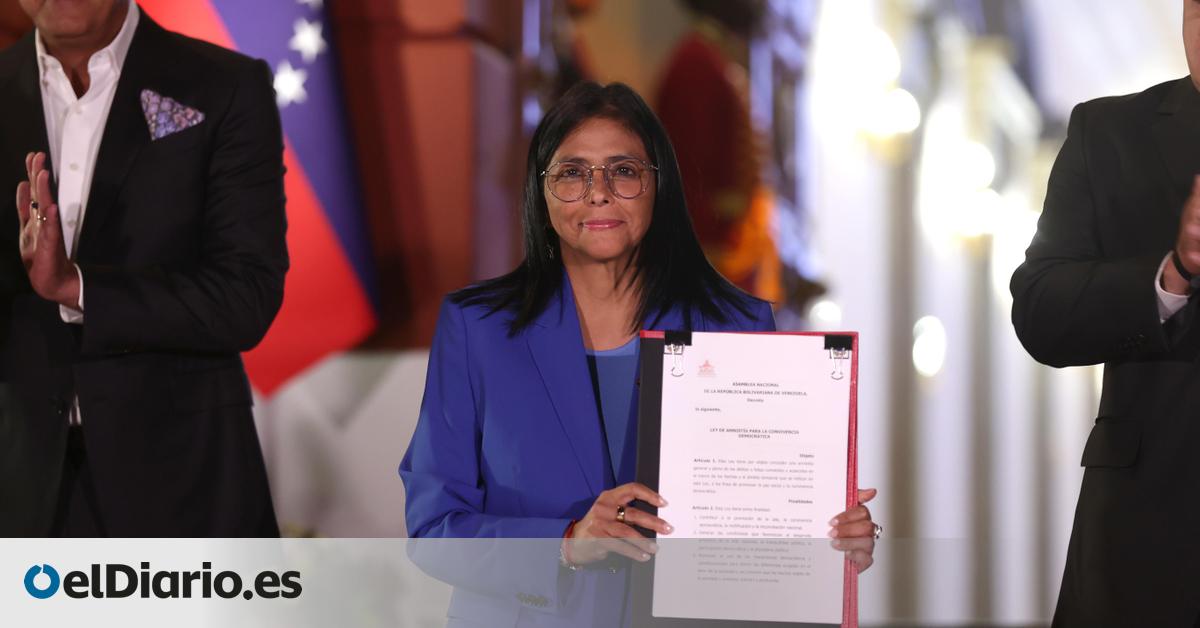
In a historic session, the deputies of the Government and the democratic opposition of the National Assembly of Venezuela have unanimously approved the 16 articles of the Amnesty and Democratic Coexistence Law. Despite the bad omens and the general skepticism in society, the commission of 19 deputies managed to put together an article by consensus that was presented to the plenary session of the 285 deputies for its second discussion. The session started two hours late and lasted exactly 99 minutes.
The document establishes that the purpose of the instrument is to “grant a general and full amnesty” to people “prosecuted or convicted for the alleged or proven commission of political or related crimes, from January 1, 1999 to January 30, 2026.” “I regret that all those events have occurred so that we can understand each other; but we also learn from those pains. We are in a new moment,” said Jorge Rodríguez, president of the National Assembly, at the end of the session.
The text establishes “clear safeguards on the crimes that will be excluded from the legal instrument, namely: serious violations of human rights, crimes against humanity, war crimes, intentional homicide, corruption and drug trafficking.”
I regret that all those events have occurred so that we can understand each other; but you also learn from those pains. We are in a new moment
Jorge Rodriguez
— President of the National Assembly
Furthermore, in the middle of the debate, Rodríguez let in an announcement that was a request from the NGOs. Although he does not completely satisfy the demand, he said that the Law against Hate, which punishes even messages published on social networks, will be reformed, as he admitted that, in some cases, it had not been used “appropriately.”
The document includes the episodes of politically motivated violence that occurred during the Coup d’état of April 11, 2002—including assaults and attacks against governorates, mayors’ offices, and public and private facilities; the acts of violence for political reasons within the framework of the business and oil strike and sabotage from December 2002 to February 2003; those of February, March and August 2004; May 2007; after the 2013 presidential elections; in February and June 2014; March and August 2017; in January and April 2019—Juan Guaidó’s self-proclamation—and in the presidential elections of July 2024.
Before being approved, the Venezuelan government reported that between November 2025 and the beginning of this month, 896 people have been released from prison, detained for allegedly having committed crimes related to political violence or after being found guilty of such actions. According to the NGO Foro Penal, however, there remain 644 political prisoners in the country, after more than 406 releases in the midst of a process initiated on January 8 by the Government in charge.
A key point for opponents was that a mechanism be created to follow up on special cases and the operation of the articles. The final provision establishes the creation of a commission made up of 23 deputies.
The president of the National Assembly appointed a commission of parliamentarians to deliver the recently enacted law to the president in charge, Delcy Rodríguez, so that it is published in the Official Gazette and comes into force.
With the approval of the law, the Police, the investigation bodies and the military “will conclude the investigations and procedures related to the events” referred to. Likewise, the files on the processes opened to the amnestied people must be eliminated.
Why now?
Although many people blindly believe that the Donald Trump Government is behind the push for the amnesty, various sources from the Law Consultation Commission, both Chavistas and opponents, assured that the initiative came from Chavismo. Because? “They need agreements with the democratic opposition because the country’s sovereignty is compromised,” said one.
So much so that a senior government official stated bluntly: “It is a real attempt at reconciliation after the horror of January 3.”
For political scientist and university professor Ricardo Sucre, the approval of the Amnesty Law represents much more than a legislative process: it symbolizes the closing of a period marked by political violence and a confrontation that failed to improve the quality of life of the population. Venezuela has spent two decades in an “intractable” conflict, characterized by hyperinflation, mass migration and repression. “Citizens eagerly await the end of this antagonism to define a framework of coexistence that allows institutions to function and alleviates the climate of fear,” he stated.
The government recognizes its limitations, forcing the opposition sectors that remain in the country to adopt a more pragmatic stance towards the conflict.
Ricardo Sucre
— Political scientist and university professor
He emphasized that the North American bombing on January 3 marked a turning point. In his opinion, the right-wing opposition that represents and accompanies María Corina Machado always sought for Chavismo to end in “capitulation” or a process similar to the Nuremberg Trials. On the other hand, current political actors seem to have become aware of the need to coexist.
This change in position would even reach the leadership of Chavismo. Sucre maintains that the ruling party has reflected after incidents that they perceived as direct threats to their personal safety. He said that the statements by the acting president, Delcy Rodríguez, about the releases, and her brother and president of the National Assembly, Jorge Rodríguez, who has even mentioned the concept of “guarantees for the losers,” suggest an acceptance of the current political reality. The scenario after January 3 makes it clear that the government recognizes its limitations, forcing the opposition sectors that remain in the country to adopt a more pragmatic stance towards the conflict,” he stated.
The law is based on values such as respect for life, freedom, justice, equality, solidarity, democracy, social responsibility, human rights, ethics and political pluralism, which make up the “democratic and social State of law and justice.”
Source: www.eldiario.es