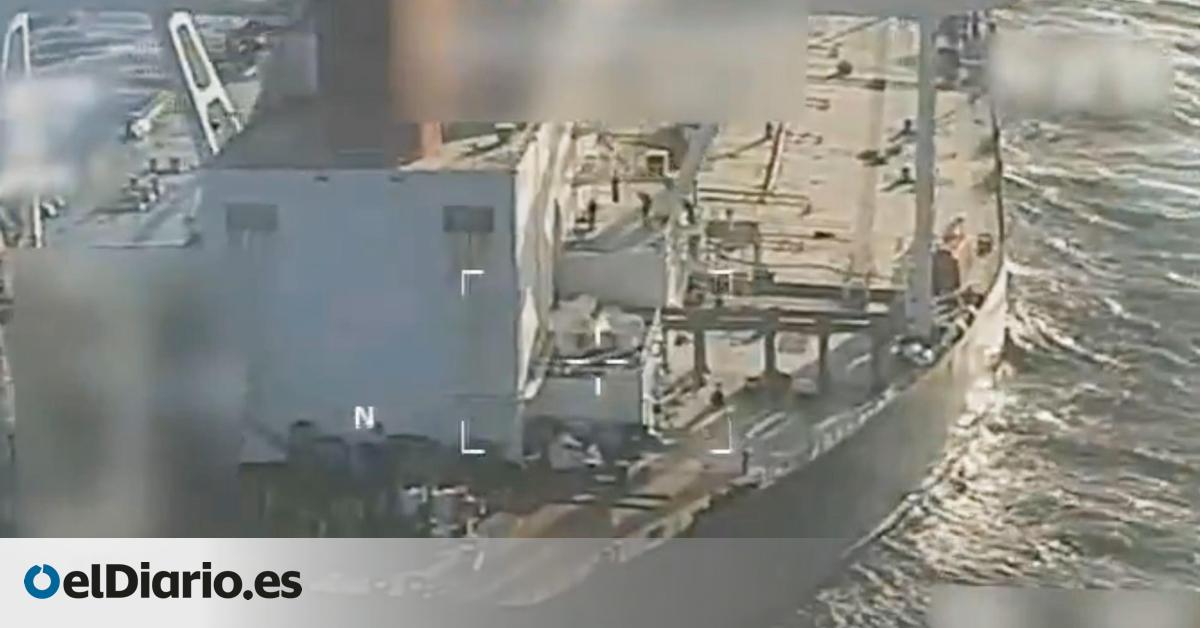
The military escalation of Donald Trump’s Government against Nicolás Maduro continues. The United States Coast Guard intercepted a second oil tanker this Saturday in international waters of the Caribbean Sea, off the coast of Venezuela, as confirmed by the Reuters agency and the American media ABC News, which have confirmation from three North American officials.
The US Army “is providing support” with helicopters that transport Coast Guard personnel to the ship and also supervise the operation, according to NBC News.
According to The New York Timeswhich quotes a US official and two sources from the Venezuelan oil sector, the ship detained today is called Centuries and is not part of the list of oil tankers sanctioned by the US. In addition, the newspaper indicates that the ship belongs to an oil company based in China that transported Venezuelan crude to refineries in the Asian giant.
However, the White House stated this Sunday that said oil tanker is a “false flag ship” that is part of the “ghost fleet” of the South American country to circumvent sanctions and transport crude oil used to finance the Government of Caracas.
“The tanker was transporting oil from PDVSA, a sanctioned company. It was a false flag ship that operated as part of the Venezuelan ghost fleet to traffic stolen oil and finance the narcoterrorist regime of (Nicolás) Maduro,” Donald Trump’s Government spokesperson, Anna Kelly, wrote in X.
This is the second oil tanker seized by the Trump Administration in just ten days. The first, which left Venezuela, was intercepted and confiscated on December 10. “A big, big oil tanker, the biggest you’ve ever seen, and other things are happening that you’ll see later,” Trump then described. “We’ll keep it, I guess,” he added.
The decision was justified by referring to the “theft” of “oil, land and other assets” by Venezuela, although it did not explain what oil, assets and territories it refers to nor did it provide evidence of this alleged theft. Nor what legal basis does the US have to prevent ships sanctioned by Washington from sailing through international or Venezuelan waters.
Voltage escalation
The president has intensified his pressure on Venezuela in recent weeks. This same week, the US president has redoubled his siege on the South American country by tightening the blockade of its main industry and means of income and subsistence: oil. “I order a total and complete blockade of all sanctioned oil tankers [por EEUU] that enter or leave Venezuela,” he wrote on his social network Truth Social.
Trump is now resorting to a 50-year-old nationalization to redouble his pressure on Maduro. And he remembers when, starting in 1976, the oil industry began to be managed by Petróleos de Venezuela (PDVSA) in a political and legal decision in which the companies most affected by nationalization were the American Exxon Corporation, Gulf Oil Corporation and Mobil Oil Corporation.
Half a century later, the president of the country who hides behind supposed national security emergencies to make arbitrary economic decisions such as unilateral tariffs says he wants to reverse that nationalization by force.
The Government of Venezuela describes this act as “robbery and kidnapping”
For its part, the Maduro Government rejected events that it described as “robbery and kidnapping.” In a statement, the Chavista Executive described the event as an act of “piracy” and also denounced the “forced disappearance” of the crew.
The South American country warned that “these acts will not go unpunished” and that it will take “all appropriate actions, including reporting to the United Nations Security Council, other multilateral organizations and the governments of the world.” “The colonialist model that the United States Government intends to impose with these types of practices will fail and will be defeated,” he stated.
Caracas added that international law “will prevail and those responsible for these serious events will respond to justice and history for their criminal conduct.”
In this context, Iran offered Venezuela its cooperation “in all areas” to confront “piracy and international terrorism” from the United States, according to the Venezuelan Foreign Minister, Yván Gil, said this Saturday after a call with his Iranian counterpart, Abás Araqchí.
Last Wednesday, Venezuela requested an urgent meeting with the United Nations Security Council, which plans to hold a meeting next Tuesday the 23rd in the afternoon to discuss the situation regarding the South American country, as confirmed to EFE by the rotating presidency of the body.
Source: www.eldiario.es