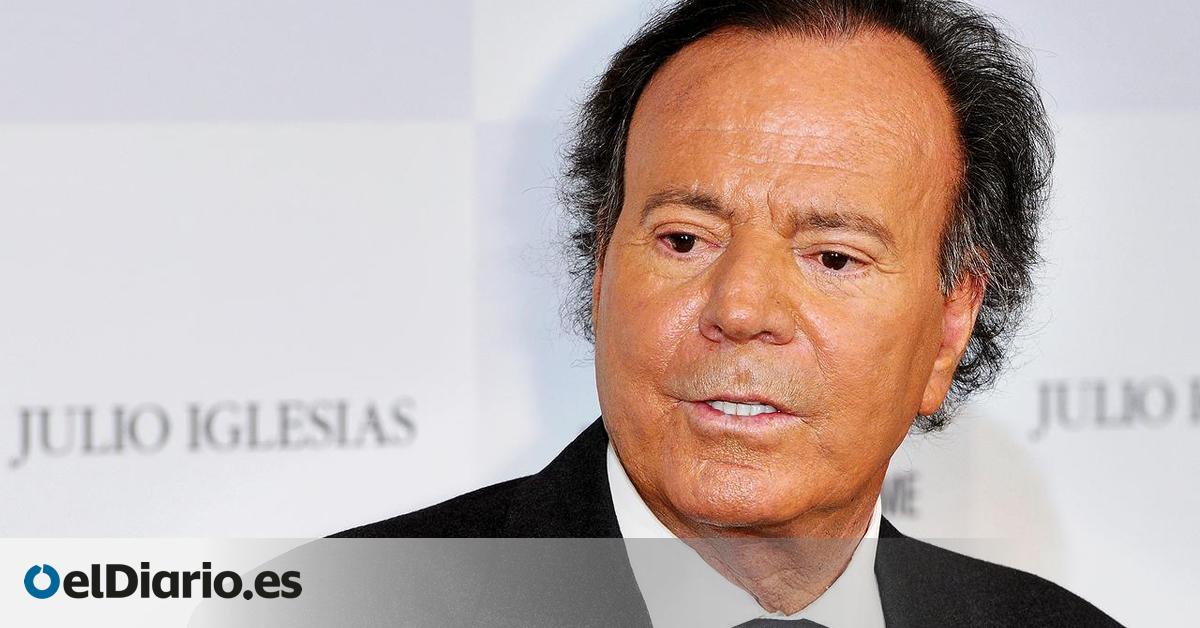
The Prosecutor’s Office of the National Court has archived the investigation opened into singer Julio Iglesias after complaints filed against him by two former employees for human trafficking and sexual assault. The Public Ministry concludes the investigations due to the “lack of jurisdiction” of the Spanish courts and will not file a complaint against the artist.
The resolution does not go into the substance of the matter or analyze the facts reported. The Prosecutor’s Office argues that the Spanish courts lack jurisdiction to examine the case given that the events occurred exclusively abroad – the Dominican Republic and the Bahamas – and the territorial or personal “links” required by law do not exist for the Spanish Justice to intervene. “The facts must be prosecuted by the directly competent States, because that is where they occurred and where the evidence is found,” the decree states.
The complaint included the testimonies of two former employees of the singer who reported having suffered sexual assaults in an environment of continuous control and intimidation while they worked for him in 2021 in his mansions in the Dominican Republic and the Bahamas. The story of these former workers is part of an exclusive investigation by elDiario.es in collaboration with Univision.
Women’s Link Worldwide, the organization that legally advises Laura and Rebeca, the former employees who denounced the singer, have reacted to the Prosecutor’s Office’s decision with a statement in which they announce that there will be more legal actions. The lawyers affirm that the reported facts have not been evaluated and describe the resolution of the Public Ministry as “regrettable.”
There is no “personal or territorial link”
After granting them the status of protected witnesses and taking their statements, the Prosecutor’s Office concludes that the former workers are not Spanish, “nor did they travel with the accused at any time to Spain”, so there is no “personal or territorial link with our country.” Regarding the artist, he states that “he neither resides in Spain, nor does he maintain his center of life, interests, activity in this country” despite the fact that he has real estate properties here.
Article 23.2 of the Judiciary Law extends Spanish jurisdiction over crimes committed abroad by Spaniards if three conditions are met: that the act is a crime in the place where it was committed, that the victim or the Prosecutor’s Office file a complaint before the Spanish courts and that the perpetrator has not been acquitted, pardoned or punished abroad for these acts or, if he has been convicted, that he has not served his sentence.
The decree explains, however, that the Supreme Court has established that this article must be applied restrictively and that the so-called “principle of territoriality” prevails, which requires the existence of “relevant links” with Spain that do not exist in this case.
The Prosecutor’s Office also alludes to the “restrictive” reform of universal jurisdiction approved in 2014. It remembers that this reform imposed the “principle of subsidiarity”, which determines that “Spain only intervenes if the directly competent State cannot or does not want to investigate and this is proven” and that “Spanish universal jurisdiction is residual and assessed.” In this case, says the Prosecutor’s Office, there is no evidence that the authorities of the Dominican Republic and the Bahamas “have renounced exercising their jurisdiction or are unable to do so.”
The Public Ministry relies on two cases that the Supreme Court has resolved in the last decade. In one of them, Spanish judges refused to investigate an illegal fishing network that developed in international waters of the Antarctic and with connections to a corporate network based in Spain.
In the other case brought forward by the Public Ministry, the judges of the Supreme Court and the National Court refused to be competent to investigate the murder of a Colombian trade unionist in 2001, supposedly in a paramilitary operation.
Source: www.eldiario.es