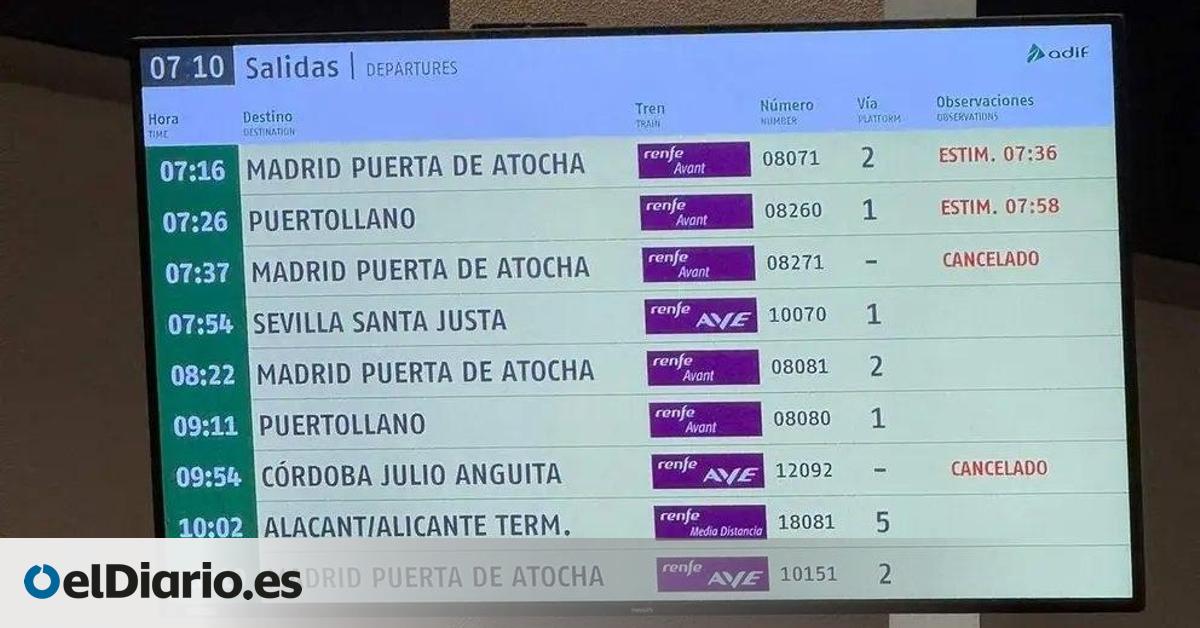
The majority unions of Adif and Renfe have called off the railway sector strike scheduled for Tuesday and Wednesday, February 10 and 11, after the strikes in the sector this Monday that have affected several hundred trains.
The agreement comes after the fourth meeting between the Ministry of Transport and Sustainable Mobility and the majority unions of the two public companies (CCOO, UGT and the machinists’ union, Semaf). Last week there were already three meetings, which did not lead to an agreement.
However, the CGT and Railway Union (SF) unions, both minority in the sector and which have not been present at the meetings, have decided to maintain the strike on both Tuesday and Wednesday, according to the Efe agency. SF sources explain that “no one has negotiated” any type of agreement with them, nor do they know the terms of the call, statements that CGT subscribes to.
For its part, the Ministry of Transport and Sustainable Mobility points out that the agreement includes an investment in maintenance of 1,800 million euros, as well as the creation of 3,650 jobs and the reinforcement of public railway safety. “This is an important agreement to continue improving the Spanish railway system and guarantee its present and future competitiveness,” said the Minister of Transport and Sustainable Mobility, Óscar Puente, after a meeting held this afternoon with worker representatives.
Furthermore, among the agreed measures is the creation of a joint commission that will meet within a month to monitor the agreements, which will be convened on successive occasions depending on the monitoring needs.
Diego Martín, general secretary of Semaf, has indicated that the agreement includes “fundamental” solutions that the union representatives were demanding, including improvements in maintenance, with a 50% increase in staffing, investment in infrastructure and greater staffing in both Adif and Renfe and in the Railway Safety Agency. The creation of working groups has also been proposed to modify regulations and legislative standards that affect both security and maintenance and investment.
The main agreed measures
The agreement between Transport and the workers’ representatives contemplates more than twenty measures. Among them, the constitution within a maximum period of one month of the committee for the harmonization and coordination of shared risk management in railway operation, where both the infrastructure manager Adif, the railway companies, the State Railway Safety Agency (AESF) and representatives of the unions will be present. Also, the creation of a working group to monitor temporary speed limitations (LTV), where there will also be the presence of unions.
Furthermore, among the agreed measures is the creation of a working group to develop a common and coordinated action protocol for weather alerts and the development of a standard for the coordination of risk notification systems in the safety of railway operations. The latter has the objective of guaranteeing that the notifications issued by the workers are received by both the affected railway company and the infrastructure manager, and that the receipt of these notices is notified.
In labor matters, the agreement contemplates the additional provision of the AESF with 50 new structural positions, which will include two new general subdirectorates and middle management. For these positions, “mechanisms” will be established to “attract and retain talent in these positions.”
Regarding the evolution of employment in Adif, the agreement contemplates processing a specific replacement rate of 2,400 additional positions to the replacement rate “to address needs that are essential for the purposes of the entity, which will result in the field of security, foreseeing its management, on a multi-year basis, of around 480 positions per year for the period 2026-2030.”
In addition, it is contemplated to process a new financing agreement for Adif until 2030 with a maintenance expense for the year 2026 of 861 million euros and which will increase until reaching 1,179 million euros at the end of the period.
And it plans to process a new financing agreement for Adif High Speed 2026-2030 with a “significant growth” in maintenance spending, which will increase by 44% between the years 2025 and 2030.
In the case of Renfe, the number of additional contracts will rise to 1,200 between the different groups: structure, management, driving, auditors and maintenance. Likewise, the internalization of the maintenance of Renfe rolling stock has been approved.
Day of strikes after high-speed accidents and Rodalies
Before this agreement, this Monday the first of three days of strikes after the tragic accidents high-speed train in Adamuz (Córdoba) and Rodalies in Gelida (Barcelona) in which three train drivers died, among the 47 fatalities.
The unions present at the meeting (CCOO, UGT and the machinists’ union Semaf) have demanded more investments in railway infrastructure to improve both railway safety and service. Regarding the meetings, CCOO sources indicated this morning that the proposals from Transport were “insufficient”. They have also stressed that this Monday’s strikes have been developed based on the professionalism of the staff, with security and the state of the infrastructure once again at the center of the debate.
Specifically, the unions called the strike to demand more staff at Adif for the maintenance of infrastructure and more resources for this, in addition to more workers on board at Renfe, as auditors, as well as the reinforcement of the public company’s workshops. Also, that protocols be put in place in situations of adverse weather, such as the one that existed in Gelida at the time of the incident and that have occurred in recent weeks.
The following document sets out the terms of the agreement.
Source: www.eldiario.es