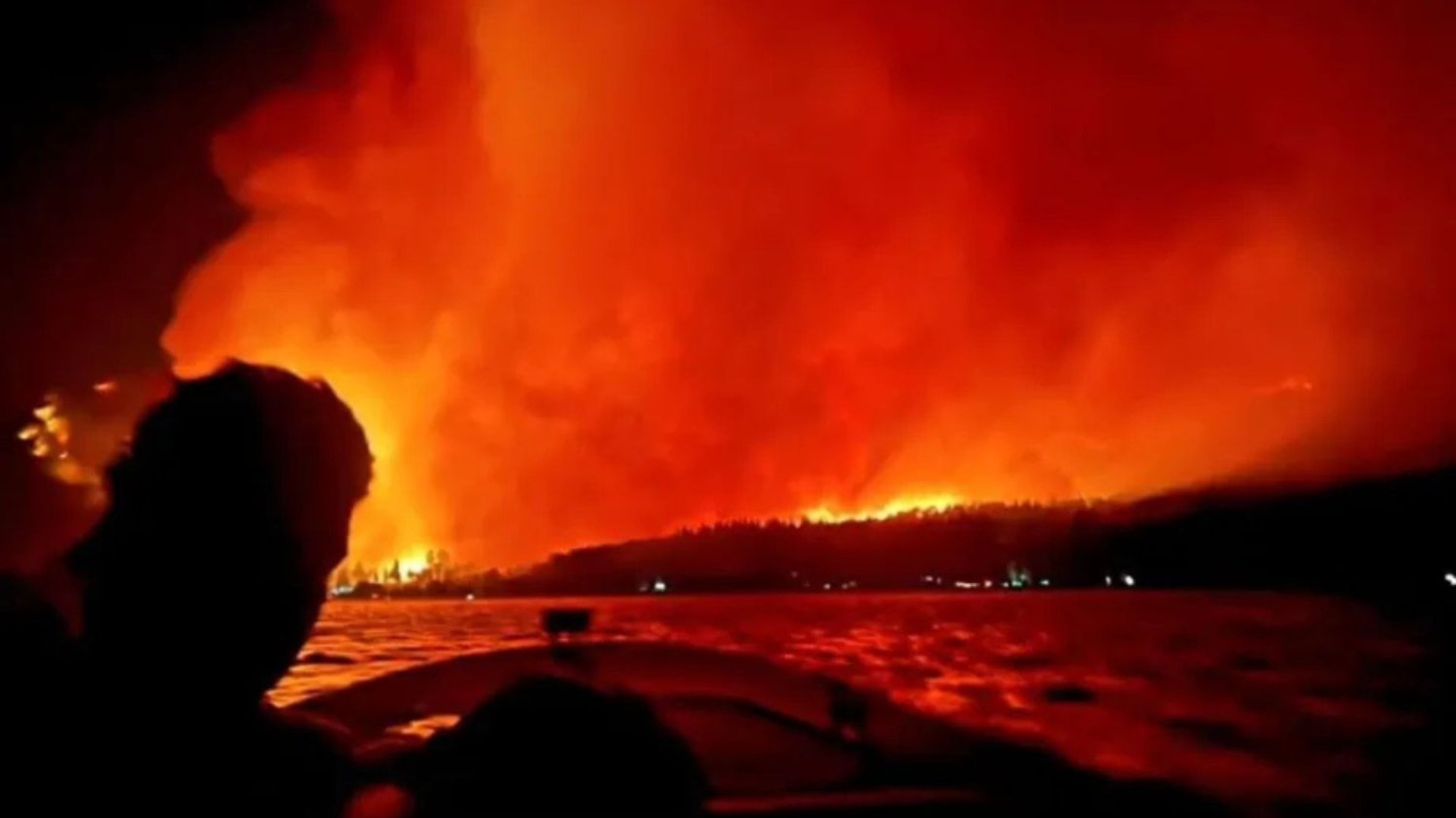
At the same time that the fire destroys native forest, homes and thousands of evacuees in the south, Manuel Adorni announced the agenda agreed upon by the Mayo Council to empty the socio-environmental laws of Forests, Lands and Fire Management. They prepare to do business on the burned land, enabling the change in the productive destiny of the fields after a fireprecisely the barrier that exists today to discourage speculation and intentional fires.
Beyond the punitive rhetoric already rehearsed by the Chubut governor Ignacio Torres, in harmony with Patricía Bullrich, the interests behind the fires are visible: they are the forestry, real estate and extractive businesses.
They are not interested in fighting fire because they prepare the ground for private appropriation of the territories inhabited by the native populations and communities. Sepoyism and delivery are obscene, in an explosive combination of adjustment and precariousness, deregulation and further deepening of the socio-environmental crisis.
The reforms that were not approved with the first Omnibus Law They return to the task of negotiating with the governors. This February 10 there is a first battle against slave labor counter-reform and the reform of the Glacier Lawand will be key to stopping this entire counter-reform plan tailored to imperialism and big foreign businesses.
More foreignization, less sovereignty
The current regulations of the Land Law (Law 26,737) sanctioned in 2011, establishes a limit of the 15% to the foreignization of rural landboth at the national, provincial and departmental levels. Even with that limit, close to 5% of Argentine territory – more than 13 million hectares – is already in foreign handsmostly large companies and economic groups that do not inhabit the country, but do exploit its resources.
The government initiative aims to eliminate or relax these limitsenabling purchases in areas of very high strategic value: Patagonian freshwater lakes, native forests, border areas, mountain ranges with critical minerals and large aquifers.
The mega decree 70/23 already included in its article 154 the repeal of the Land Law, but the measure was preventively suspended by a federal judge in La Plata at the end of January 2024, following a precautionary measure presented by the Center for Former Combatants of the Malvinas Islands (CECIM). Then, the Federal Court of Appeals of La Plata confirmed the suspension and declared the repeal unconstitutionalelevating the case to the Supreme Court, where the precautionary measure remains in force until this January.
Despite repeated calls from the deputies of the Left Front to discuss and roll back this decree, the Peronism was unable to provide only five legislators to bring this discussion to the venue. For this reason, the disastrous decree remains in force and the Land Law is in danger.
Once again against the Forest and Fire Management Law
Native Forest Law and the Fire Management Law They also appear as central objectives. Both standards are already chronically underfundedeven since before the Milei government with budget allocations well below what the laws themselves establish, which weakens the tasks of prevention, control and environmental restoration.
The lack of resources is not a management error, it is a political decision which leaves the territories more exposed to the advance of fire and the loss of native forest for business to advance. The entire political arc, all governments from the right to Peronism, have been promoting the call for decades. extractivist consensusonly consistently denounced by socio-environmental organizations and the left.
These laws had already been attacked in the first version of the Omnibus Law. There an attempt was made to make environmental limits more flexible and enable change in land use, a historical claim of agribusiness, real estate developers and extractivism. Although these articles did not prosper at that time, today the Government returns to the fray.
Every fire is political
Forest fires are logical consequence of these policies. They cannot be analyzed as isolated events or as simple natural disasters. In a context of climate crisiswhat is prevented, what is financed, what is protected and what is delivered to the market are part of the causes of forest fires.
Modifying laws to allow the change of use of burned lands is institutionalize the disasterlay the legal foundations so that fire is functional for business. Faced with that, an opposite policy becomes urgent, fighting for emergency budget, strict protection of the native forest, real prohibition of the sale of burned lands and social control of the territories. The enormous solidarity that is displayed from all territories can transform into a real fight to demand all the necessary resources to put out the fire.
Against the government plan, prepare the resistance
The government’s agenda is more than clear and it is felt emboldened with a Donald Trump attacking Venezuela in the face of authoritarian and highly discredited governments such as that of Maduro, and progressive governments such as that of Lula and Sheinmbaum that do not consistently denounce the imperialist offensive. But Milei is nothing more than a puppet of imperialism and the enormous tradition of Latin American struggle against looting, extractivism and the companies that benefit from this shows that there are forces to fight.
And We do not want to be slaves or a Yankee colonywe have to impose on the CGT a true plan of struggle, a general strike and block the entire congress to prevent the slave labor reform, the relaxation of the Glaciers law and this entire package of environmental reforms against our lives and territories. A very important battle is played this February 10.
Source: www.laizquierdadiario.com