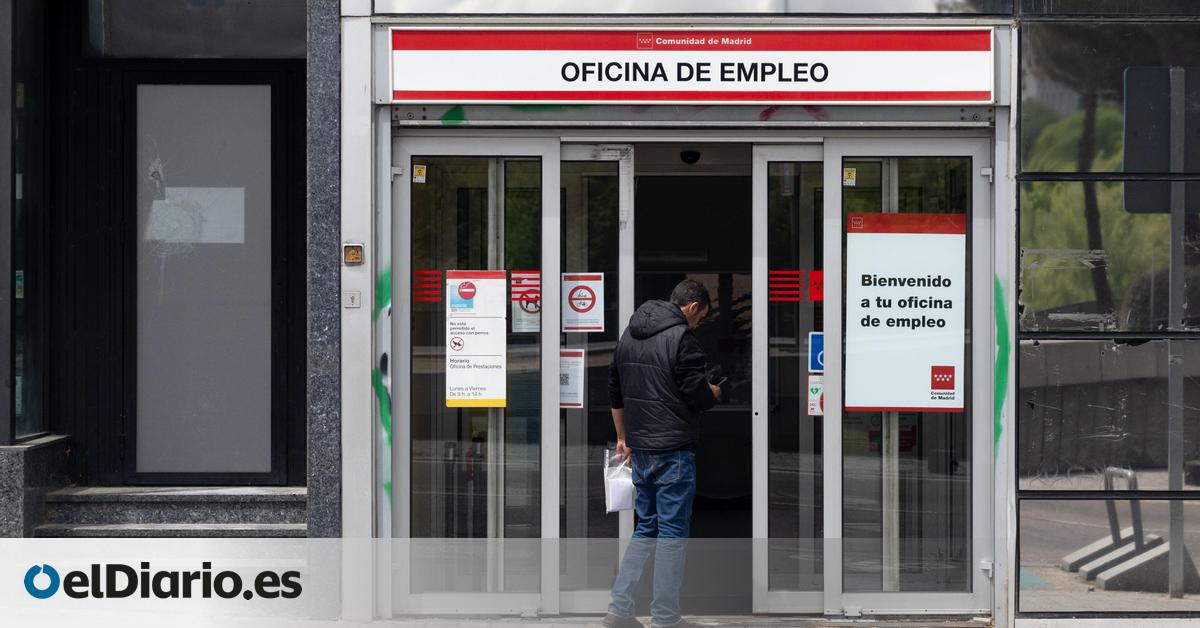
The Government has eliminated the obligation for unemployed people who receive unemployment benefits to file their income tax return. It was a new mandate, approved in 2024 and that had already been delayed to 2026, but now the Executive reverses completely and annuls the measure, which it considers “was not appropriate.”
This is one of the many measures approved in the macrodecree to increase pensions at the end of the year, which also includes the extension to 2026 of the so-called “social shield” (such as the prohibition of evictions of vulnerable families and the extension of the energy bonus), but also a lot of other small print in matters of Social Security, employment and taxes.
In this case, the Government deletes two sections of the General Social Security Law – letter k) in articles 271.1 and 299.1 – that were included in the last reform of the unemployment benefit of 2024 and that obliged beneficiaries of unemployment benefits to file the personal income tax declaration.
“It seeks to prevent, through a rule specific to the social sphere, such as the General Social Security Law, a modification of the tax obligations of people who benefit from unemployment benefits,” states the last decree of the year.
The Government argues that the elimination of this obligation to submit an income tax return for beneficiaries of unemployment benefits is “necessary”, “since its current scope does not only imply a formal obligation. This exceeds the intention of the rule, which was initially to provide an additional source of information to the entity managing unemployment benefits.”
The Executive recalls that this obligation followed the example of the mandate to make the declaration in the minimum vital income (IMV). However, it concludes that “there are substantial differences both in the applicable regulations and in the purpose of each benefit” and decides to eliminate these obligations for unemployment benefits.
“On the other hand, the data necessary to verify the responsible declarations of the people applying for unemployment benefits must be verified by the entity managing the benefit through consultations of the tax data of the beneficiaries,” the decree adds.
The mandate to file income tax returns for unemployed people generated quite a bit of controversy with its approval, mainly because of the group of people who would start paying personal income tax. However, greater fiscal transparency is also an element highly demanded by tax specialists to improve the arrival of aid to the most vulnerable groups, and make it more possible to grant it ex officio, since in many cases they are left without it as they are outside the radar of the Public Administrations.
“Unnecessary burden” for 2.5 million people
The Government also argues for the elimination of this mandate to file income tax returns because “it would also mean an unnecessary increase in the administrative burden for the worker.” Specifically, it estimates this reach at “approximately two and a half million new people who access unemployment benefits.”
The Executive argues that “the responsible declaration that was incorporated into the regulation” of the unemployment benefit and “the reinforcement of interoperability with the State Tax Administration Agency have made it possible to dispense with this legal obligation to present the corresponding declaration.”
Furthermore, the decree highlights “what this new obligation would mean” for 2.5 million people “for the State Tax Administration Agency”, by “having to manage this volume of additional declarations”.
The Government maintains that “75% of these filers obtain unemployment income of less than 5,400 euros.” “Therefore, the extension of the obligation to submit an income tax return to beneficiaries of unemployment benefits does not only imply a formal obligation, but also implies that many of these taxpayers have the obligation to self-assess and pay a tax amount to which they would not be obliged in accordance with strictly tax regulations,” adds the decree, as another of the arguments that justifies the elimination of this mandate.
The law contemplates that “it is appropriate that this provision be approved prior to the close of the 2025 fiscal year,” so that it can “have adequate publicity so that citizens can be aware of the measure in good time, as well as so that tax organizations can adequately plan the work prior to the start of the 2025 income campaign.”
Minimum salary, self-employed modules and other fine print
The year-end macrodecree also incorporates many other measures, such as the extension of the 2025 minimum interprofessional salary, of 1,184 gross euros per month, until a new SMI is agreed upon by the Government. The Ministry of Labor will continue negotiating with unions and employers after the Christmas holidays, but has already confirmed that the new SMI will be applied retroactively from January 1, as has happened in recent years.
The Social Security contribution bases are updated, with an increase in the maximum to 5,100 euros per month, according to the mandate of the latest pension reforms, which gradually expand the part of the salary for which the highest earnings are contributed. The minimum, non-contributory and maximum pensions are also set, as well as the increase in the supplement against the gender gap in pensions.
In the case of the self-employed, their minimum Social Security contributions remain frozen for the moment at the same amounts as in 2025, due to the lack of agreement between the Ministry of Elma Saiz and the social agents to continue the reform started in 2022.
There are also relevant tax measures, such as the extension of the module system for self-employed workers. As well as new developments, such as avoiding taxation in personal income tax of aid for this summer’s fires: “In order to avoid taxation of those affected by the forest fires and other civil protection emergencies that occurred between June 23 and August 25, 2025, the aid granted to them for personal injuries is declared exempt from Personal Income Tax,” the text states.
“In line with the Spain Auto 2030 Plan and to contribute to the fight against climate change,” the Government also extends “other tax incentives for electric vehicles, charging infrastructure and investments that use renewable energy in personal and corporate income taxes.”
All the measures and the fine print of the decree can be consulted here, in the Official State Gazette (BOE).
Source: www.eldiario.es