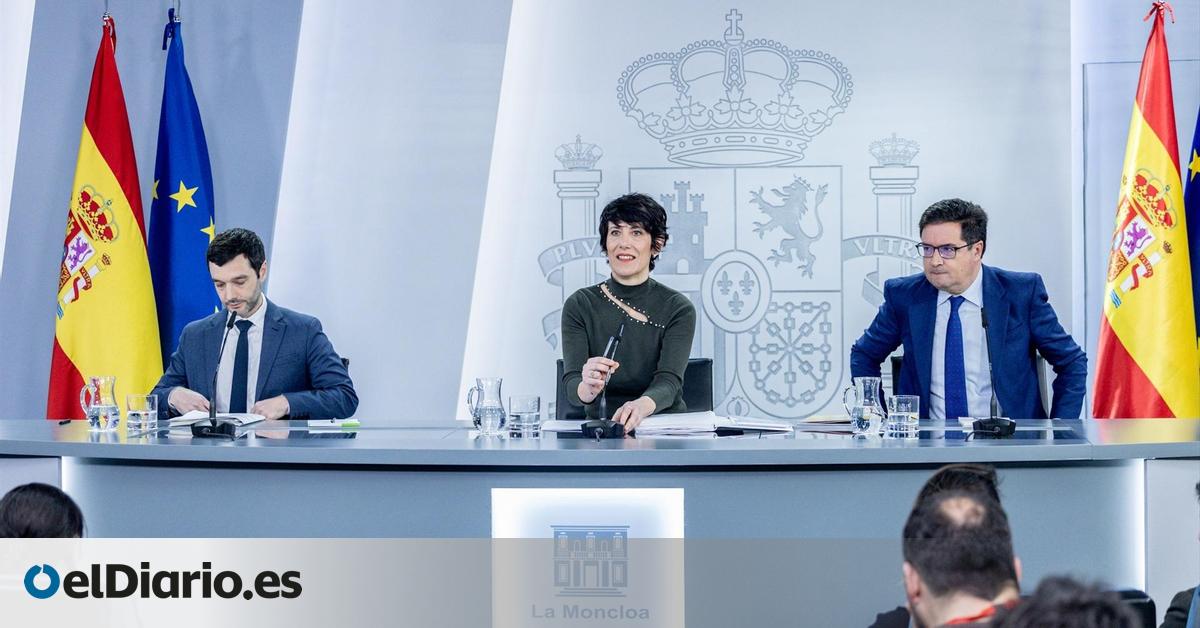
Green light for the declassification of 23F documents. The Council of Ministers has approved this decision announced on Monday by Pedro Sánchez so that the memory is not “under lock and key” and which will become effective on Wednesday, when the BOE publishes the authorization. The 153 “documentary units” that have been found in the Administration about the failed coup d’état will be published starting at noon on the Moncloa website. One of the reasons that Moncloa gives for carrying out this measure now is to battle with the narrative of the extreme right and “avoid conspiracies and manipulations that some use to write a parallel reality.”
“What the Government is doing with this decision is to prevent the extreme right from continuing to use hoaxes, conspiracies, and misinformation to spread theories that our democracy does not deserve and also to misinform young people, kids who think that life was better with Franco and who are singing in the face of the sun in our streets,” said the spokesperson, Elma Saiz.
“For the Franco regime in our country everything was secret by default and forever if the opposite is not said. That is what we do today with 23F. We thus end with an atypical situation in modern democracies regarding the declassification of State information,” said the Government spokesperson, Elma Saiz, who gave as an example the publication carried out in Germany in 2012, in Italy in 2016 or in Greece in 2024 about the coup d’état in Cyprus. In the case of Spain, the bulk of the documents are written and some images, although in Moncloa they believe that there are no recordings.
“The past is not the past, it is a dimension of the present and a full democracy must have access to that dimension,” said the spokesperson, paraphrasing the writer Javier Cercas in ‘Anatomía de un Instante’. “The years since the attempted coup d’état, whose perpetrators were convicted of a crime of military rebellion, do not represent a real and present risk,” Saiz pointed out. The Government maintains that the information will not pose a risk to national security.
However, the spokesperson has avoided commenting on whether the publication will change the image of King Juan Carlos I’s actions during the coup attempt. In any case, Moncloa notified Casa Real of the decision in advance, although not with much advance notice.
“This measure will allow all the documentation that has been found so far to be declassified,” Saiz stated about the information that is in the hands of the ministries of the Interior, Defense and Foreign Affairs. In Moncloa they do not have an estimate of how many thousands of pages there will be. “There are 153 documentary units that for decades have remained classified under Francoist regulations, but that can now be consulted, can be consulted by historians, by researchers and by the citizens themselves through official channels,” continued Saiz, who recalled that the decision comes when 45 years have passed since the coup attempt. This is the threshold established by the Government in the proposal to reform the law on official secrets, which dates back to 1968.
However, that rule, which would allow the automatic declassification of classified or secret information, is stuck in Congress. “We now hope that the Classified Information Law project can move forward in Congress so that decisions like this cease to be an exception and become the norm,” said the spokesperson.
Despite the ideological symbolism of the decision, it is insufficient for the coalition partners, who demand more ambition and that materials related to other passages from the country’s recent past, such as the GAL, be declassified. Among the claims, there are events prior to 1981, which is the 45-year threshold to which the Government refers to justify the declassification of the 23F documents.
Limit on institutional advertising
The Council of Ministers has also approved the Draft Law on Institutional Advertising with which it will put a limit, in line with European regulations, on public financing of the media and also new digital platforms.
The rule, which still has to go through the second round and Parliament, establishes a limit of 35% of income from institutional advertising. “A media outlet that has 50%, 60% or 70% funding from the public sector is not a media outlet, it will be something else,” defended the Minister of Digital Transformation, Óscar López. What the rule includes is a “safeguard” for local media since it will be applied from two million euros in turnover.
The new regulations also aim to comply with the EU regulation that obliges the media to publish who their owners are to guarantee informational independence. The media will have to register and in that registry (CNMC in the future) appear who their owners and shareholders are.
Source: www.eldiario.es