Marked by asymmetry between agriculture and industry, the treaty began to be seen by South Americans less as an economic engine and more as a strategic instrument of autonomy in the midst of the dispute between great powers.
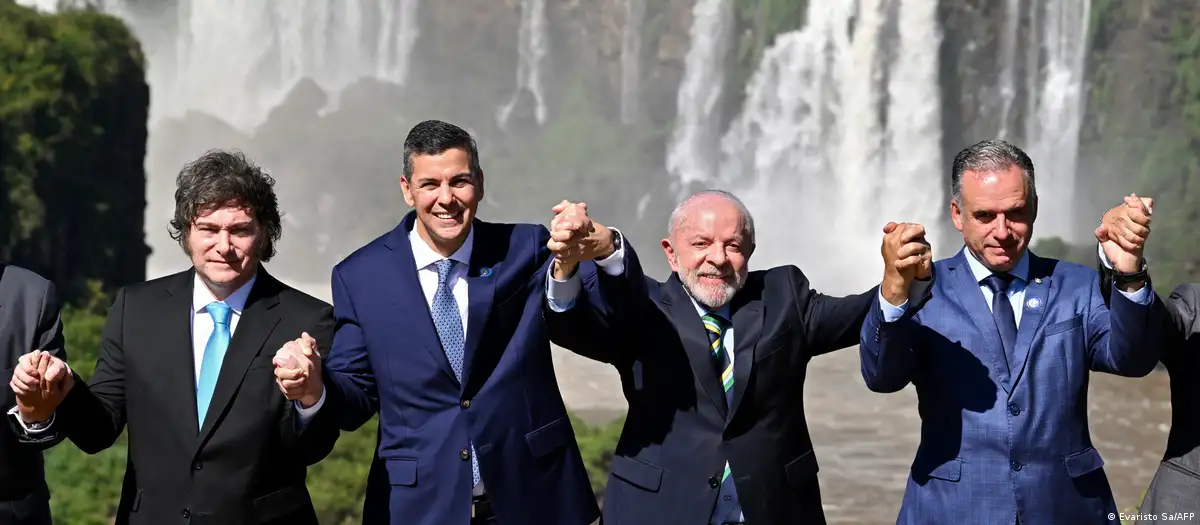
The assessment of the free trade agreement between the European Union and Mercosur countries has changed profoundly in South America in recent months. It is no longer the economic importance that is at the center of the debates, but the geopolitical dimension. South Americans began to perceive the agreement, to be signed this Saturday in the Paraguayan capital, Asunción, above all as an opportunity to reposition themselves in a rapidly changing world.
The person mainly responsible for this is Donald Trump. The president of the United States arbitrarily increases tariffs, withdraws the US from international organizations, demands access to the natural resources of other nations and interferes in their internal policies, as in the case of Brazil. Faced with this situation, the European Union and Brazil, Argentina, Uruguay and Paraguay decided to follow the opposite path: focusing on cooperation, rules and predictability.
That the agreement is “historic above all due to its geopolitical importance” was the conclusion of the Minister of Finance, Fernando Haddad. The world should not allow itself to be drawn into tensions between the great powers.
Concern about growing US interventionism
Political analyst Thomas Traumann believes that Trump’s economic chauvinism even ended up accelerating the conclusion of the EU–Mercosur agreement. On both sides of the Atlantic, it would have been clear how important it is to find new partners and put aside old concerns.
For Mercosur, the agreement also has a clear security dimension. The US military intervention in Venezuela and Trump’s military threats against Cuba, Colombia, Mexico and other countries are interpreted as a sign that Washington is ready to dominate the hemisphere at will.
Especially for Brazil, which traditionally defends principles such as sovereignty and non-intervention, the agreement gives more international weight to the South American bloc, in addition to strengthening it internally. Uruguay’s Minister of Foreign Affairs, Mario Lubetkin, speaks of a “leap in quality” for the entire region.
Political scientist Oliver Stuenkel understands the treaty as a visionary decision. “Europe and South America have expanded their strategic options,” he tells DW, showing that it is still possible to sign agreements based on rules. EU and Mercosur reject coercion, arbitrariness and the law of the strongest.
Brazil treats agreement as a security issue amid US pressure | Mauro Pimentel/AFP
Strategic raw materials
For Brazil, the agreement is historic, emphasizes Stuenkel. It allows the integration of Brazilian industry into global value chains and brings the country’s rare earths into the spotlight.
Brazil holds around 20% of the world’s reserves of critical minerals, necessary for the production of batteries, semiconductors, energy technologies and modern weapons. At a time of growing dependence on China, which to this day has an almost monopoly on these minerals, the treaty positions Brazil as a relevant actor in this market.
Furthermore, the agreement would make South America as a whole more attractive and give it more weight in future trade agreements, Stuenkel believes.
From a purely economic point of view, however, the signed text reveals how asymmetrical the interests between the EU and Mercosur are. While South Americans gain space to sell agricultural products, Europe benefits from reduced taxes on industrial goods, such as machinery, automobiles, chemical and pharmaceutical products.
A study by the European arm of Fundação Getulio Vargas (FGV) indicated that there is a risk of the agreement being interpreted as a growth engine for South America. “There is a danger that Mercosur countries will become trapped in the role of suppliers of poorly processed goods”, says Mariana Fleischhauer, one of the study’s authors.
“At the same time, local industries are under pressure due to strong European competition.” According to her, Mercosur governments could only face this through an active industrial policy.
Low economic effects
The EU-Mercosur agreement should not be overestimated from an economic point of view either, Fleischhauer tells DW.
The positive effects would be more in the stabilization of prices and better margins than in the actual increase in export volumes. FGV calculates long-term increases in Mercosur GDP of just 0.3% to 0.5%, which should be driven by the smaller countries, Uruguay and Paraguay.
On the other hand, trade with the EU offers greater political predictability than trade with the US and less volatility than trade with China, but its overall macroeconomic effects remain, for now, limited.
Therefore, it is natural that geopolitical aspects dominate the current discussion about the agreement. The new US National Security Strategy, which defines Latin America as Washington’s zone of influence, as well as China’s white paper on Latin America, in which Beijing formulates power ambitions in the region for the first time, have increased fears that South American countries will be trapped between the two great powers. With the EU–Mercosur agreement, South America now has an alternative.
Excessive expectations?
José Augusto Fontoura Costa, head of the International Law department at the University of São Paulo (USP), questions expectations about the agreement. “This is an attempt to contain the disintegration of international standards and the institutional bases of trade,” Fontoura Costa told DW. “But, by itself, it is not capable of reversing the general erosion of institutions nor of restoring Europe’s former role in relations with South America.”
In the case of Brazil, the treaty will hardly be enough to break development structures based on commodity exports and reduce dependence on China and the United States, he says.
The Secretary of Foreign Trade of the Ministry of Development, Industry and Commerce of Brazil, Tatiana Prazeres, on the other hand, highlights a different aspect. For her, the country’s broader strategy is to expand Mercosur’s network of trade agreements globally.
In recent years, partnerships have been established with Singapore and EFTA, made up of Norway, Switzerland, Iceland and Liechtenstein, for example. “We are currently working on an agreement with the United Arab Emirates and expanding the agreement with India. We are also in intense negotiations with Vietnam, Indonesia and Canada,” he tells DW.
It is clear that the EU-Mercosur agreement is, for South America, much more than a simple free trade agreement. Political scientist Stuenkel describes it as an “instrument for expanding strategic autonomy” in a world in which great powers seek hegemony. Keeping options open is, according to him, the best thing South America can do at the moment.
Originally published by DW on 01/17/2026
By Philipp Lichterbeck
Source: https://www.ocafezinho.com/2026/01/17/a-guinada-geopolitica-do-acordo-ue-mercosul/