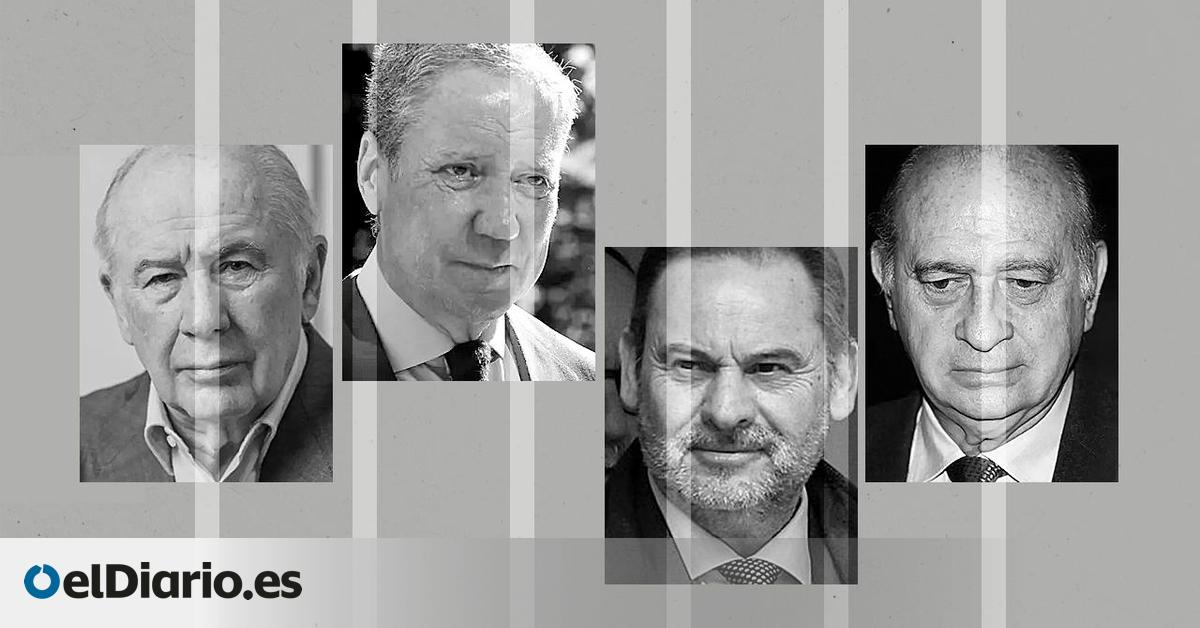
The new judicial year will be decisive for several former ministers and senior officials linked to the PP and the PSOE who face imminent resolutions and trials that could end with prison sentences. The Supreme Court must rule on the appeals presented by former political officials, while corruption cases ranging from the irregular use of public money to espionage plots and influence peddling will be prosecuted.
The trial is scheduled for the first months of 2026 against the former socialist minister José Luis Ábalos, who was his advisor Koldo García, and the businessman Víctor de Aldama in the part of the case focused on the pandemic mask contracts awarded by hand by the Ministry of Transportation. The first two, who have been in provisional prison since last November, face sentences of up to thirty years in prison.
Although he has been out of the Government since 2021 and was expelled from the PSOE last June, Ábalos was a key figure in the rise of Pedro Sánchez: minister, Secretary of Organization of the PSOE and man of maximum confidence of the President of the Government. It was he who defended in Congress the motion of censure that managed to remove Mariano Rajoy’s PP from the Moncloa Palace in 2018 precisely with a speech based on democratic regeneration and the fight against corruption.
His image in the dock accused of favoring the commission agent Aldama in exchange for bribes and other perks will be a hard blow for the Government, which will have to face the trial sessions while new revelations come to light from the other part of the case, the one focused on the alleged rigging in public works awards and in which Santos Cerdán, who replaced Ábalos in the Organization Secretariat of the PSOE and who spent almost five months in preventive detention, is also being investigated.
Ábalos has been in the same situation since last November. After the trial, it is foreseeable that the sentence will arrive in the summer, which will be final as it is from the Supreme Court, which predicts that he will spend a long time in prison waiting for the progress of the rest of the procedures that are open. In this hearing, his relationship with the businessman Aldama, the “corrupting nexus”, according to the Civil Guard, will be substantiated in exchange for commissions, and the mask contracts that two entities dependent on his department – Adif and Puertos del Estado – will also be analyzed to the company of the plot along with the hiring of one of his alleged ex-partners in public companies.
The dirty war of the PP returns
More than a decade has had to pass for other events to be judged that, however, bring back to the present day one of the darkest episodes of recent democracy. In April the oral hearing for Kitchen will begin, the operation orchestrated by the Government of Mariano Rajoy to sabotage the most serious case of corruption in the history of the Popular Party, that of its irregular financing or box B.
On the bench will sit the police commanders who made up the political brigade that the PP orchestrated when it came to power in 2012 to attack first the Catalan independentists and then Podemos. In between, all of them allegedly participated in a maneuver to make the evidence kept by the former treasurer of the PP Luis Bárcenas disappear and that could incriminate the party and its leaders in the case opened for illegal financing.
The longest prison sentences requested by the Anti-Corruption Prosecutor’s Office are for the former operational head of these police officers, Commissioner Eugenio Pino, and for the top political officials of the Ministry of the Interior, its head, Jorge Fernández Díaz, and the Secretary of State for Security, Francisco Martínez. For the three, Anticorruption requests 15 years in prison. The last time an Interior Minister sat on the bench was for the state terrorism of the GAL during the Government of Felipe González. As then, now the alleged crimes of Operation Kitchen were paid for with public money from reserved funds.
The hearing will begin on April 6 and will last until the end of May. Former President Rajoy and his deputies in the Government, Soraya Sáenz de Santamaría, and in the party, María Dolores de Cospedal, will appear as witnesses, for whom the current judge in the case must decide soon whether to change her situation to accused in view of new revelations and a request from the PSOE. Among the police officers tried will be the former commissioner Villarejo, the former Bárcenas driver Sergio Ríos and José Luis Olivera, recently current for his participation in the setup against Miguel Urbán and Podemos.
The corruption of the Madrid PP, 12 years later
The piece ‘Waiter Music’ from the Púnica case alludes to even older events, which will put the former secretary general of the PP in the Community of Madrid and former Minister of Justice Francisco Granados on the bench as of January 19. In October, the macro case of corruption against the Madrid PP of Esperanza Aguirre turned 11 years since the first arrests took place and there are still several trials to be held.
The Anti-Corruption Prosecutor’s Office requests in this case for Granados six years in prison for two crimes of fraud in contracting and as many of prevarication. The man who was Esperanza Aguirre’s right-hand man was already sentenced to two years in prison in another part of the case, due to a tip from a civil guard when he was being investigated. Granados would have maneuvered so that several PP town councils and a regional entity would hire Waiter Music at local parties, the company of his friend José Luis Huerta who will not be tried because he died in 2020.
Along with Granados, former senator and former regional deputy David Erguido, who also served as an advisor to Esperanza Aguirre, and eleven more people will sit on the bench, including six mayors of the Popular Party when the power of the party in the Madrid region was already omnipresent. These are the former mayors of Valdemoro José Carlos Boza and José Miguel Moreno; the former councilors of Móstoles Esteban Parro and Daniel Ortiz; the former mayor of Ciempozuelos María Ángeles Herrera, and the mayor of Moraleja de Enmedio Carlos Alberto Estrada.
The former mayors face requests for two years in prison or simply disqualification by Anti-Corruption. However, the popular prosecution, carried out by Adade, requests sentences of between 13 and 27 years in prison for some.
Sánchez’s brother, on the bench
As is the case with the agility in the Supreme Court when it comes to judging Ábalos, the trial against Pedro Sánchez’s brother will not last as long in the Badajoz Provincial Court. 11 people will sit on the bench after the case instructor concluded that the Badajoz Provincial Council created the position of head of the conservatories for David Sánchez to occupy and that he appeared for the selection process and the interview “to simulate the formal legality of the procedure.”
The socialist candidate for the Junta de Extremadura in the last elections, José Miguel Gallardo, was prosecuted because Judge Beatriz Biedma concluded that it is “implausible” that, as president of the Provincial Council, he did not know that the purpose of the creation of the position was for it to fall to Pedro Sánchez’s brother, since it was “generally known.” He also accused him of having participated “directly” in the events by having the authority to appoint him. Gallardo has resigned from his position as general secretary of the Extremaduran PSOE after having achieved the worst result in history in the autonomous community.
A complaint from Clean Hands that included false information gave rise to the procedure. The ultra pseudo-union requests 3 years in prison for David Sánchez for continued crimes of influence peddling, administrative prevarication and illegal appointment. The Prosecutor’s Office says that the judge’s indictment is riddled with “conjectures” and requests acquittal for all the accused.
Aznar’s ministers
In the coming months, two heavyweights of the Government of José María Aznar risk going to prison. The Supreme Court will decide on the appeals to the sentence imposed by the Provincial Court of Madrid against Rodrigo Rato in the case of his personal fortune. The court sentenced the former vice president of the Government to 4 years and 9 months in prison for tax fraud, money laundering and corruption between individuals, for hiding assets abroad. The Supreme Court has already confirmed the sentence of four and a half years in prison against Rato for the ‘black cards’, a reason for which he has already served his prison sentence.
For his part, Eduardo Zaplana faces serving ten years and five months in prison for the crimes to which the Fourth Section of the Valencia Court sentenced him: prevarication, bribery, falsehood and money laundering. The court also imposed a fine of more than 25 million euros on him as responsible for collecting bribes between 1997 and 2000, when he held the position of regional president in a scheme to award service stations for technical vehicle inspections (ITV). Zaplana, who was prevented from going to prison in the past by controversial medical reports on his state of health, could go to prison if the Supreme Court confirms the sentence of the Provincial Court.
Source: www.eldiario.es