After several weeks of expectation surrounding the conversation between Gabriel Rufián and Emilio Delgado, the event that exceeded expectations and brought together hundreds of people was the one called this Saturday by the main parties of the alternative left. An unexpected line of people arrived from the Círculo de Bellas Artes in Madrid to Puerta del Sol despite the fact that it was a launch initially designed more inward, to repair the wounds between political organizations and present something new, rather than towards the progressive electorate.
This Saturday’s event, ‘Un paso al front’, sought to be the public presentation of the discreet work that the four groups of what is now Sumar in the Government have been carrying out for months. The conversations began to take place in a much more profound way following the crisis of the Executive with the Santos Cerdán case: the need to agree on a strategy and coordinated responses laid the groundwork for a dialogue structure between these four organizations that had surprisingly not been able to occur in the first two years of the legislature.
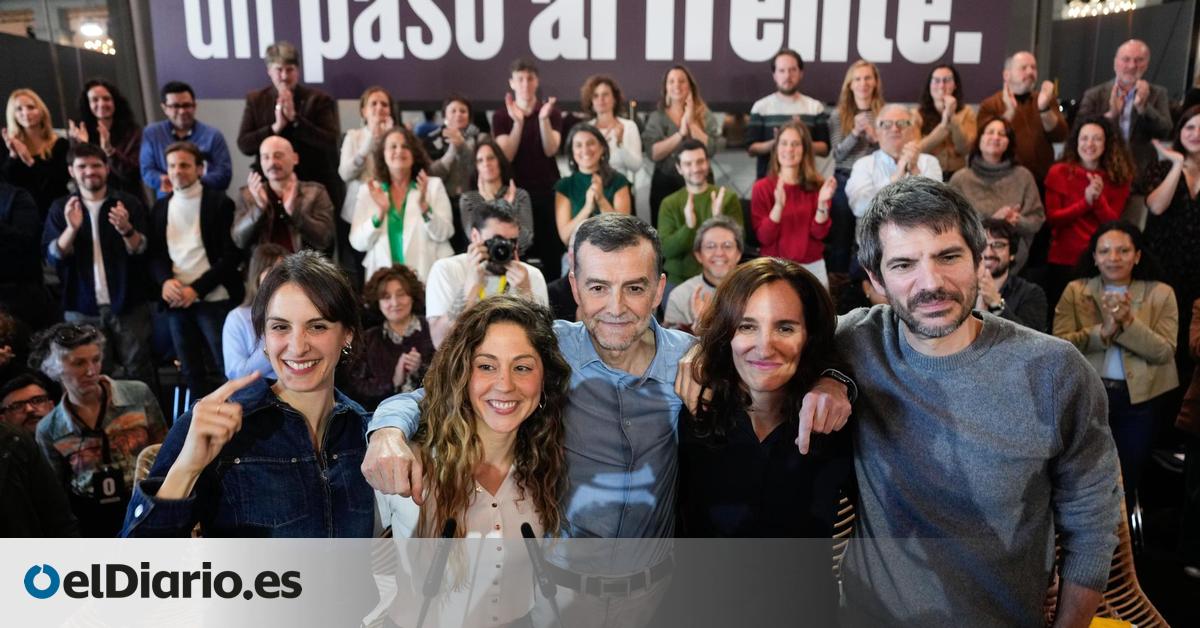
The novelty was that this space spoke, that formal conversations, work structures, decision-making groups at different levels were generated and finally the willingness of these four organizations to present themselves in the same candidacy, something that was not assured after the subtle calls from Podemos to Izquierda Unida and Comuns to reissue the coalition of the previous legislature. “This is irreversible,” Antonio Maíllo, leader of IU, said this Saturday, amid the applause of his stage companions: Lara Hernández, from Movimiento Sumar, the Minister of Culture, Ernest Urtasun, the leader of Más Madrid and Minister of Health, Mónica García, and her party colleague Rita Maestre, who was in charge of presenting the event.
The staging has a lot to do with the work of these months: four interventions without leaders that stood out above the others and that also exhibited coordination in the discursive aspect despite the fact that according to the sources consulted, only a few lines had been agreed upon, for example, that the ministers focused more on the task of Government and the party leaders spoke about the more political areas. Although all the speeches were finally loaded with ideological content at a time when certain sectors of the left are beginning to question the themes and forms of the progressive space.
That “corality” is in itself a novelty in the coming stage and was enabled by the absence of Yolanda Díaz, who has decided at this moment to step aside to give prominence to the matches. Only Mónica García made a reference to the one who was Sumar’s candidate in the last elections and has been the leader of the space until now. The Minister of Labor has a personal reflection ahead of her about her political future, which inevitably involves clarifying whether she wants to once again aspire to the new front that is beginning to take shape publicly today.
“A cohesion has been seen in the speeches. It has given the image of a solid thing, which reflects the months and months of work,” reflects a leader of that political space on the idea that what was shown this Saturday on stage is the result of virtuous work between organizations that until not so long ago functioned in a logic of competition rather than organically despite sharing a parliamentary group and the Government.
Beyond the political discourse and the impact that the step taken by Rufián and Delgado has had on the left, this Saturday’s event was marked by the explicit commitment of four different parties to walk together and do so in a coordinated manner. “The debate may be how we build unity, but unity itself is no longer a reason for debate in this space, because unity is a popular mandate and that is sacred,” said Maíllo, who added: “Not even the most optimistic could think of this act of overflow. It seems that there are frameworks that invite melancholy. The melancholy on the left has ended and a stage of government ambition, dispute and cultural war begins.”
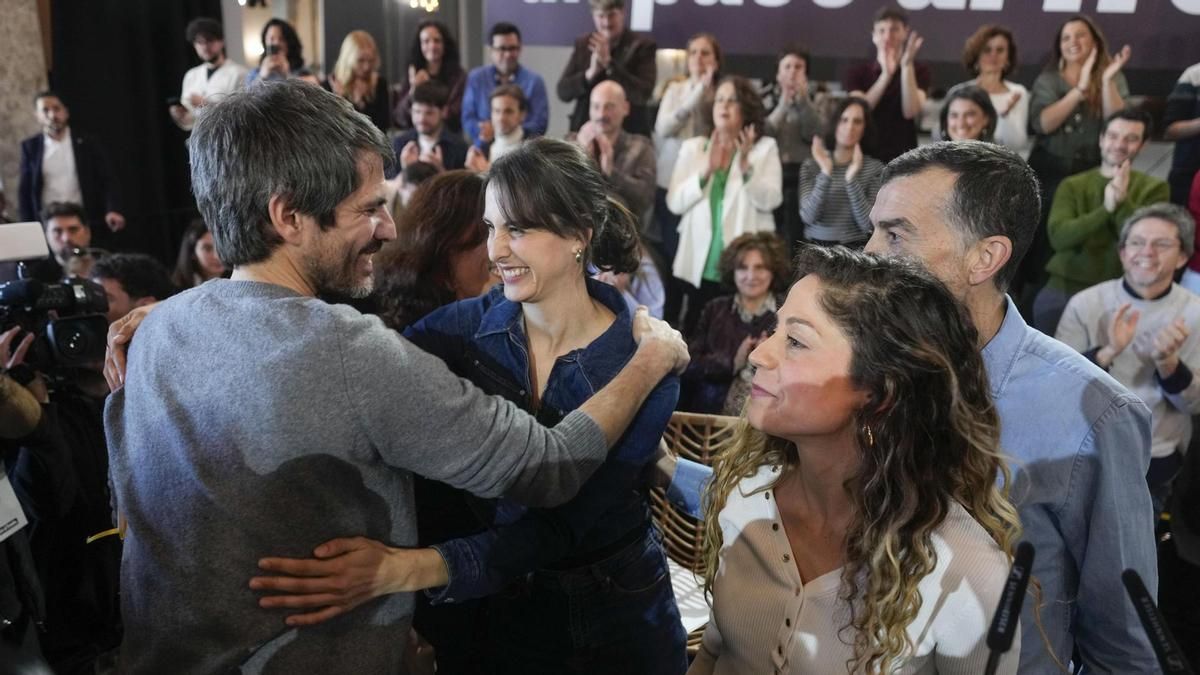
During all the interventions of the political leaders of the left, there were allusions to that alliance and the promise that tensions and fratricidal wars were left behind. Something that was staged even in the messages intertwined between the two most ideologically distant forces, Izquierda Unida and Más Madrid. A harmony that has been strengthened in these months of work to build the future alliance, according to sources familiar with these conversations. As an example, the effusive applause of Eduardo Fernández Rubiño during Antonio Maíllo’s speech.
“We want more fraternity, more trust, more unity. This is the common house of the left and we are building it from the foundations. But the doors are open,” said the Minister of Health and leader of Más Madrid, Mónica García. The coordinator of Movimiento Sumar, Lara Hernández, appealed to the path taken to build the future on the successes achieved but also on the errors. “We must learn from our mistakes to never repeat them again. We must take stock. A balance that inoculates us from not listening to each other, from not closing ourselves in, from valuing consensus over dissent and from strengthening community ties,” he added.
The main background of all the speeches was precisely that. That faced with the challenge of once again being able to stop the rise of the extreme right and prevent its entry into the Government and the citizen demand for unity, there is already a project of different political forces conspired to go hand in hand that also appeals to those who are still outside. “We are collective work, we are an alliance to fight the most important battle of the century. And we hope that many more people join and that we learn from the past. In 2023 we did what we could, a coalition in a hurry and running that was capable of preserving one of the few progressive governments in Europe. And now we are here to do even better.”
“Thanks to Gabriel, thanks to Emilio”
At this Saturday’s event there were many references, some explicit, some not so much, to the approach outlined in recent weeks by Gabriel Rufián for an alliance of the left that in some way incorporates the pro-independence forces. The event that he convened with the leader of Más Madrid Emilio Delgado in the Galileo room initially blurred the launch of this coalition, but as the days went by the parties have tried to reinterpret these movements to use them in a virtuous way. “We need every voice, every energy, every progressive atom in all spaces. On social networks and in gatherings, in debate spaces and door-to-door, in the Government and in the BOE. Everywhere,” said Mónica García in her speech.
It was a conciliatory gesture after a complicated week in which Emilio Delgado, who has threatened in recent months with aspiring to run in a primary to be the Más Madrid candidate against Isabel Díaz Ayuso, has gained a lot of media relevance. The move to launch an event with Rufián, which was also interpreted by some sectors as the beginning of a broader political platform, felt very bad in his party.
It does not seem that this is going to be the case, as evidenced by Wednesday’s talk between the two in which Rufián focused on the electoral formulas and Delgado more on the discursive. Precisely in recent days, his interviews and interventions at the event have opened a conversation about whether the left is speaking in the correct way about certain issues such as immigration or LGTBI. And at this Saturday’s event there were many responses.
“We are here to listen, because there is a lot of conversation inside and a lot of conversation outside. No one is going to make a mistake by covering their ears. We are here to understand the discomfort, to look for solutions, to direct our gaze to the right place, which is above and not to the side,” said Rita Maestre in her first words, in the presentation of the rest of the leaders. Among the audience was Delgado, with his closest team in the game.
“We have to be everywhere, in the neighborhoods. We welcome any contribution, any reflection that helps us to be better. Thanks to Gabriel, thanks to Emilio for the act the other day. And thanks to all of you who have worked on this act. This is the common house on the left. We are building the house from the foundations. The doors are open,” said García. Social movements and also unions were present at the launch of this new alliance. Unai Sordo, from CCOO, and Pepe Álvarez, from UGT. And some important faces of the left were seen in the last decade, such as Ada Colau, Alberto Garzón or Nacho Álvarez.
Urtasun also criticized the messages about the discursive turn of the left on issues such as immigration. “You don’t fight the extreme right with the glasses of looking at the reality of the extreme right, you beat them where they are weak, you beat them by saying that they sell countries, that they always defend the strong against the weak,” he said.
But there was also a response to the Republican leader’s idea to optimize the electoral system with broad candidacies from the pro-independence and pro-sovereignty left. “Arithmetic is very necessary, but elections are not won with electoral sociology alone, they are won with a winning project, which is what we have done so far. Govern well for the majority for the remainder of the legislature,” he defended. Urtasun also claimed that precisely what Rufián proposes is part of the work done by Sumar on 23J, a very broad union of the left that allowed the coalition government to be revalidated.
In the midst of an atmosphere of defeat due to the latest electoral calls, the polls and the rise of the extreme right, this Saturday’s event largely became something similar to a boost of self-esteem after the wake-up call that the step taken by Rufián and Delgado represented for the left. “We come to get rid of the pessimism, we come to recover self-esteem, hope and joy. Let’s shake off the dark cloud and pessimism. Enough of defeatism. We are not a cup of Mr. Wonderful, but we are not going to make a mess of the extreme right,” Mónica García concluded.
All the leaders consulted at the end of the event admit that this Saturday’s event exceeded everyone’s expectations, including the organizers. Despite setting up a second annex room to accommodate part of the gathered public, hundreds of people remained on the street due to lack of space and after forming a long queue early in the morning that was lost along Alcalá Street until reaching the vicinity of Puerta del Sol.
Source: www.eldiario.es