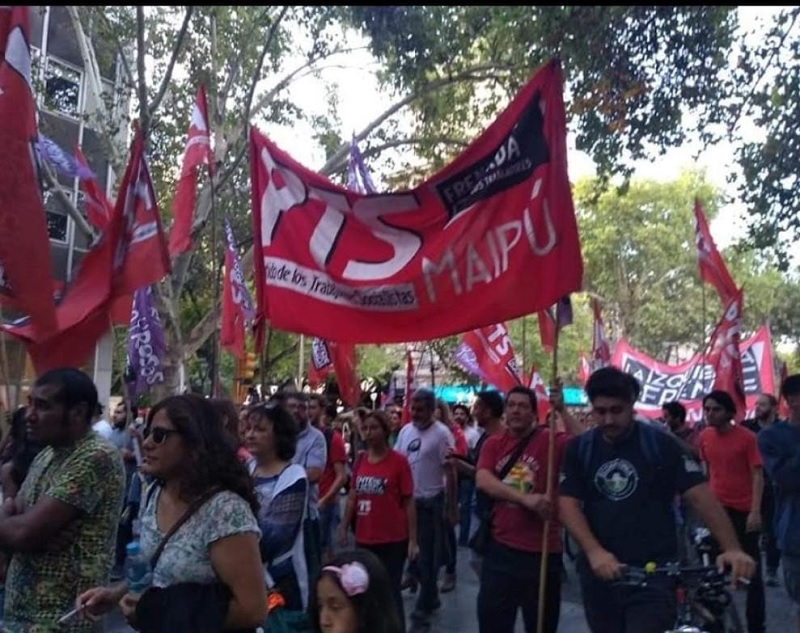
In a context of widespread price increases, salaries that are not enough and a development model that privileges corporate business over people’s lives, Maipú returns to the elections this February 22. A group of candidates for councilors present a platform that openly declares: “Maipú is not a sacrifice zone.”
The phrase seeks to capitalize on the fight they have carried out in the streets in defense of water, although it is not the only battle they have fought; they have also mobilized for the disability law and in defense of free, quality public education.
The candidates present a clear rejection of the policies of the national and provincial governments. “For Milei and Cornejo, Mendoza, our land and its people are a zone of sacrifice: they give away our common goods to extractivism and try to impose a slave labor reform,” they point out from the Frente de Izquierda Unidad. But the criticism also points to the Peronism that has governed the municipality uninterruptedly since the return to democracy: “The PJ has governed for decades and is, to say the least, complicit,” they point out.
What are they complicit in? The candidates point to the heart of a problem repeatedly denounced: the “territorial planning” that serves speculators. In “the cradle of the olive tree,” they authorize private luxury neighborhoods that remain empty, destroying hectares of historic olive trees, while ignoring the urgent needs of working-class neighborhoods. Something that we have been consistently denouncing and confronting
“There is a lack of gardens and spaces designed for older adults; transportation is expensive and inefficient, mental health collapses and there are no plans to access housing for the working class,” they list.
Faced with this panorama, the electoral proposal is presented as the tool to “take the fight to the Council.”
“The money has to come from there”: Concrete Proposals and Financing
The axis of the campaign is that the resources to improve life in Maipú exist but there is no political will to put them at the service of improving the lives of the residents of the department. “There are millions of taxes and fees that are forgiven to real estate companies and private neighborhoods, for which there are works and investment,” they say. “There are no cracks for that: Peronists, radicals and liberals join hands to take care of the business of the speculators.”
From this premise arise its three axes of proposals.
1. Decent Work, Not Precariousness: Total rejection of labor reform. They propose an emergency increase and a move to permanent employment for all municipal workers, financed with taxes on private neighborhoods. In addition, they promote the creation of free municipal public transportation that links all districts with efficient frequencies and routes.
2. For the Right to Care and Be Care: They propose a network of Kindergartens (kindergartens and infants) and Playgrounds in all districts, with low enrollment per room and teacher salaries that cover the family basket. They add the extension of birth licenses, the creation of free Day Centers for Seniors and a “Support Networks” program with support for parenting and mental health in health centers.
3. Water for Life, Not for Looting: In line with Mendoza’s historic struggles and complaints of contamination in productive areas, they propose an Anti-Extractivist Ordinance that prohibits polluting activities. They demand the immediate remediation of the areas already affected by oil activity and declare a Water Emergency, prioritizing water for human consumption and local production.
“You know us. We were in every march for water, for education and our rights and we always defended the rights of workers, women and youth.”
The candidates seek to capitalize on a history of mobilization. “We were in every march for water, for education and our rights,” they emphasize, in clear reference to the struggles that have marked the province. The final call is to organize and vote: “This February 22, we need your vote to win seats in the Deliberative Council and strengthen the struggle. Join so that there is a seat for working people, youth and women in the Council.”
The PTS integrates the List, together with the PO and the MST, with Veronica Paizsecondary and higher education teacher and Valentino Tupac Collettiyoung worker and Nursing student at CECIT.
With this platform, the Left Front Unity puts the dispute over the department model at the center of the electoral debate: one based on speculation and extractivism, or one that prioritizes decent work, the care of life and the defense of common goods.
Source: www.laizquierdadiario.com