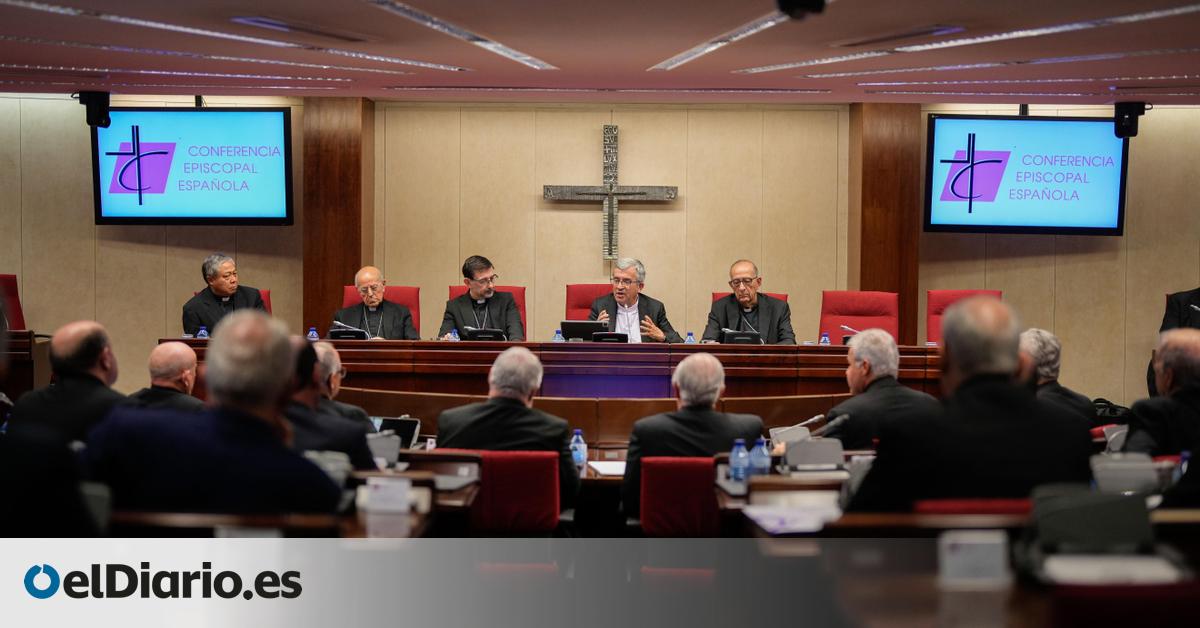
“In case we were not few, the bishops gave birth.” A prominent socialist leader this week pointed out his discomfort at the growing prominence of some officials of the Episcopal Conference, fueling tension and launching messages against the Government, which break the traditional neutrality that the Catholic Church has been presumed to have since the Transition.
And, as members of the Government privately confess, “it seems that the Church has once again recovered the banners against the PSOE that they brandished twenty years ago”, in reference to the demonstrations that took place during the first term of José Luis Rodríguez Zapatero, with twenty prelates in the front row, protesting against Education for Citizenship, equal marriage or promoting the sadly famous ‘masses in Colón’ on the last weekend of December, which became authentic rallies commanded by the bishops against the Government and which, since the retirement of Cardinal Rouco Varela, have not been repeated. At least, organized by the diocese of Madrid.
Los Rosaries of Ferrazthe rallies ‘to pray’ in front of clinics that perform abortions, the advertising campaigns of Hazte Oír or the judicial pressure against Pedro Sánchez from Abogados Cristianos are just a sign that, at least in some sacristies, José María Aznar’s ‘Whoever can do, let him do’ is being fulfilled point by point.

Because the truth is that, from Añastro Street, headquarters of the Spanish Episcopal Conference (CEE), a growing radicalization of the discourse can be observed, which has its roots in the dialectic of its president, Luis Argüello. Last week, in the middle of the electoral campaign in Extremadura, the archbishop of Valladolid once again took the stand (it was the second time in a few months) with statements to La Vanguardia in which he called for “a question of confidence, a motion of censure or giving the citizens the floor. That is, what the Constitution provides for” in the face of the current institutional crisis. Some words that were answered by Pedro Sánchez himself, who encouraged Argüello to run in the elections with Christian Lawyers, and reminded him that the time when bishops influenced political decisions ended with the death of the dictator.
The reflections of Argüello – who according to those close to him “has the sin of the intellectual, he wants to be understood in all its nuances, and that, today, is impossible” – add to a dynamic of confrontation that, for some time, bishops such as Ignacio Munilla or Jesús Sanz have led. A fight against the Government in which these bishops from the most radical sector have the support of Hazte Oír and its satellites, organizations that different investigations link directly with secret associations such as El Yunque, and with the strategy of the extreme right worldwide to change the international political order (MAGA, Milei, Bolsonaro, Orban or Le Pen) in which ‘Catholic’ members of Vox and institutions such as the Catholic Association of Propagandists or the ISSEP collaborate.
The archbishop of Oviedo has criticized the “moral decadence” of the Government of “saunas and brothels.” The one from Valencia has invited Sánchez to reflect because “the purpose of politics is not only to stay in power
Because Argüello is not the only one. Thus, the archbishop of Oviedo, Jesús Sanz, took advantage of the criticism of the president of the Episcopal Conference to launch a harsh diatribe against the “moral decadence” of the Government of “saunas and brothels.” “They are finished. Luis Argüello says it right: turn the page, now,” perpetrated the Oviedo prelate, who for years has ‘given up’ the Covadonga basilica for the symbolic opening of the electoral campaign of Santiago Abascal and his obsession with the ‘Reconquest for God’ of Spain. On the eve of Christmas Eve, the Archbishop of Valencia, Enrique Benavent, in statements to À Punt, stated that “when an element of instability is introduced into political life in those who have responsibility for the government, we must think that the common good that political activity aims not only to remain in power, but also to progress society”, inviting Pedro Sánchez to “reflect” on his future.
The dissenting voices
Not all bishops are in that line. What’s more, for the first time in quite some time, the ‘contest’ within the EEC to the words has been growing, with calls for “prudence” and the role of the Church as a moderator of social dialogue, and not as a political actor. This is how we must read the recent statements of the cardinal of Madrid and vice president of the Episcopal Conference, José Cobo, who at the COPE microphones pointed out that “the Church has to be prudent in this difficult moment,” adding that “there are Catholics in all parties and tendencies.”
Cobo, who served as mediator and interlocutor in the historic agreement between the Government and the Holy See for the resignation of Cuelgamuros (which is why he has suffered insults and personal attacks, leading to an ‘escrache’ at the doors of the bishops’ headquarters), stressed that the mission of the Church is to “accompany to recover ethics, consensus, without dwelling on how to do things, that is the political game,” in the face of groups that “They live Catholic, without being Catholic,” in a clear reference to the ecclesial extreme right groups, directly linked to Vox and its related movements.
Similarly, the archbishop of Tarragona, Joan Planellas, called for “prudence” from Argüello, warning of “the ideologization of Christianity” in policies such as hatred of migrants or interference in partisan politics. The cardinal of Barcelona, Juan José Omella, demanded “less confrontation, more fraternity and more justice.”
For his part, the new bishop of Malaga, José Antonio Satué, asked for “humility and moderation” in the face of the “quagmire” of current politics. “We bishops are pastors of everyone, those on the left, those on the right, those in the center,” he warned. The bishop of Ciudad Real, Abilio Martínez Varea, although defending the freedom of the president of the EEC to give his opinion in the public sphere, did ask for “understanding and consensus” in the face of political confrontation. From Rome, unofficially, there has also been a request to lower the tone of the controversy, especially when, as elDiario.es previously reported, Leo XIV is finalizing what will be his first trip to Spain.
All the information at www.religiondigital.org
Source: www.eldiario.es