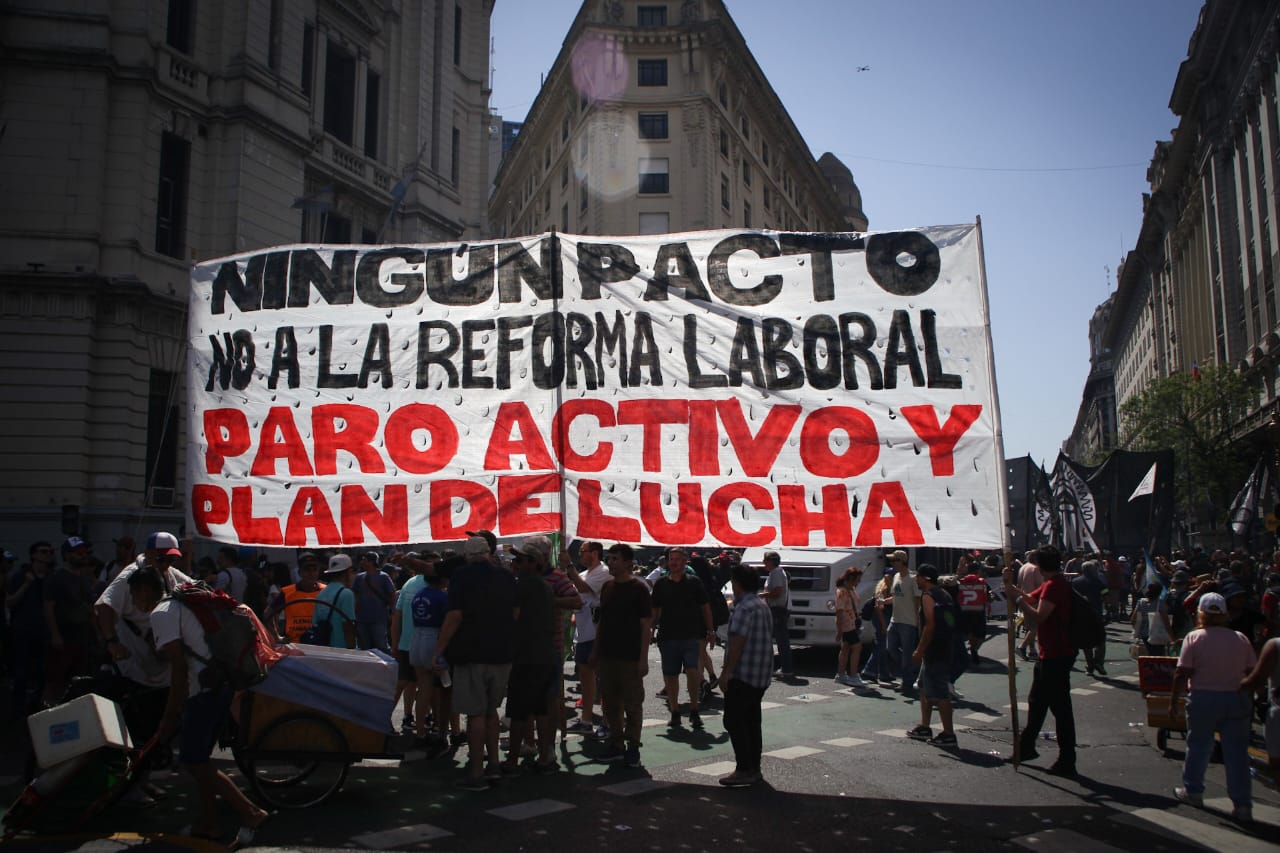
At dawn, in a session marked by tensions and maneuvers by the ruling party, the Government achieved the general half-sanction of the 2026 Budget, but suffered a setback in a key chapter. Milei failed to advance with the repeal of university financing or the disability emergency. They also failed to approve the end of the mobility update of the AUH and family allowances, an adjustment that gave the government the power to choose when and how much to increase these benefits. EITHER eliminate gas subsidies for cold areas. Good news for the social majorities, disability groups and the educational community, who fought in the streets against the Milei adjustment and the IMF.
These cuts – which had been added to the final ruling in Chapter XI – fell despite the more than $70 billion that the government paid through the distribution of ATNs (National Treasury Advances) to the provinces to guarantee the votes. Leaving a Budget that to maintain the fiscal balance pursued by Mile will surely add modifications and new cuts when it is discussed in the Senate. It is clearthe government’s firm decision to continue adjusting to the most vulnerable sectors in the midst of a social crisis.
The Kueider block.
The deputies who respond to the governors of Tucumán, Misiones, Catamarca, Salta, etc., take much more than a suitcase in exchange for leaving people with disabilities without an Emergency Law, and without a Budget Law for universities.
The cast… pic.twitter.com/IZpet9TXWx— Nicolas del Caño (@NicolasdelCano) December 17, 2025
In the opposite direction, despite the drop in tax revenues, which in the month of November was 10% (ai) in real terms according to the consulting firm LCG, Milei and Caputo propose a tax reduction for companies in the labor reform. This concession implies lower collection, ergo a reduction in tax revenue. “The drop in income was anticipated by the tax collection data (8.8% y/y real). Added to the drop in PAIS Tax throughout the year was the generalized drop in rates and Export Duties that left the 0% withholding measure at the end of September, causing exports to advance,” the LCG report maintains. The drop in VAT collection also deepened, as a result of the recession. For large economic groups there is no adjustment.
The setback in the Lower House comes in the same week that the IMF once again twisted Caputo’s arm in relation to the exchange rate scheme and the accumulation of reserves. The floor and ceiling of the flotation band will be updated by inflation, with a two-month delay. In this way, in January the recalibration of bands will be 2.5%, instead of the current 1%, fueling devaluation pressures. In the same BCRA announcement the willingness to strengthen reserveswhich remain in the red and below the levels inherited from the last Peronist government.
Far from the accumulation goal agreed with the IMF for the end of 2025, Caputo still must raise more than $2 billion to meet debt maturities with private bondholders in Januaryfor the sum of US$4.5 billion. The minister continues to pass the cap with the banks asking for loans in dollars, nor is it ruled out that the swap with the US could be activated. The government’s strategy continues to be to return to the international credit markets, to obtain the gasoline (debt) that keeps the engine of this model on. “The maturities of the Treasury and BCRA with private entities, the IMF and the Paris Club amount to US$13,800 billion in 2026 and US$18,000 billion in 2027,” states a report from 1816.
Employer reform
It is worth continuing to tear apart the project for labor “modernization” that entered the Senate, since in its articles it is clear why it has nothing to do with generating employment or with improvements for workers. Contrary to what is explained in the media related to the LLA and openly pro-employers, this reform has clear beneficiaries. The project not only modifies labor rights by determining enslaving relations for workers (which we will address below), it also grants tax reductions to entrepreneurs with a fiscal cost calculated at 0.83% of GDP by the consulting firm Inveq.
And 0.5% of the fiscal impact is taken by the 3-point reduction in employer contributions of the Argentine Integrated Pension System (SIPA), are funds that finance retirements, PAMI and family allowances. About this Lucia Ortega pointed out in this medium that “it represents a loss in collection of contributions of 16%, or in the vision of those who wrote the project, a “profit” that goes directly to the employers.”
While the discounts in the Corporate Income Tax represents 0.2% of that loss in collection, and the elimination of some Internal Taxes represents the remaining 0.1%. The proposed change for the Business Profits rates applies to tranches 2 and 3, going from 30% to 27% and from 35% to 31.5%, respectively. A calculation carried out by the deputy and former Director General of Customs, Gustavo Michel, showed that of the 163,587 sworn declarations presented by companies, 89.4% are excluded because they belong to Tranche 1. While in tranches 2 and 3, only 10.6% of these companies are the beneficiaries of this change. This tax benefit is largely concentrated “in only 144 large companies.” What are those companies?

However, the main dish of this offensive of capital against labor It focuses on a set of extensive regulatory modifications. “To find an attack of these characteristics you have to go back to the first years of the last military government,” warns the labor lawyer Luis Camposconsulted by this means. And he explains: “At the same time, the government seeks to weaken collective action, through the prohibition of the practice of striking, the imposition of obstacles to the holding of assemblies, the decentralization of collective bargaining and restrictions on the operation of unions; and to strengthen discipline in the workplace, by granting greater powers to employers to manage the day-to-day labor relations, for example, through the possibility of imposing totally different regimes in individual contracts. “flexible in terms of working hours and vacations.”
Regarding the possibility of generating employment from this reform, Campos maintains, based on what has happened in recent decades and with the same legislation, that “between 2002 and 2011 millions of jobs were created, and since 2012 employment has remained stagnant.” And he adds: “In the 90s, the flexibility of labor legislation coincided with the growth of unemployment to the highest levels in our history. In all cases, the explanation for the variations in formal employment must be sought in the dynamics of economic activity and in the behavior of the sectors that are most demanding of the workforce.”.
What’s coming
Patricia Bullrich is the one designated by the libertarian government to lead the treatment of the labor counter-reform introduced this week in the Senate. In another hot december 20Bullrich was Minister of Labor in the government of Fernando de la Rúa, remembered for applying a 13% cut to pensions, in the midst of the worst economic depression that the country was going through. His cruelty is consistent with the class interests he represents.

“The labor reform promoted by the government is part of a historical process that began in the mid-1970s. It is, in reality, the third phase of a counter-reform, whose objectives aim to retrace a large part of the labor rights achieved throughout the 20th century. It goes far beyond the intentions of the current government and dialogues directly with the initiatives promoted by the last military dictatorship and during the long decade of the 90s,” says Luis Campos.
If “everything solid vanishes into air,” the immediate future is full of questions and battles in defense of the rights conquered, in the face of the war plan proposed by the owners of the country and their representatives. The vote on the official labor project – and the 2026 Budget – would be postponed until mid-February 2026. So far, the Peronist union leadership has not shown the will to resist at the level of the attack, maintaining a line of dialogue with those who seek to enslave the workers. The express march of 18D was insufficient: to confront the adjustment plan of Milei, the businessmen and the IMF, a permanent plan of struggle is needed on the path of the general strike.
Continue strengthening the ties of Submission to international financial capital through external debt will only make the lives of working families worse.. Sectors of Peronism agree with this diagnosis, but none propose non-payment of the foreign debt or breaking the agreement with the IMF. They seek to manage the crisis without questioning capitalist interests. Only the left is willing to fight for a anti-capitalist and socialist solution that truly reverses structural backwardness and dependencywhich questions the existing order of production relations and confronts the looting of strategic assets. Down with the colonial pact with the IMF, no more labor exploitation, no more payment of the foreign debt! Here’s to a 2026 full of struggles and possibilities of building a different path, a different kind of future.

Source: www.laizquierdadiario.com