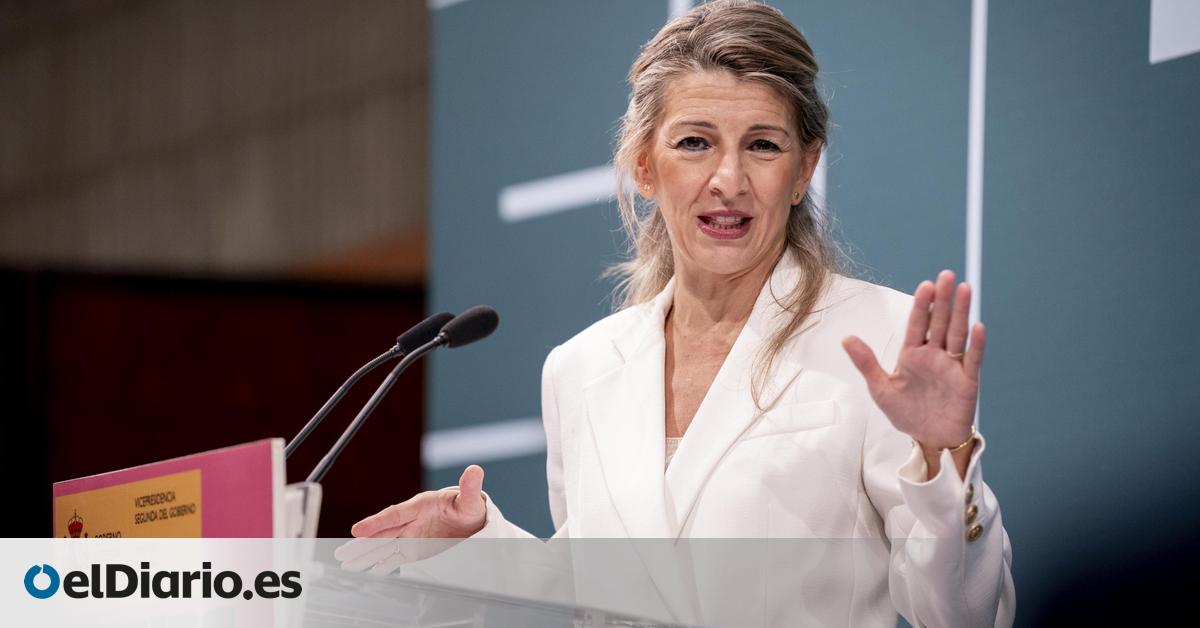
Sumar believes that the crisis facing the Socialist Party but also hitting the Government is not like the others. The diagnosis that comes from the parties of the plurinational coalition is that the situation is even more delicate than six months ago, when the Santos Cerdán case broke out. The mismanagement of the complaints against Francisco Salazar for alleged sexual harassment, they understand, is even more corrosive for the electorate than the cases of corruption that have been uncovered. For this reason, the second vice president, Yolanda Díaz, asked Pedro Sánchez for the first time this Friday for a “radical” reform of the cabinet.
The parties of the minority partner of the Government met urgently this Friday to assess the situation of the legislature after a particularly hard week for the socialists, who have seen how the Salazar case exploded in their hands while the judicial fronts multiply after the arrest of the former militant Leire Díez and the former president of the SEPI Vicente Fernández, who will go to court this Saturday.
The conclusion of that meeting was to demand that Sánchez remodel the Government. “A new executive that addresses the promotion of social measures of the legislature now,” reported sources from the coalition that forms Movimiento Sumar, the vice president’s party, Izquierda Unida, Más Madrid and Catalunya en Comú. The request was outlined by Díaz herself in an interview in La Sexta in which she described the situation as “unsustainable.” “It can’t last like this. The reflections, the cosmetic changes and reforms are over. There is a point and an aside and it’s time to act,” Díaz said in the interview.
The Government reform proposed by Sumar is not limited to changing the names of some ministers from the socialist side, but involves a programmatic proposal to respond to the multiple cases of sexual violence and machismo that affect the socialists, but that also affect the Government.
A few minutes after the public request for a “radical” remodeling of the cabinet, in Moncloa they ruled out a scenario of these characteristics. “We didn’t consider it,” they said without hiding their surprise at the second vice president’s move. The socialists defend that there is currently no one within the Government involved in corruption cases.
In the coalition they relativize this refusal and believe that the PSOE will have to act sooner or later. Although they recognize that the remodeling of the cabinet is an exclusive responsibility of the president, they hope that in the coming days there will be forceful steps in line with what both the vice president and the group of coalition parties demanded of him this Friday.
In Sumar they do not want to ask for specific heads nor are they going to point to ministers directly. But they believe that the remodeling is one of the few “political solutions” that the Government has in its hands in the face of the crisis due to an issue so sensitive for feminism. The problem, they defend in the coalition, is that an exit like the one in July is no longer valid, when the president appeared before Congress and presented a series of measures that to a greater or lesser extent satisfied his parliamentary partners and especially the coalition of Yolanda Díaz.
“They have to move,” summarize the alliance parties, more concerned than ever about the stability of a government that, they maintain, has a great reform agenda ahead. “The situation is the most difficult of the legislature,” summarizes a member of the political space who believes that unlike other crises, this one attacks “the center of contradiction: it comes from within the PSOE.” “And there is no greater corrosion of a building than that of its main beams,” he summarizes.
The current crisis does not have to end with an electoral advance, reason sources from that coalition who see the president determined to finish the legislature. The risk is in the disaffection that a situation like this can generate if it is not resolved appropriately.
One of the ways to get out of the situation, they understand, is this remodeling of the Council of Ministers, but Sumar believes that there are social measures that do not allow further delay, among them, the decree that they proposed to the socialists to extend the more than 300,000 contracts that, according to their calculations, were signed during the pandemic in a context of price drops and expire now. Its renewal can entail very harsh increases that may even force many families to look for another home.
“Immediate audit, complete reformulation of the Government and give hope to people, because we are doing very positive things: we have revalued pensions, we have raised the minimum wage, we are improving people’s lives and now it is time to change everything radically,” the vice president said this Friday.
Precisely, this week Sumar has achieved important victories in the Congress of Deputies. On Tuesday, Labor got its new Social Economy law approved in the Senate; and on Thursday, the Ministry of Social Rights, led by Pablo Bustinduy, saw its first law definitively approved, the customer service law. Furthermore, another of its main projects, the reform of the dependency and disability system, passed the first parliamentary procedure, both norms with a consensus practically unprecedented in this legislature.
“We need a new executive to address the legislature’s push for social measures now. People on the street need it and want to see that this progressive coalition government is worth it,” Sumar sources said this Friday after the meeting. Strong, clear and accurate answers must be given, and do it now,” the general coordinator of Izquierda Unida, Antonio Maíllo, wrote on his networks.
“Citizens deserve respect. They have to give explanations and make decisions at this moment. This thing of resigning, doing nothing and remaining, no. Governing is not resisting. This point is a turning point, there is no going back, we have to react, act, defend our country,” Díaz claimed.
Sumar thus tries to resolve a crisis that fully affects the PSOE, but that affects them directly as partners of the Government. The departure of the Executive does not currently cross the minds of its leaders, but they fear that the electorate will perceive a following of the socialists without clear demands. That is why they will now wait for Sánchez’s next steps before evaluating new scenarios. “If your alternative is to stay as we are, the storm will not pass,” they reason.
Source: www.eldiario.es