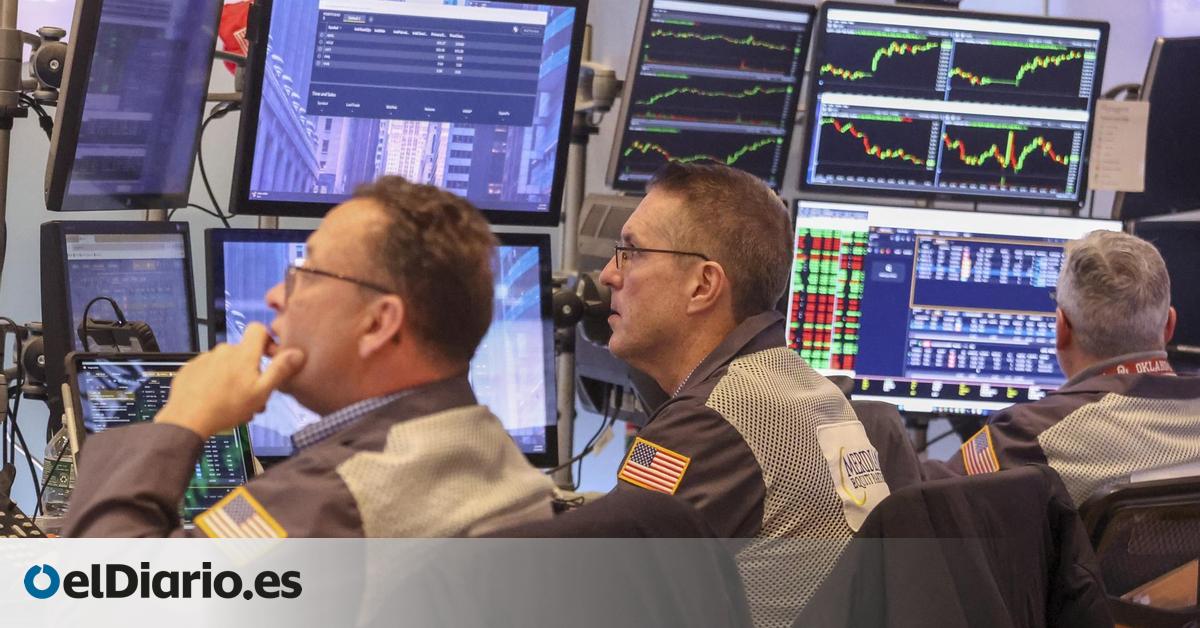
Microsoft, Alphabet, Meta and Amazon have presented their 2025 accounts with record results. Their respective businesses run like well-oiled machines. However, Microsoft and Meta, which presented their accounts last week, have accumulated drops of 10% in the value of their shares since then. Google, which did so this Wednesday, managed to overcome the 8% depreciation with which Wall Street punished it during the following day. Amazon, for its part, fell 9% after having presented a net profit increase of 31% compared to the previous year, very in line with the rest of the group.
The reason for the falls is the massive investment figures in AI and computing infrastructure that the four data center giants have announced for 2026. Amazon will reach $200 billion, Google has budgeted up to $185 billion, while Meta could reach $135 billion. Microsoft has not reported a figure, but if it maintains the pace of the last two quarters, it will reach $150 billion.
There are, in total, more than 500,000 million euros that the largest companies in the world will invest in their AI business. The problem is that they are not very clear about where they will recover them, which has exhausted the patience of investors. “The market reaction is not against AI, it is against the lack of visibility of profitability,” Javier Molina, eToro Markets Analyst, clarifies to elDiario.es.
“In 2026 the market leaves behind the storytelling [la narrativa] and enter the ‘show me the money’. Alphabet [matriz de Google] and Microsoft fall not because of income, but because the investor no longer rewards spending, he wants execution,” he continues. Are we, then, at a turning point? “Yes, there is a clear change in attitude, as there is a shift from indiscriminate enthusiasm to surgical analysis of the return on investments.”
A very expensive technology without a clear business model
Those 500,000 million euros are six times more than what these companies invested per year in operating expenses in 2020. However, their income sources have not changed much since then. Generative AI models like ChatGPT or Gemini have hundreds of millions of users, but most don’t pay for them. Their AI services for businesses are growing very modestly, but they still represent a small fraction of these companies’ total revenues.
Between the four companies, AI has only added about 50,000 million euros to their accounts in 2025. Ten times less than what they will commit to develop it in a single year, to which a similar figure must be added between the two previous years. OpenAI, which is not listed on the stock exchange, is in a similar position, with a trillion euros committed to computing until 2033 and just 15 billion in revenue a year.
From a strategic point of view, the expense is justified, since not investing is being left out of the system
Javier Molina
— eToro Market Analyst
It is a sprint in which the goal is not seen, but each company must make every effort to remain in the peloton in case it appears. “From a strategic point of view, the expense is justified, since not investing is being left out of the system. But the market is beginning to doubt the timing of return, not of direction. The difference is key, since the investment is defensive and structural, but the investor wants to know when it becomes margins and cash, not just capacity,” says Molina.
Apple, meanwhile, represents the other side of the coin. Having accepted that it has been left behind in the AI race, it has decided to outsource to Google the technology that will power the new Siri and its other tools based on this technology. It will pay about 1,000 million a year and will leave the race to the competition. Its shares have risen 8% since it presented its annual accounts last week.
The countdown has started
The question hammering investors is simple: who will pay for all this? If the AI business model does not appear and the investments do not obtain returns, the answer is that it will have been them as owners of the companies.
That is why this week’s falls also extend to companies like Nvidia or other chip manufacturers like AMD (-13% in the last week). The concern extends even to the top leaders of the leading companies. In presenting results to analysts, Sundar Pichai, CEO of Google, acknowledged that there is one question that “keeps him awake” at night: “How can we increase capacity to meet this extraordinary demand, get our long-term investments right, and do it all in a way that drives efficiency?”
Both Pichai and the rest of the technological emperors run out of time to respond. The “fatigue” of investors due to the lack of return has activated the countdown of the AI bubble. “2026 is the year in which the market stops giving credit to the promise of AI and begins to demand results,” warns Javier Molina.
We are in a bubble and many people are going to lose a lot of money
Bret Taylor
— president of OpenAI
“In the first half of the year, volatility will be tolerated as long as usage continues to grow, but in the second, stability of margins and clear signs of efficiency will be requested. If at the end of 2026 there is no visible inflection in free cash flow, the punishment could be structural, that is, potential permanent adjustment of multiples and end of the future narrative. AI has this year to demonstrate that it can convert investment into real profits… afterward, there will be no room to wait,” he concludes.
The question is what form that punishment will take. A Bank of America survey of fund managers conducted in October 2025 showed that 54% consider AI stocks to be in a bubble, an all-time high in such surveys. Even tech executives have admitted the risk: Bret Taylor, chairman of the board of OpenAI, was clear when he declared that “we are in a bubble and a lot of people are going to lose a lot of money.”
The scenario is reminiscent of the dotcom bubble of 2000, when technology companies with astronomical valuations collapsed after failing to materialize profits. Back then, companies with minimal revenue were trading as if they already dominated the market. Now the situation is diametrically opposite in the protagonists, but they share one trait: massive investments in a technology whose business model has yet to be defined.
Source: www.eldiario.es