“What is this about simply extending an occupation of the coast for 75 years?” With this question, Greenpeace’s coastal coordinator, María José Caballero, illustrates how difficult it is to undo the coastal management formula created in 2013 by the Government of Mariano Rajoy and his Minister of the Environment, Miguel Arias Cañete. A model that, in the long run, has proven contrary to European law. The Ministry of Ecological Transition is trying for the second time to end this way of allowing businesses to be set up for a century on a coast, in theory, in the public domain.
The point is that in Brussels they had to ask themselves a similar question because the European Commission (EC) opened a sanctioning file against Spain in February 2023 since national regulations still allow these permits to be granted in an opaque and partisan manner and, in addition, “to extend existing concessions up to 75 years without justification”, as detailed by the EC.
Since the coastal rule was tweaked in 2013 to be able to extend permits for factories, beach bars or walkways almost automatically for decades, more than 300 infrastructures obtained that amnesty, according to Ecological Transition calculations.
Initially, this Ministry approved a regulation in 2022 to limit these private occupations after the grace that the PP granted to many constructions in its 2013 legal reform, which “was a terrifying reform,” says Caballero.
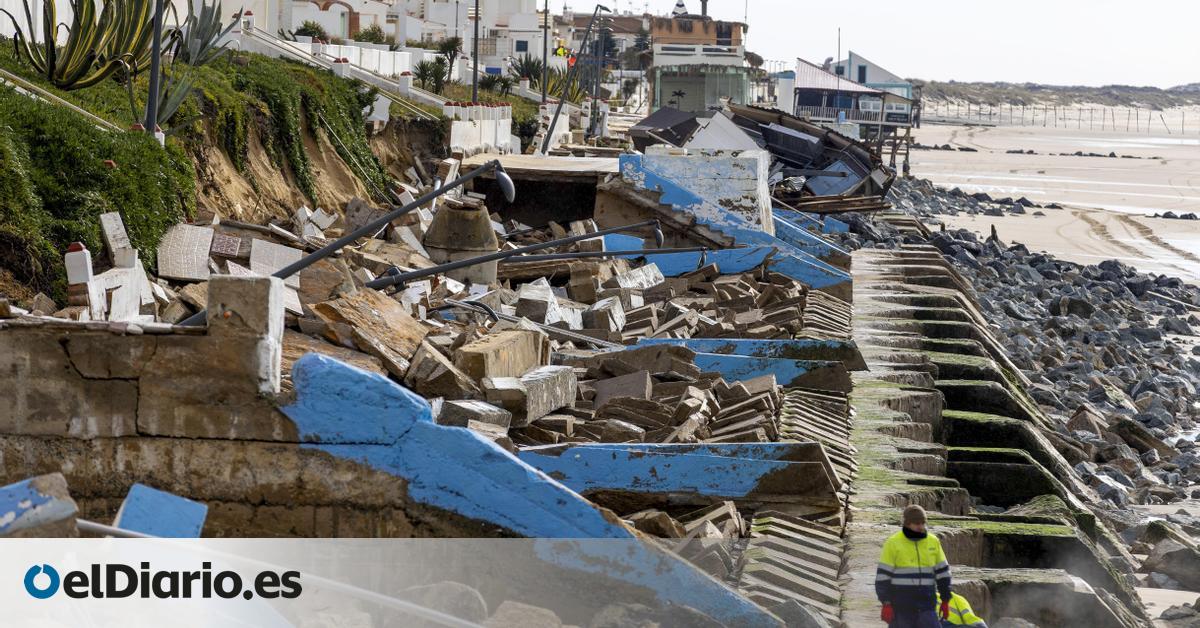
That new regulation included another battery of measures that, in theory, were aimed at ensuring that the coast fulfilled its defense function against the onslaught of the sea. A defense that has increased its importance due to the worsening and multiplication of marine storms brought about by climate change. Among its latest most visible examples: the destruction of Matalascañas beach in Huelva due to Storm Francis.
When, as the Ministry explains, it was in the process of informing Brussels of what it was doing to adapt Spanish laws – the same as the EU infringement procedure – a ruling from the Supreme Court arrived in December 2024 which, at the request of the organization Affected by the Deslinde de Costa Formentera, annulled the new regulation. We returned to square one: the rule and procedure designed by Arias Cañete.
With this procedure, “it has not been unusual for authorization to be given to a City Council for the operation of a beach bar, but there was no follow-up as to whether that City Council held a public exhibition with a list of conditions for different companies to apply and for it to be awarded with a transparent and legal procedure,” exemplifies Manuela Cuevas from Ecologistas en Acción.
What Brussels tells us is that the coastline cannot be occupied in that way and for so long. The Constitution establishes that the coast is public and now, in addition, it must protect us, so you can only be on the coast if there is no other place you can be, even if you are a paper mill or a petrochemical company.
María José Caballero
— Greenpeace Coastal Report Coordinator
“What Brussels tells us is that the coast cannot be occupied in that way and for so long – adds the Greenpeace spokesperson – the Constitution establishes that the coast is public and now, in addition, it must protect us, so you can only be on the coast if there is no other place where you can be, even if you are a paper mill or a petrochemical company.”
That was also the procedure with which Mariano Rajoy’s executive approved in 2016 (while already in office) the extension of occupation of the Ence paper mill in the Pontevedra estuary until 2073. Although the National Court ruled against this new permit, the Supreme Court ended up endorsing it. What the passage of time shows is that, once the coast is occupied, it becomes very difficult to free it (the El Algarrobico hotel in Almería is perhaps the crudest example).
The Ministry explains that, after meetings with the European Commission, it has been decided to modify the regulation to “correct” what has to do with the duration, processing, granting, management, extension and termination of occupation titles. “It is essential to prevent the infringement procedure from escalating to a conviction,” they argue in Ecological Transition.
Dunes yes, roads no
When the regulation was annulled by the Supreme Court (the legal reason was procedural: it had not been properly submitted to public information), not only did norms regarding how invade legally the coast, but provisions that incorporated more surface area and elements within that maritime-terrestrial public domain that is protected were also lost. For example, the decree included almost any dune as an element of the beaches and established that the line that marks the maximum level that the waves reach served to say: this is a beach (and therefore public domain) that must be preserved and forced to control what can or cannot be raised on it.
The construction of parallel roads and circulation or parking in the public domain area were also prohibited, not only on the beach itself. In general, the regulations required that the new context of climate crisis be taken into account before any occupation concession on the coastline.
“The Ministry can take advantage of the issue of infringement to deal with the intensification of pressure on our coasts and the competition between the different uses of that space,” reflects Marta García Pallarés, spokesperson for a state coalition of environmental organizations among which are – in addition to Ecologists in Action – the Ornithological Groups of the Balearic Islands, the Juan Tábara Foundation or SOS Costa Brava and Mar Menor.
The platform places emphasis on an aspect that is sometimes little observed: coastal waters. And that is why they consider it important to “extend the speed limitation beyond the bathing areas” of jet ski-type vessels, “prohibit navigation parallel to the coast within the unmarked bathing areas and regulate the anchoring of boats in these areas to avoid floating overcrowding.”
Such intensive use of the coastline “directly affects both the safety of people and the conservation of key marine species and ecosystems,” concludes García Pallarés. The threat of a European ruling gives the coast a second chance. It remains to be seen if this time it’s the charm.
Source: www.eldiario.es