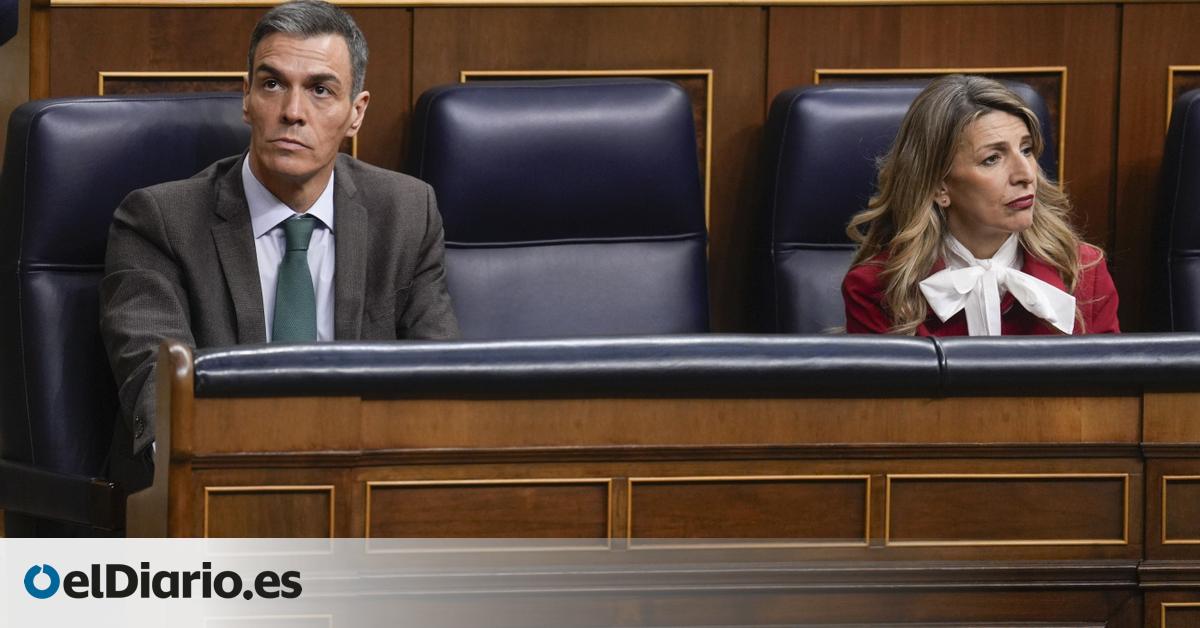
Pedro Sánchez has already made his capacity for resistance clear with chapters and chapters that would allow him to write another essay, perhaps with the title Survival Manual. It will largely depend on his chances of exhausting, as he says, the legislature in 2027. The paths may be different: doing so despite not having budgets throughout the mandate or even taking the trouble to obtain them. In the Government they are working for the second scenario, although they do not hide the difficulty, and the president is conspiring against the end-of-cycle climate that swept over at the end of the year, with the extension of those derived from corruption and the accumulation of harassment cases after the revelation of the complaints against former advisor Francisco Salazar.
With the most adverse climate towards his political survival since he arrived in Moncloa, the warnings from partners, including PNV and ERC, multiplied. Although no one showed signs of intending to let the Government fall, not even the minority partner despite the request for a cabinet remodeling that Yolanda Díaz demanded and that Sánchez ignored, the warnings sounded like an ultimatum. “Either he manages to stop the bleeding or Sánchez will have to consider calling elections,” Aitor Esteban even said.
In Moncloa they took note and have focused a good part of their efforts with an eye on the General State Budgets that the vice president and Minister of Finance, María Jesús Montero, promised to present in the coming weeks. “The previous screen is to regroup the majority of the investiture,” explain government sources, who maintain that they are not going to throw in the towel.
“We are taking measures. We have the power to govern. We are going to raise the minimum wage and pensions. As long as we are there, we are going to do things. But to do things we have to regroup that majority,” these sources point out, reminding the partners that, “the day after the 2027 elections, the best scenario for the majority of the investiture is the current one, that Pedro Sánchez governs.” “None of them want PP and Vox to govern, for the future of our children, but also for a matter of political profitability,” they add. “It is in all of our interests (PSOE, Sumar, PNV, ERC, Podemos and Junts) to approve the Budgets and tell the electorate: Vote for me to continue doing things,” they encourage in Moncloa: “The sooner we love each other again, the better.”
But they are also aware that they have to fix the climate of mistrust that has been established among the partners and that had its peak with the involvement of the former secretary of the Organization Santos Cerdán in the corrupt plot.
First ERC and PNV
And that is where Sánchez has been making gestures in recent weeks. The first was with ERC, which has become, together with the PNV, its main parliamentary stronghold. “Beyond the press conferences, the great phrases, the TikTok videos, the Government crises, we ask the president for a direct face-to-face meeting with ERC, in Moncloa or wherever he wants, and for him to tell us to our face what he plans to do to regenerate his party and his Government,” Gabriel Rufián told him at the end of the year. No sooner said than done.
Sánchez met twice secretly with Oriol Junqueras and at the beginning of January he received him publicly in Moncloa to stage the agreement on regional financing that has generated the rejection of all the communities, including those governed by the PSOE, except Catalonia.
Progress has also been made with the PNV. The Government and Euskadi signed the transfer of five powers on January 16 and, practically in parallel, the Lehendakari, Imanol Pradales, warned of a “revalidation” to Sánchez. Days later, both leaders met in Moncloa and Pradales presented a list of “non-compliance” by the central government. The meeting ended with a commitment to hold two meetings before Easter to conclude the transfer of management of the airports and the review of the quota.
Regularization of migrants to seduce Podemos
The big surprise this week was the rapprochement with Podemos, which had been brewing for more than three months, since the formation of Ione Belarra overturned the bill for the transfer of immigration powers to the Generalitat of Catalonia. That was one of the commitments reached by Sánchez with Carles Puigdemont and the rejection was one more argument for the breakup that Junts formalized at the end of October.
The Minister of the Presidency, Félix Bolaños, began a negotiation with Podemos, which at some point became three-way with the presence even of the Junts spokesperson, Míriam Nogueras, at a meeting to try to rebuild the bridges. Moncloa’s idea was to agree with Podemos on an extraordinary regularization of migrants in exchange for compromising with the delegation of powers. The move, for the moment, is also going well because Junts has agreed to change the preamble of the law, which for Podemos was “racist.” However, the Government has not managed to culminate with the ‘yes’ of Junts to the decree of the social shield, which includes the increase in pensions and the Congress knocked down with its votes and those of PP and Vox this week.
In Moncloa they do not see the possibility that the “triple carom” will occur when they bring back the decree and that Junts will give in regarding the ban on evictions, which is the excuse for voting against. “They consider that the delegation of powers is something that we owed them. There will be no negotiation,” say government sources. And so it is: it was one of the commitments of the investiture agreement.
They rule out a “triple carom” due to the difficulty with Junts
At the moment, the relationship is complicated, if not non-existent, and Junts has found a new argument against the Government in the Rodalies chaos, which envisions yet another difficulty with its former partner, and also with ERC. “In Catalonia we have the country collapsed. The system has failed. It has told us enough is enough, this is it. This is very serious. You must resign,” post-convergent senator Eduard Pujol told Minister Óscar Puente.
The Government is working to comply with other pending issues, such as the publication of fiscal balances or the official status of Catalan in the EU – for whose torpedoing they clearly blame the PP due to the pressure on governments of their political family –, as a prior step to trying to recover the relationship with Junts. The hope is that ties will be mended in the spring, when the rulings on the amnesty that would allow Puigdemont’s return are expected.
The calendar is complex, but meeting the demands of Junts – and the new impositions of other partners – is the only way for Sánchez to get the parliamentary accounts for the Budgets.
Source: www.eldiario.es