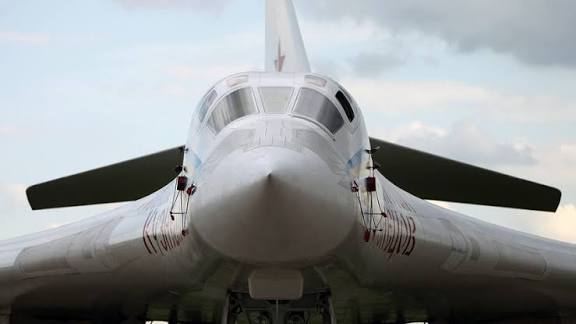
Russia carried out the first flight of the Tu-160M supersonic strategic bomber built entirely from scratch since the end of the Soviet Union, in a move that marks the resumption of the country’s industrial capacity to produce heavy, long-range military aircraft. The inaugural test was confirmed by defense sector officials and state-owned companies linked to the Russian aeronautics program.
The flight took place from the Kazan Aviation Factory, a unit linked to the manufacturer Tupolev and the state conglomerate Rostec. According to official information, the aircraft remained in the air for around 30 minutes, reaching an altitude of approximately 600 meters and carrying out initial maneuvers designed to verify the stability, controllability and basic functioning of the flight systems.
According to the Russian industry, this is the first Tu-160 manufactured entirely in the post-Soviet era, and not a modernization of old airframes remaining from the Soviet Union period. The announcement was treated as a symbolic and operational milestone, indicating that the country managed to rebuild production chains considered critical for strategic aviation.
Industrial recovery and deep modernization
Tupolev and the United Aircraft Corporation (UAC), a conglomerate that brings together the main Russian aircraft manufacturers, reported that around 80% of the Tu-160M’s systems were modernized or replaced. The upgrades cover engines, avionics, navigation systems, flight controls, communications and weapons management, as well as adjustments to mission systems.
According to Tupolev’s chief test pilot, Viktor Minashkin, the performance presented on the inaugural flight was above initial expectations, especially considering the short and preliminary profile of the mission. The objective of this stage was to evaluate the basic behavior of the aircraft before expanding the flight envelope in subsequent tests.
Russian authorities say the Tu-160M maintains the general configuration of the original model, but operates with updated electronic architecture, digital instruments and components designed to extend the platform’s useful life and reduce maintenance costs over time.
Recovery of technologies considered strategic
In addition to the flight itself, the program was presented as evidence of the recovery of industrial skills that had deteriorated after the collapse of the Soviet Union. The resumption of production required the reorganization of manufacturing lines, the reactivation of specialized suppliers and the recovery of complex manufacturing processes.
One of the highlights was the full digitalization of the Tu-160’s technical documentation, which allows for greater quality control, component traceability and industrial repeatability. The Kazan plant underwent structural modernization, with significant renovation of the industrial park.
Also mentioned was the recovery of titanium vacuum welding technology, considered essential for the production of structural components subjected to high mechanical loads and extreme thermal variations, typical of large supersonic aircraft.
Political decision and strategic context
The decision to resume production of the Tu-160 was originally announced in 2015, under President Vladimir Putin, as part of a broader strategy to rebuild the defense industry and preserve Russia’s long-range strategic capabilities.
Since then, the program has been cited in official statements, albeit with extensive timelines and gradual advances, reflecting the technical and industrial complexity involved in manufacturing heavy strategic bombers.
Russian Industry and Trade Minister Denis Manturov stated that the Tu-160M was designed to employ new generation weapons, including systems still under development. However, the government did not disclose details about the types of weapons or deadlines for their full operational integration.
Importance of the Tu-160 in strategic aviation
Known as the “White Swan”, the Tupolev Tu-160 is described by Russian authorities as the largest supersonic bomber in operation in the world. The aircraft is approximately 54 meters long and can reach approximately 56 meters in wingspan with the wings fully open.
Classified as a heavy strategic bomber, the model was designed to transport large loads of conventional or nuclear weapons over long distances. In Russian military doctrine, the Tu-160 operates in conjunction with the Tu-95MS, forming the basis of the country’s strategic deterrent air capability.
Experts note that the real impact of the Tu-160M will depend on the results of additional tests, the pace of serial production and the effective integration of the promised new systems. Still, the maiden flight of the model built from scratch is seen as a demonstration that Russia has once again operated an industrial chain capable of manufacturing strategic bombers, with direct implications for its military posture and the global strategic balance.
Source: https://www.ocafezinho.com/2026/01/16/russia-realiza-primeiro-voo-de-bombardeiro-hipersonico-produzido-do-zero-apos-a-era-sovietica/