The facts
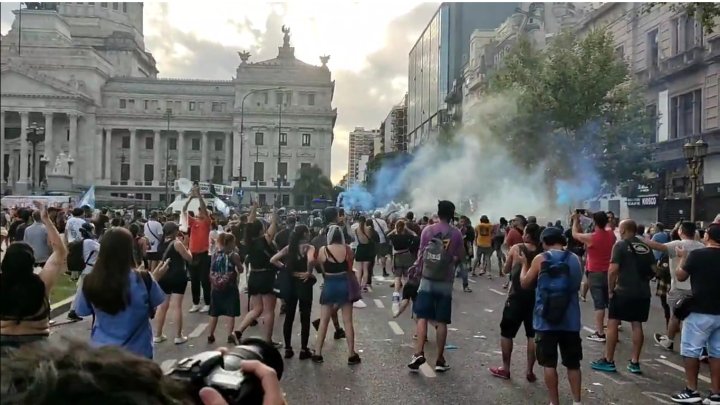
At two in the afternoon, Avenida de Mayo was packed; there were the columns of many unions, social and political organizations that were beginning to enter the square, in columns. The original plan for most of the pipelines was clear: “Guys, around 4 in the afternoon we break camp.”. While thousands of self-organized people were arriving, many others, who were still far away or at work, asked the groups how the hand was coming, with the intention of being able to arrive.
Without a General Strike and with a fleeting call, the demonstration planned by the CGT was destined to fail, to become a classic parade and staging so that some could say: “we did something”. The same as always. That was the most favorable scenario for the government: give half-sanction to the Law with an already empty square and with the unions and organizations well trained. The peace of the cemeteries.
Three in the afternoon arrived, the Plaza much more crowded with people. On Hipólito Yrigoyen Street and Entre Ríos Avenue, different protesters began to hit the fences. CGT security approached with the order to remove all those who were “rotting it.” At the same time, on the other side of the square, on Avenida Rivadavia – where the Left was located – the same thing began to happen. That moment can be clearly seen in this video by YouTuber Gabino Silva.
We all already know that the demonstrations that Patricia Bullrich (or her employees such as the current minister Alejandra Monteoliva) are involved in are full of illegal and shady things, such as infiltrators and provocations. But, regardless of how events unfolded, What was relevant about yesterday was the resistance and the demonstration of anger by hundreds of young people (some who left their columns and retreated through the pipelines) to join legitimate demonstrations of resistance.
The real resistance (beyond viral images)
The networks were filled with spectacular (and spectacularized) scenes: Molotov cocktails, wooden shields, bullfights. But the day was not just those 5 people with wooden shields and Molotov cocktails. There was some organized and spontaneous resistance at different points: in the square itself, in the side streets such as Yrigoyen and its intersections, in attempts to maintain positions against the police advance. There were young people who did not leave when the repression began. There were workers who did not accept the script of “short act and orderly deconcentration” of the CGT and the CTA’s. That’s what started to partially change.
For years the idea was established that the “conflict” has to be a parade: schedules, speeches, agreed withdrawal. A protest liturgy without any consequences. Yesterday something about that administration began to crack.
As National Deputy Nicolás del Caño said in today’s session: “Criminals are those who steal money from people with disabilities.” To expect there to be no expression of resistance “from below” while systematic structural violence is applied “from above” is to simply demand submission and ignore the History of our country.
The bombings of the Plaza de Mayo in June 1955, killing more than 300 people (many of them children) and injuring thousands, opened 18 long years of resistance. The Ongania dictatorship brought nothing more and nothing less than the Cordobazo, opening a stage that could only be closed with a genocidal coup. Today, those economic and political heirs of the coup intend to apply and continue (with the complicity of large companies and union leaders) the same plan with slave laws… without any consequences?
Some seem to be more afraid of the possible popular anger than of the police who shoot, repress and imprison. Obsessively insisting with the infiltrators (which there probably were and will be) in the face of any act of resistance, can end up fulfilling the function of displacing the underlying discussion: how do we defend ourselves against these attacks of historical magnitude?
Of course, identifying the provocative elements in each mobilization is a fundamental part of any type of demonstration that aims to be serious, in order not to allow itself to be sabotaged or frustrated by external elements. Now, stopping at the viral images and not asking ourselves why thousands decided to stay when the CGT had already withdrawn, despite the repression, does not allow us to carry out a deeper analysis of the situation we are in and the increasing weakness of the mediations of the traditional union and political apparatuses. The focus should not be on how the “conflict” began, but rather on how many stayed and resisted.
In view of the treatment of the Labor Reform in the Chamber of Deputies, from the PTS Youth we will continue to insist on the need to call an active Strike with mobilization to overthrow the treatment of the Law, accompanying those who resist in the streets. But, regardless of whether the Law ends up being approved, yesterday’s day promises a hellish 2026 for the government, employers, governors and the corrupt union bureaucracy.
Source: www.laizquierdadiario.com