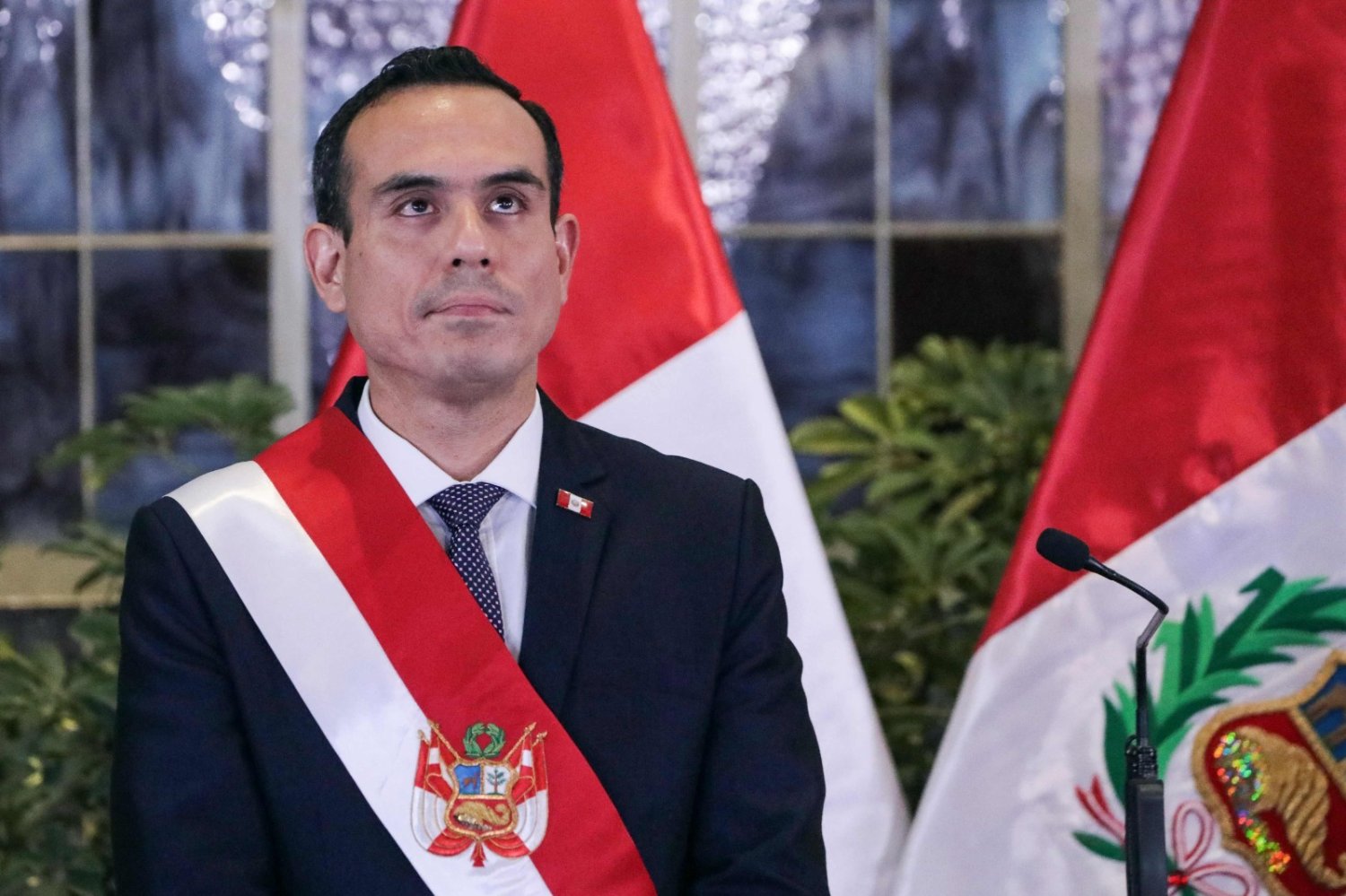
This Tuesday, the Peruvian Congress dismissed the interim president, the right-wing José Enrique Jerí Oré, less than two months before the general elections, which becomes the eighth presidential change that the Andean country has experienced in almost a decade of political instability, which began after the 2016 elections.
He did so with 75 votes in favor, 24 against and 3 abstentions, due to the investigations opened against him as a result of several semi-clandestine meetings with Chinese businessmen contractors of the State and alleged irregularities in the hiring of officials who previously had meetings with him in the Government Palace.
Jerí was acting as interim President of Peru in his capacity as president of Congress, after the dismissal of President Dina Boluarte (2022-2025) in October of last year, so when he is censured as the highest authority of Parliament he automatically loses his status as acting head of state.
The images that unleashed the political crisis in Peru show Jerí, with a hood, entering an establishment owned by Chinese businessman Zhihua Yang. The then president had another meeting with Yang, on January 6, at a store selling Chinese products, where he arrived wearing dark glasses. None of those meetings were in the presidency’s records.
Yang appears in the final report of a congressional commission that investigated “irregularities in tenders and works carried out by Chinese companies” convened by various entities of the Peruvian State, from 2018 to 2022. Jerí was part of this commission, hence the suspicions of corruption.
Below we reproduce an article published in La Izquierda Diario de Perú
The fall of Jerí and the bankruptcy of bourgeois parliamentarism
The censure of José Enrique Jerí Oré does not constitute an accident or a moral outburst by Congress. It is, rather, the visible symptom of prolonged decomposition. Seventy-five votes were enough to precipitate the fall of another president, the third in a row, the seventh in less than a decade. Since 2018, Peru has seen leaders parade as if they were interchangeable parts of a machinery that creaks under the weight of its own contradictions.
It is not the tragedy of an individual that unfolds before our eyes. It is the crisis of a regime incapable of ensuring stability even to the class whose domination it administers. When the bourgeois State incessantly replaces its representatives, it is not because the people have emerged victoriously onto the historical scene, but because the fractions of capital fail to agree on a lasting form of political leadership. The internal struggle at the top is not a sign of democratization, but of fragility.
Scandal as a function, not as a deviation
The so-called “Chifagate”, with its reserved meetings between the Executive and Chinese businessmen – as well as with the US ambassador himself – interested in the awarding of public contracts, does not constitute a moral anomaly or a circumstantial slip. It exposes the very nature of the State in a dependent capitalist formation; direct administrator of private interests, mediator between fractions of capital and institutional guarantor of its expansion. The president would have done nothing but perform, with greater or lesser clumsiness, the structural function that the constituted order imposes on him.
Reports of sexual violence and irregular hiring deepened the discredit. But reducing the crisis to the behavior of one man would be a comfortable illusion. Patrimonialism, the confusion between the public and the private, the use of the state apparatus as loot, are not individual excesses, they are structural practices of a regime where political power is an instrument of reproduction of economic power. The scandal is no exception; It is the everyday procedure by which domination is administered.
Prosperity for capital, precariousness for the worker
While the political leadership is consumed with intrigue, almost a third of the population lives in poverty and more than 70% of employment is informal. The working class subsists without stability, without effective rights, without material guarantees for its reproduction. And yet, the large mining sectors exhibit high profitability; Macroeconomics offers figures that technocrats present as trophies of rationality.
This coexistence is not a paradox, it is the internal law of dependent capitalism. The accumulation is concentrated; precariousness is socialized. Mining, agro-export, and other sector wealth flow regularly, while the worker assumes the risk and uncertainty. The State demonstrates diligence in protecting contracts and income, but appears powerless in the face of insecurity and the expansion of illegal economies that thrive in the social vacuum that it itself produces.
When more than 80% of citizens identify crime as the country’s main problem, it is not simply an administrative failure. It is the expression of a structure that does not guarantee minimum conditions of dignified living to broad popular strata. Social violence does not fall from the sky, it springs from an order that privatizes profit and socializes misery.
Spare parts without breakage
The rise of Jerí after the fall of Dina Boluarte was not a sovereign decision of the masses, but rather an internal adjustment of the dominant bloc. Each recent president has been a transitional administrator of the same social edifice. The foreman is changed, but not the farm; The face is replaced, but not the structure.
The Peruvian bourgeoisie, closely linked to international capital, uses these changes to prevent the political crisis from becoming a regime crisis. Censorship is not democratic justice; It is a self-regulation mechanism. Parliament does not embody the popular will, it only administers the continuity of the constituted order.
Power without legitimacy
Today Congress concentrates formal power, but it carries levels of disapproval that reveal its divorce from society. This contradiction—maximum authority, minimum legitimacy—expresses the exhaustion of bourgeois parliamentarism. The figure of “moral incapacity” has become a routine instrument to reconfigure the Executive without altering the system.
An alternative program of social organization is not debated. Control quotas over the same state apparatus are disputed. The working majorities are summoned as a public, not as a historical subject.
Elections and suffrage limits
The next elections are presented as an institutional remedy. However, distrust towards parties and authorities is overwhelming. Suffrage runs the risk of becoming a ritual of symbolic renewal, not a mechanism of real transformation. When alternation does not modify exploitation, formal democracy is reduced to a legitimation procedure.
Parliamentarism was born as a mediation of the class struggle. But when it leaves material domination intact, it reveals its limited character. Stability is guaranteed for capital; uncertainty is reserved for work.
A crisis that goes beyond names
The succession of scandals and censures does not announce a new model; It shows the current inability to ensure cohesion under bourgeois hegemony. The State is not faltering because the people have achieved their emancipation, but because the ruling class governs with increasing difficulty.
The decisive question is not who will occupy the next presidential office. It is whether the dispersed discontent of the majorities can become an organized force, aware of their historical interests. Experience teaches that regimes do not fall due to the accumulation of scandals, but when the masses stop tolerating the structure that produces them.
Today Peru is witnessing the incessant repetition of relays without interruption. But history is not a stationary wheel; Beneath the surface of political instability, the contradiction between concentrated wealth and impoverished social life matures. There, and not in the halls of Congress, the future is decided.
Source: www.laizquierdadiario.com