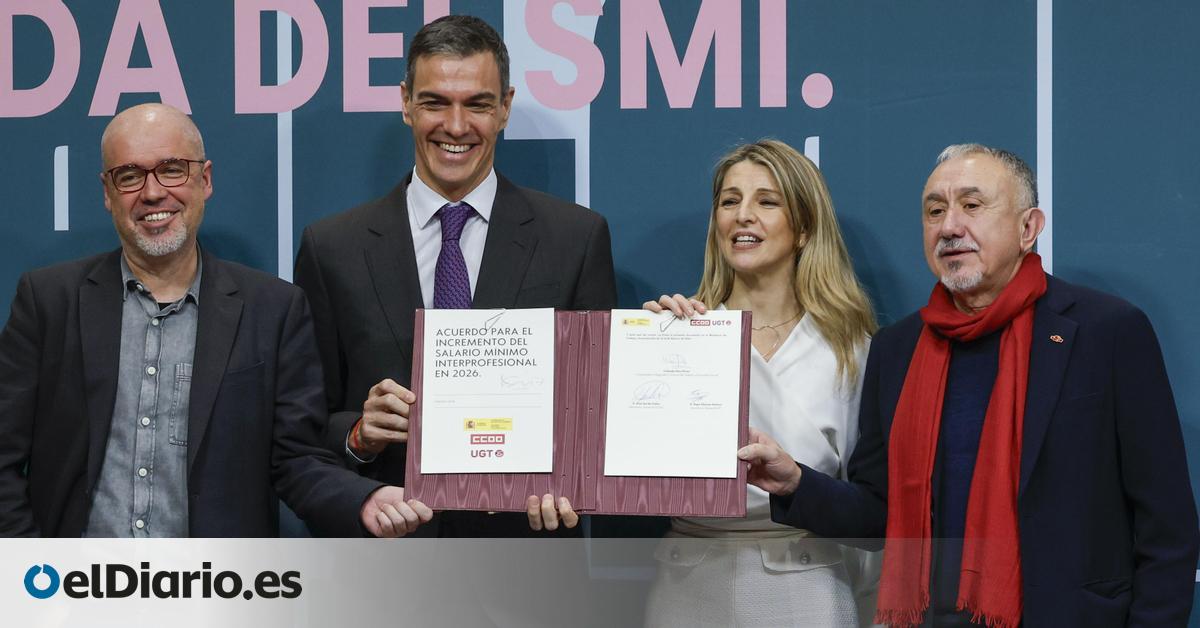
The leader of the Government, Pedro Sánchez, presided this Monday over the signing of the agreement to raise the interprofessional minimum wage (SMI) by 3.1% in 2026, to 1,221 gross euros per month, between Labor and the majority unions, which will be approved tomorrow in the Council of Ministers. It is the first time that Sánchez leads an act of a bipartite pact of the Ministry of Yolanda Díaz, only with the workers’ representatives, after signing the 2020 increase in Moncloa, which the businessmen also supported at the time.
“Let no one tell us that there is no margin [para subir salarios]when the economy advances,” said Pedro Sánchez in his speech in which he criticized the employers for “deciding to cancel themselves” from the pact at a time of economic prosperity and record business profits.
The President of the Government has pointed out that “where is the employers” when the IBEX 35 reaches historical highs and when the same thing happens with the escalation of company profits. “It is there,” Sánchez told CEOE and Cepyme, but not in the increase in the legal minimum wage, something that he considered “not admissible” in the current economic context.
“It is not acceptable that, in a context of economic prosperity, the salary of those who earn the minimum is looked at with a magnifying glass, while looking the other way when multimillion-dollar profits are recorded,” he concluded. As the Government has done with the increase in the SMI, and the salary increase for public employees, Sánchez has asked the employers “to also do their part, and pay more,” he said.
The second vice president and Minister of Labor, Yolanda Díaz, was responsible for leading the event and signing the agreement with the general secretaries of CCOO and UGT, Unai Sordo and Pepe Álvarez. As it has done in recent years, in which the Ministry has only agreed on the increase with the working party.
The employers’ associations, CEOE and Cepyme, only subscribed to the 2020 increase, to 950 euros per month, after which they have distanced themselves from the rest of the increases in this salary floor, which reaches around 2.5 million workers.
Sánchez and Díaz raise the flag of the minimum wage
This year, as a novelty, the event held at the Ministry of Labor was chaired by President Pedro Sánchez, and was also attended by several ministers from the two formations of the progressive coalition, in a high-level signing that had not occurred before for this type of bipartite agreements with the union centers.
The President of the Government has stressed that raising the minimum wage “is not a whim, nor a symbolic gesture.” “Let them tell those who charged 735 euros” a few years ago, recalled Sánchez, who described it as an act of “social justice and economic intelligence.” During his mandate the SMI has risen 66%, something unprecedented in such a short period of time in Europe, the leader of the Executive has maintained.
“This increase in the SMI sends a very clear, very powerful message” to working people, Sánchez said: “That their work matters, that their effort matters and that their dignity matters,” the president concluded.
Díaz has stressed the “importance” of Sánchez’s presence in the firm, which he has described as a “symbol.” “The President of the Government comes to the Ministry of Labor and not the other way around,” he highlighted. The leader of Sumar in the coalition has stressed that “this Ministry is the first time that it has a life of its own”, without depending on “others”, and has stressed that “this is the Government of the working people, of the social majority.”
Yolanda Díaz has sent several public and direct messages to the President of the Government, reminding him of “all the discussions” they have had within the Government, in which she has stated that she has been “where she should be”, without being “neutral”, with “the working people”. “You have always been on the right side of history,” Díaz finally thanked Sánchez.
“We are addressing the forgotten ones of the governments of this country,” insisted Yolanda Díaz, who has attacked the Popular Party for its policies in its last mandates, freezing the SMI, Sánchez has also recalled, and for its current proposals, which they have placed within the framework of the ideas of Donald Trump in the US and Milei in Argentina.
On the socialist side, the signing was attended by the second vice president and Minister of Finance, María Jesús Montero, the heads of Education, Vocational Training and Sports, Milagros Tolón, and the heads of Inclusion, Social Security and Migration, Elma Saiz, also spokesperson for the Executive. On the Sumar side, the event was attended by the Minister of Social Rights, Consumption and Agenda 2030, Pablo Bustinduy.
In addition, the president of Congress, Francina Armengol, deputies from the two political formations and numerous social groups and organizations have been invited to the event. From self-employed organizations, social economy organizations, household employment groups, and third sector associations, among others.
At a time when it is very difficult for the Government to carry out initiatives, due to its lack of support in Parliament, the increase in the interprofessional minimum wage is one of its exclusive powers, which does not require going through Congress. Furthermore, it is one of the flags that the Executive usually highlights during his mandate, under which this salary floor has increased by almost 66% since 2018, when Pedro Sánchez arrived at Moncloa.
Increase of 37 euros per month, up to 1,221 euros
The pact with the unions will raise the interprofessional minimum wage (SMI) by 1,221 gross euros per month in 14 payments. That is, 37 euros more than the current one, of 1,184 gross euros per month. In annual terms, the new minimum wage will be 17,094 euros gross.
The increase of 3.1% will place the SMI a little above the commitment reached by the Government coalition, bringing this minimum remuneration to the goal of 60% of the country’s average salary, recommended by the European Committee of Social Rights.
This year, the increase responds to the Government’s intention to protect the purchasing power of workers who receive the SMI, with an increase slightly above inflation, in line with what is recommended by the commission of experts that advises the Ministry of Labor.
Unai Sordo, leader of CCOO, has highlighted that the increases in the SMI in recent years, which has exceeded the poverty threshold, and has also celebrated that the facts have overturned several neoliberal “mantras”, such as that increasing this salary floor destroys employment and that salaries can only be raised if productivity is previously improved.
The general secretary of UGT, Pepe Álvarez, has asked Sánchez not to have complexes about “distributing the wealth of this country” and has criticized employers for their reluctance to raise salaries, not only with respect to the legal minimum but also in collective agreements.
In addition, the interprofessional minimum wage will continue without paying personal income tax, after the Treasury decided to extend the tax deduction agreed upon last year with Labor. On this occasion, Díaz’s department had not been so reticent about the possible payment of taxes (although it preferred to maintain the deduction), while the CCOO and UGT unions defended that the SMI begin to pay taxes, once it has reached the goal of 60% of the average salary in the country.
The Ministry of Labor attempted a tripartite pact to raise the SMI, also with employers, with a proposal even for tax aid raised by the department of María Jesús Montero. However, it was rejected by the CEOE-Cepyme employers’ association, which disassociated itself from the pact after calling the aid a “trilera.”
The pending commitments
As an important novelty, still pending, Labor has committed to the unions to approve a new regulation on the compensation of bonuses so that companies cannot absorb the increase in the SMI through certain supplements (such as those for dangerousness, residence or those linked to “intrinsic characteristics” of the worker.
“Now it has to be done, this royal decree has to have enough agility so that it does not eat into the increase in the minimum wage of working people”; Álvarez has claimed.
This legal change will be carried out through a regulation, which does not have to go through Congress, in which it is intended to transpose the European minimum wage directive. Here, the Government also intends to include the mandatory sending of information on business benefits to the negotiation tables of unions and employers.
Source: www.eldiario.es