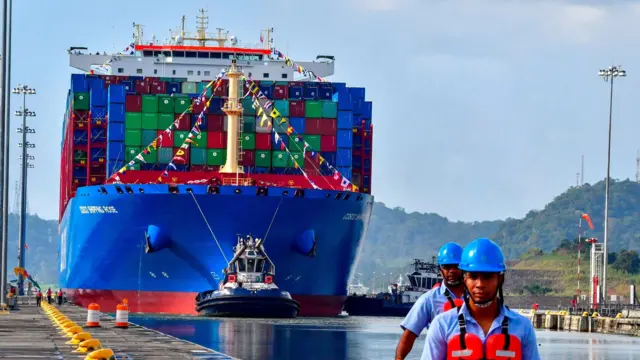
Judicial decision in the Central American country reignites geopolitical tensions and exposes the battle for influence in Latin America
The Panama Canal, one of the most strategic arteries of world trade, has once again occupied the center of the geopolitical chessboard. The waterway that connects the Atlantic and Pacific oceans has once again become the scene of a power struggle between the United States and China. This time, the trigger was a decision by the Supreme Court of Panama that removed the right of a company linked to Hong Kong to operate two key terminals on the maritime route.
Although the measure has a legal character, its effects go far beyond the limits of the Panamanian judicial system. In practice, the decision was interpreted as a clear victory for Washington, which has been trying for years to contain Chinese advances in areas considered strategic in the Western Hemisphere. At the same time, Beijing reacted harshly, raising its diplomatic tone and signaling possible political and economic retaliation.
Next, understand how a port dispute turned into another chapter in the rivalry between the two largest economies on the planet.
A judicial decision with global impact
The center of the controversy involves two container ports located at opposite ends of the Panama Canal. Until then, these terminals were operated by a subsidiary of CK Hutchison, a conglomerate based in Hong Kong. However, the Supreme Court of Panama decided to annul the company’s license, alleging irregularities in the concession contract.
This waterway is not just symbolic. Around 40% of all container traffic in the United States passes through it annually. In total, approximately $270 billion worth of goods cross the canal every year. Therefore, any change in the management of this route has a direct impact on global trade and, above all, on North American economic security.
Therefore, the decision was quickly celebrated by sectors of the US government. The White House has treated blocking Chinese influence on strategic routes as a priority. In this context, CK Hutchison’s withdrawal from control of the terminals was seen as a concrete step in that direction.
At the same time, analysts warn that the episode reveals something bigger. For many experts, the case of Panama reveals an open dispute for hegemony in Latin America, a region historically treated by Washington as an area of direct influence.
Beijing’s harsh reaction raises the tone of the conflict
China’s response was quick. In its strongest statement yet, Beijing warned that Panama “will inevitably pay a high price, both politically and economically”, if it does not reverse the decision. The statement came from the Hong Kong and Macau Affairs Office of the State Council of China, which classified the verdict as “logically flawed” and “completely ridiculous”.
Furthermore, Chinese authorities began to signal practical measures. According to Bloomberg, the Chinese government ordered state-owned companies to suspend negotiations on new projects in Panama. It also asked shipping companies to evaluate redirecting cargo to other ports in the region.
As if that weren’t enough, Beijing plans to intensify customs inspections on Panamanian products, including sensitive exports like bananas and coffee. These actions, although isolated, show how China uses its economic weight as a tool for diplomatic pressure.
Despite this, experts assess that Beijing’s room for maneuver is limited. The Panama Canal is seen by Washington as a strategic bottleneck. Given this, any Chinese attempt to force a change of course tends to run into US resistance.
Panama reacts and reaffirms institutional sovereignty
Faced with the threats, Panamanian President José Raúl Mulino adopted a firm speech. In a public statement, he said he “firmly rejects” the words of the Hong Kong and Macau Affairs Office. For Mulino, the Supreme Court’s decision reflects the independence of the country’s institutions.
On social media, the president reinforced that Panama is a “country of law” and that the government respects the decisions of the Judiciary. According to him, the Executive does not interfere in the verdicts of the highest court. With this, Mulino sought to dispel the idea that the measure had been taken under external pressure, especially from the United States.
Meanwhile, CK Hutchison announced that it has taken the case to international arbitration. The company stated that it “strongly disagrees with the decision [do tribunal]”, signaling that the dispute will still drag on for years in different legal instances.
For analysts, this prolonged scenario tends to increase political and economic instability around the canal, affecting not only Panama, but the entire global supply chain.
A dispute for regional hegemony
Geopolitical experts see the episode as part of a larger conflict. Scott Kennedy, senior consultant at the Center for Strategic and International Studies, stated that, given the doubts about security risks and the lack of consensus on mitigation measures, the case boils down to “a simple dispute for hegemony in Latin America”.
According to Kennedy, “the most likely scenario is a protracted legal battle in multiple jurisdictions, coupled with substantial political and economic pressure imposed by both Beijing and Washington.” This reading reinforces the idea that Panama has become yet another indirect battleground between the superpowers.
This clash occurs at a time of deterioration in Sino-American relations. Last year, then-President Donald Trump imposed broad tariffs on Chinese goods. In response, Beijing tightened controls on rare earth exports. Furthermore, tensions involving Taiwan, the war in Ukraine and US military actions in Venezuela and Iran further aggravated the scenario.
Chinese advances in maritime infrastructure
Despite the setback in Panama, China continues to expand its presence in Latin America’s strategic infrastructure. One of the most emblematic examples is the Port of Chancay, in Peru. Operated mainly by the state-owned company Cosco, the deep-water terminal promises to cut maritime transport times in the region by half.
Studies by the Foundation for the Defense of Democracies, based in Washington, indicate that China exercises significant control over the global maritime industry. According to researchers Elaine K. Dezenski and Susan Soh, the country controls more than 100 ports abroad and dominates the production of essential inputs, such as containers and port cranes.
Furthermore, China leads the global shipbuilding order book. By 2025, almost two-thirds of new orders should be delivered to Chinese shipyards, according to industry data cited by Clarksons.
Given this, analysts warn that the expansion of Chinese maritime dominance could create a dependence similar to that observed in the market for critical minerals and rare earths. This risk worries the US and its allies, who see control of maritime routes as a central factor in national security.
Multipolarity as a way out of the crisis
Amid the escalation of tensions, the UN Secretary-General, António Guterres, issued an important warning. For him, the dispute between the US and China does not offer lasting solutions to global problems. According to Guterres, “global problems ‘will not be solved by a single power that dictates the rules’”.
In a press conference held on January 29, he highlighted that the world is heading towards a division into two poles, one centered in Washington and the other in Beijing. However, he defended an alternative path. “If we want a stable world, if we want a world in which peace can be sustained, in which development can be widespread and in which, in the end, our values prevail, we need to support multipolarity.”
The case of the Panama Canal clearly shows the limits of the logic of confrontation. By transforming vital infrastructures into geopolitical weapons, great powers deepen inequalities and weaken countries that seek only to preserve their sovereignty. In this scenario, the global challenge is not to choose a side, but to build fairer rules for an increasingly interdependent world.
With information from CNBC*
Source: https://www.ocafezinho.com/2026/02/06/canal-do-panama-volta-ao-centro-da-disputa-global-entre-eua-e-china/