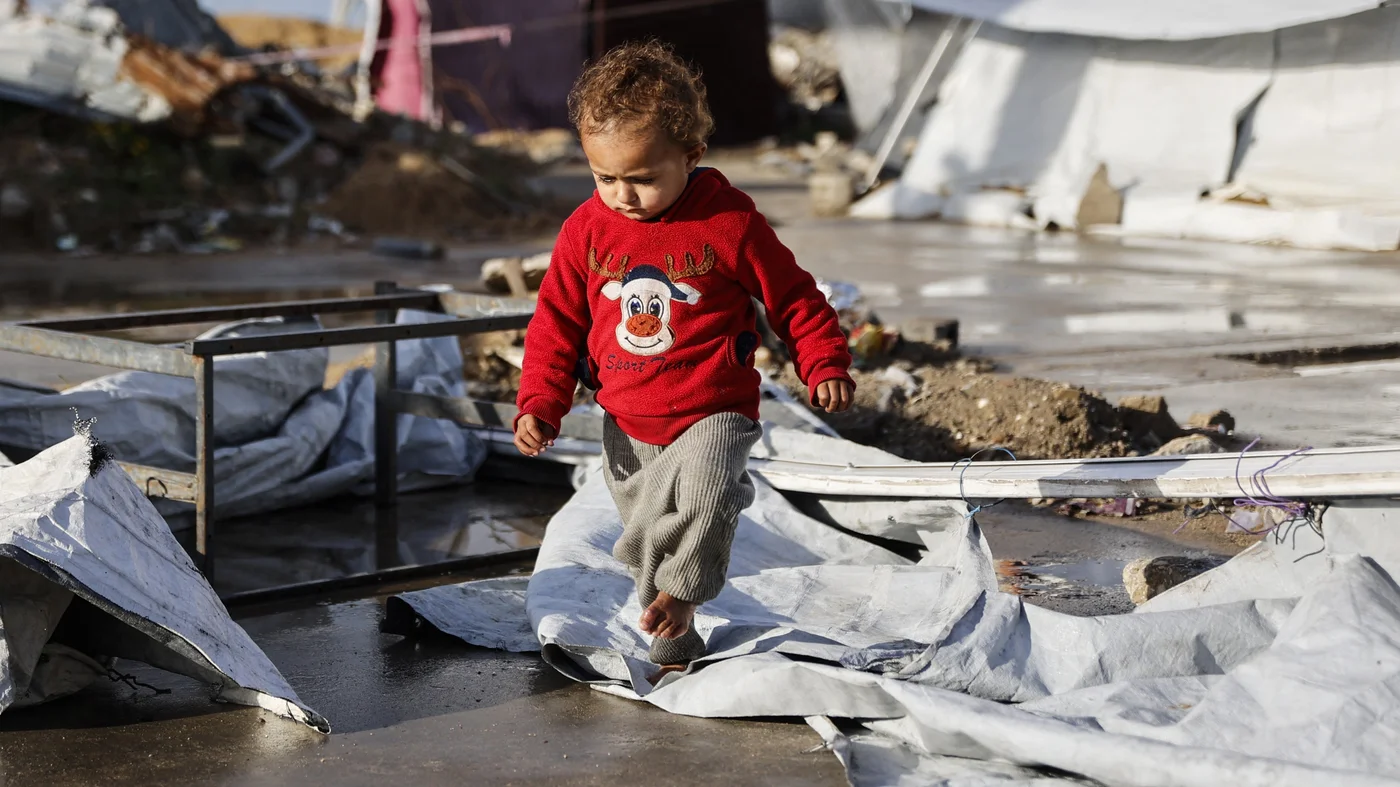
UNRWA laments the devastating, “man-made” consequences of the storms in the war-torn strip.
Heavy rains and intense winds flooded and tore away tents in the Gaza Strip on Monday, worsening the already precarious living conditions of Palestinians after two years of Israeli genocide.
The Palestinian Health Ministry reported that two-month-old Arkan Firas Musleh died of hypothermia on Monday, in a situation where harsh winter weather conditions were worsened by the Israeli blockade on the provision of shelter.
Since the start of the rainy season earlier this month, at least three children have died from the cold, while another 17 have been killed by collapsing buildings due to storms and strong winds.
According to the Shelter Cluster, more than 42,000 tents and makeshift shelters were damaged between December 10 and 17, affecting nearly a quarter of a million people in the besieged enclave.
Amro Akram, a Gaza Strip resident currently displaced in Khan Younis, described the harsh conditions.
“We are drowning,” he told Middle East Eye after Monday’s heavy rain.
The 20-year-old said he had been staying in his sister’s tent for the past few days because his own had been destroyed in the storm earlier this month. This one was also submerged on Monday.
“The sound of children drowning in the rain is unbearable. One feels powerless to help a child,” he said.
“When it rains heavily, all the tents are flooded. Everyone is lost, not knowing where to shelter their children from the cold.”
Intense cold and strong winds also pose serious threats.
“The wind is so strong that it blows the tents away,” Akram said. “The cold at night is intense and the wind is scary.”
He explained that at night “you can’t even lift a finger out of the blanket” due to the extreme cold.
According to Civil Defense spokesman Mahmoud Basal, more than 90% of the tents were blown away or flooded by heavy rain and winds, which highlights the scale of the ongoing humanitarian disaster.
Basal also noted that more than 110 residential buildings suffered significant partial collapses, putting the lives of thousands of people in the Gaza Strip at risk.
‘Help is very scarce’
Akram said his only desire these days is still to feel warm under a blanket.
“Aid is very scarce and does not reach all families,” he explained.
“If help reaches a family, it may only provide one blanket. How can one blanket cover an entire family?”
He emphasized the growing need for blankets, mattresses and tents that can provide shelter amid floods and rain. He also called for the use of caravans to help make life “more bearable” during winter.
“At the end of the day, a tent doesn’t offer much protection against the cold and wind. Everyone is in the same situation,” he added.
The United Nations Relief and Works Agency for Palestine Refugees (UNRWA) stated in a post on X that “months of war and displacement have forced people in Gaza to live amid crumbling ruins, in makeshift shelters or flimsy tents.”
“Although Storm Byron, which hit Gaza from December 10, was a natural disaster, its consequences are man-made,” he added.
The Government Press Office, based in Gaza, said on Sunday that Israel continues to fail to comply with its obligations under the ceasefire agreement, failing to allow the agreed 600 daily trucks to enter the blockaded Gaza Strip.
Only around 20,000 trucks have entered the Gaza Strip, out of the 48,000 that have entered since October, which the cabinet says is leading the enclave to a “slow death”.
“This has led to ongoing serious shortages of food, medicine, water and fuel, worsening the catastrophic humanitarian crisis in the Gaza Strip,” he added.
The lack of fuel shipments to the Gaza Strip also worsened the critical situation, “paralyzing” several sectors, including hospitals, bakeries, water and sanitation facilities, as well as hampering search and rescue operations.
The ceasefire was intended to end a two-year genocidal war in Gaza, during which Israel killed some 71,000 Palestinians and destroyed nearly 90% of the Strip’s infrastructure.
Originally published by Middle East Eye on 12/29/2025
Lubbâna Maara
Source: https://www.ocafezinho.com/2025/12/30/palestinos-se-afogam-enquanto-chuva-e-vento-arrancam-mais-tendas-em-gaza/