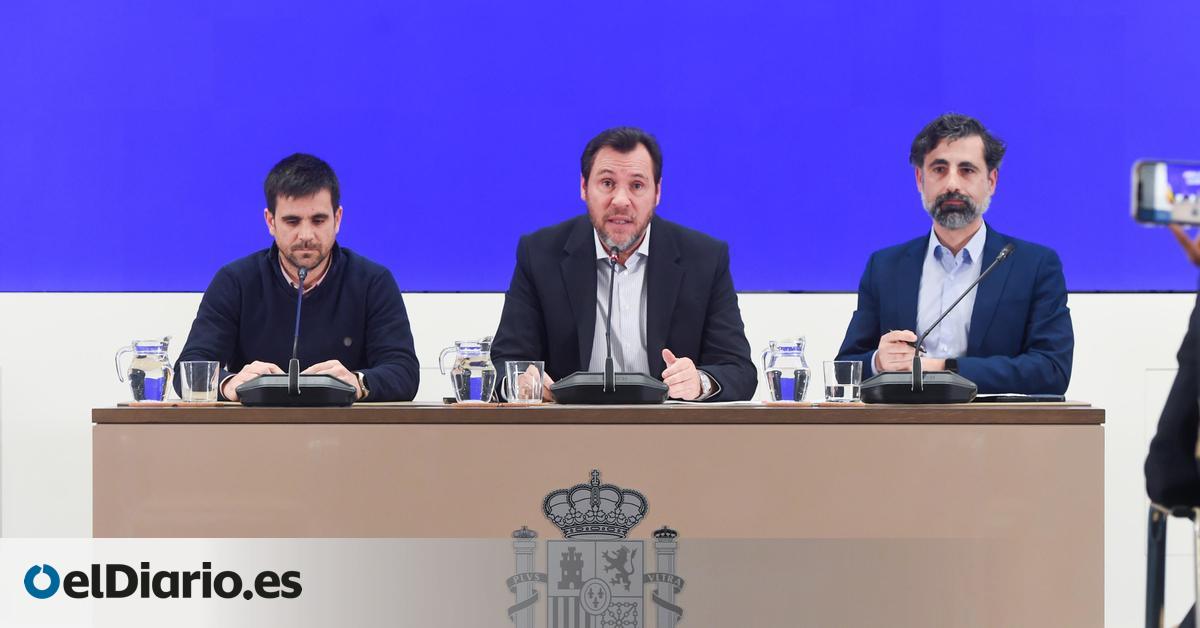
The Minister of Transport, Óscar Puente, assured this Tuesday that the origin of the train accident in Adamuz is a “very complex” problem but that it has nothing to do with the maintenance or obsolescence of the railway infrastructure nor with the lack of controls.
“If there is one thing evident, it is that it was not maintenance or obsolescence or lack of controls that led to the accident. We are facing another problem, I fear, much more complex than we are imagining,” Puente said in a press appearance to explain all the details about what happened in the accident, which has taken the lives of at least 43 people. At the beginning of his appearance, the minister asked to avoid “speculation.”
“It is probably a problem that we have never experienced before on our network, which has never manifested itself in this way and we will have to think very carefully how to prevent something so unique from occurring again,” the minister stressed in an extensive appearance in which Adif’s traffic director, Ángel García de la Bandera, and Renfe’s director of Operations, José Alfonso Gálvez, also participated.
Puente has stressed that what has happened is “something truly different from all the incidents that have occurred to date.” “It is truly unique,” he insisted when questioned about the issue during the press conference in which he denied that this statement points to the liberalization of the sector that occurred during the last legislature.
The Adif leader explained that the section in which the accident occurred was completed a few months ago and that in recent months its infrastructure was reviewed on up to four occasions, the last on January 7, just a few days before the event.
“In these four inspections of which we have evidence and control, no failure has been detected that a priori shows a relationship with the accident,” García de la Bandera stressed.
The first of the actions was carried out on October 13 of last year and was a “geometric auscultation” to review parameters of the road such as width or superelevation. The second was a walking inspection a few days later. On November 21, a dynamic auscultation was carried out, in which, he explained, the accelerations during the movement of a vehicle are analyzed, with observations that do not appear in the first review. Both the safety of the road and the comfort of the trip are evaluated. And the last one was a complete review on January 7.
It is an “undeniable possibility” that the notches in the wheels are due to defects in the tracks.
Puente has explained the “bites” found in the wheels of the Iryo train that derailed last Sunday and collided with an Alvia that was traveling in the opposite direction. These are, as reported during the day and also in this appearance, about notches “1 millimeter long and about three centimeters wide on the front bogies [conjuntos de ruedas] of the first five cars of the damaged Iryo.”
“Of a few trains that passed through that same point on that day, we have detected marks on one of the trains, specifically the one that passes immediately before the Iryo in three bogies and one section and not on the rest. And similar marks and some marks on the one that passed previously,” he said. The latter, however, are “much milder” and surprisingly have been found in the bogies on the left side and not on the right as in the rest of the trains.
However, Puente has asked for caution regarding the conclusions drawn from these marks on the wheels and the piece of damaged track in the area of the accident. “It is not easy to establish a connection test from a single element, for my part it would be very risky to say that the existing marks on the bogies automatically imply a failure in the infrastructure,” he said. He has highlighted that it is an “undeniable possibility.”
“We do not have an answer to whether it is cause-effect or if it is part cause and part effect. One of the things that must be delimited is whether that point that is broken is the first point in which the events that give rise to the derailment occur, that is not so clear,” said Puente, who specified that he does not want to give more information while waiting for it to be “verified.”
He has also clarified what happened to the bogie that was thrown and ended up in a nearby stream. The most plausible explanation, according to the minister, is that this piece became detached from one of the carriages of the Iryo train when it collided laterally with the Alvia. Due to the impact at high speed, the piece jumped into the air and ended up in the nearby stream.
He has specified that the piece was not located by a photographer from the American newspaper The New York Times but rather by the Civil Guard on the same Monday. It is located in an area that is “very difficult to access” and therefore, as explained, it will surely remain there for some time due to the problems in moving heavy machines to that area.
Human factor ruled out
The only cause that the minister has completely ruled out is human error. “That the human factor has had no impact seems clear. The Iryo train was traveling at a speed well below normal. Both trains were traveling at a very correct speed. Taking into account that the derailment occurs in a queue and on a straight line and that the subsequent impact is not avoidable, the human factor has had no impact,” he said.
He has also defended on several occasions the state of the infrastructure in that area, with a “newly renovated” road that has passed, he reiterated, “four inspections in the last three months.” “Adif respects and complies with the review protocols of its infrastructure. It has scheduled reviews and even some random ones with a specific welding machine,” he said.
Puente has claimed that the infrastructure control standards are “very high” and has valued the Spanish railway system as a “reference in the world.” That is why he has sent a message of “confidence” in the railway network: “We know how it is, it is reviewed, we know the problems and the need to solve them.”
He also detailed the levels of investment in maintenance, which, as he explained at the end of the press conference, have increased “very notably” in recent years. From 759 million in 2011 compared to more than 1,100 million in 2025.
Source: www.eldiario.es