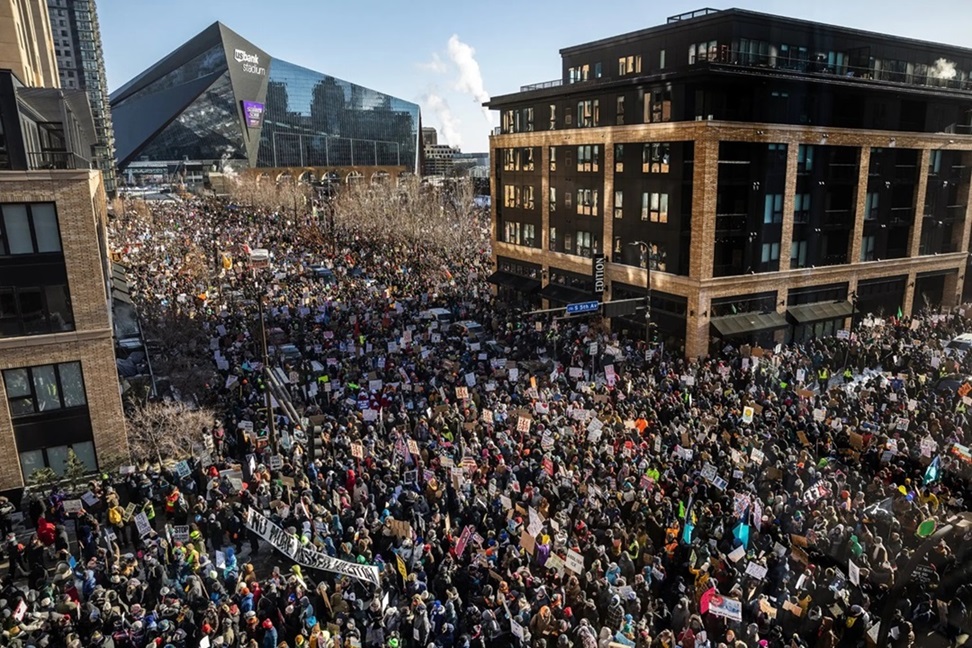
Thousands of protesters paralyzed parts of Minneapolis-St. Paul on Friday, as hundreds of businesses closed their doors and workers and students stayed home to demand an end to the sweeping immigration crackdown that has roiled the Twin Cities for weeks.
Friday’s action, which took place in subfreezing temperatures, was the most widespread and organized demonstration since federal agents arrived in Minneapolis more than six weeks ago. Their goal was to pressure the federal government to remove thousands of its officers from the streets.
Many local businesses closed their doors to halt economic activity, saying that losing a day’s income was worth taking part in the effort to end immigration enforcement.
“There’s a time to stand up for things, and this is the time,” said Alison Kirwin, owner of Al’s Breakfast, a Minneapolis restaurant that closed Friday. “If that takes away a day of revenue from us, it’s worth it.”
The day of protests followed weeks of clashes between Minnesotans and federal agents, primarily in the Minneapolis and St. Paul areas. The immigration operation, which began late last year, has led to about 3,000 arrests, at least two shootings in Minneapolis and chaotic scenes on the streets.
Residents and local officials have intensified their calls for federal agents to be expelled, especially after a U.S. Immigration and Customs Enforcement agent shot and killed U.S. citizen Renee Good in Minneapolis on Jan. 7. Protesters and state authorities have also filed lawsuits to restrict officers’ conduct and block the surge.
The largest of Friday’s protests centered in downtown Minneapolis from late afternoon to early evening, when thousands of people marched toward the Target Center, the stadium of the state’s two professional basketball teams. The protesters carried signs and chanted over and over for ICE to leave the city.
Participants in the crowd cited different indignities that led them to take to the streets. The murder of Mrs. Good. The aggressive tactics deployed by federal agents against protesters. The viral image of a five-year-old boy detained by ICE with his father.
“I got emotional,” said Butchy Austin, founder of Brass Solidarity, a racial justice activist street band, as he looked out at the crowd of thousands. “There is resistance and a level of struggle, but it is a struggle that comes from love for our neighbors.”
Austin said the group, which formed after the murder of George Floyd in 2020, came to the Target Center on Friday afternoon because they have seen “how music can bring resilience and joy, and a message of hope and change.”
Emerson Johnson, 19, had planned to come to the Twin Cities for the weekend. When she saw signs on her college campus about the march in downtown Minneapolis, she called her sister to advance her trip. “If you see violence, and some of the things you see are literally evil, I don’t know how you can see that and ignore it,” he said.
Randi Weingarten, president of the American Federation of Teachers, gave an impassioned speech at the Target Center, praising Minnesotans for taking a day off from their usual activities to make their voices heard.
“We are responding to ICE violence with nonviolence,” he said. “We are responding to their chaos and cruelty with passion and community.”
Hundreds of people demonstrated Friday at the Minneapolis-St. Paul, some from as far away as New York, going in and out of one of its terminals to stay warm.
Inside, protesters shared hot chocolate and hand warmers, and compared the layers of clothing they wore to withstand the bitter cold. After warming up enough to brave the elements, they returned to the sidewalk, as police officers warned them to stay off the street or face arrest.
At one point, a group of clerics came down from the sidewalk, knelt on the pavement and began to pray.
“Everyone has the right to live and before this campaign fails, we will all go to jail,” they sang. Protesters, many of them in snowsuits and ski goggles, cheered as police detained several dozen clerics and put them on buses.
Friday’s protests were part of a general strike organized by residents, religious leaders and unions. The goal, according to organizers, was to demonstrate the residents’ determination.
In Minneapolis neighborhoods, many businesses and stores remained closed, and some posted signs in their windows expressing solidarity.
In St. Paul, Roots Roasting had an orange sign announcing its closure. “General strike,” it said. “No to work, no to school, no to shopping, out with ICE.”
Down the street, Spyhouse Coffee, part of a local chain, had a handwritten sign announcing its closure to “show solidarity with the community and other businesses.” The same was true of almost every coffee shop in the Twin Cities.
One of the few that remained open was Misfit, in Minneapolis, which occupies a large warehouse-like building west of downtown. Owner Marcus Parkansky said his way of participating in the strike was to offer only free coffee, pastries and espresso shots. Thanks to a donation from a Texas woman, there will also be a bottle of bourbon and a bottle of Baileys for those who want to add an alcoholic touch to their cup.
Parkansky said he hoped the strike would show the federal government how organized Minneapolis is. “What we want is for the pranks to end,” he said.
News of Friday’s strike and protests spread “like wildfire” in the days leading up to it, according to Jake Anderson, an executive board member of the St. Paul Federation of Educators, a union representing teachers and educational support professionals. Hundreds of businesses, mainly in Minneapolis and St. Paul, said they would close. On Friday, it seemed that many had kept their promise.
Federal officials have said their presence is necessary to find people who are in the country illegally and to root out fraud in the state’s social services system. They have defended their interactions with protesters and the ICE agent who killed Ms. Good.
The Hennepin County Medical Examiner’s Office ruled Ms. Good’s death a homicide, the result of gunshot wounds. He did not rule on whether the shooting was justified.
Antonio Romanucci, an attorney for the Good family, said in a statement Friday that “we continue to await their full report and hope that they will contact Renee’s family and share their report before releasing more information to the public.”
On Thursday, Vice President JD Vance said the Trump administration wanted to “lower the temperature” in Minneapolis. Mr. Vance, who said he had traveled to the city to understand the tensions, called the protesters “far-left agitators” who had harassed federal agents. He also said a “lack of cooperation” from state and local officials was to blame for the situation having “got out of control.”
In an email sent Thursday, a Department of Homeland Security official called the strike “beyond crazy” and asked, “Why don’t these union leaders want these threats to public safety out of their communities?” The official then included a list of undocumented immigrants who had apparently been convicted of serious crimes.
Minnesota has 17 Fortune 500 companies. However, they have not commented publicly on federal activity on immigration, and none of Minnesota’s 15 largest employers, including Target, UnitedHealth Group and Xcel Energy, responded to requests for comment this week.
Christa Sarrack, president of a union representing about 6,000 hospitality workers, said some of her employers had decided to close for the day, while others were allowing their employees not to come to work.
“We cannot stand by and allow this to continue,” Ms Sarrack said. “We must use all the tools we have to fight.”
For some employers, the decision to participate or not has not been easy, because they simply cannot afford to lose a day’s income.
Andrew Schoenzeit, owner of Zipps Liquors in Minneapolis, kept his business open Friday. However, he stated that he supported the strike and had no problem with the one employee who requested the day off to protest.
At some Minneapolis businesses that remained open Friday, employees who came to work said that while they supported the strike in spirit, they could not afford to go without pay.
“I have to pay my tuition. I have to pay rent, food, all of the above,” said Joe Joyce, a shift manager at Potbelly, a sandwich chain. “It’s not that I reject the protest. It’s that I really have no choice but to come to work.”
For some local and state union leaders, the decision to encourage their members to participate in the general strike was difficult since it was not organized under state and federal strike laws and was not considered an “official work stoppage day.” However, the pressure to boycott was so widespread that it was difficult to ignore.
Chris Rubesch, president of the Minnesota Nurses Association, a union that represents more than 22,000 nurses and other health care workers, said he and other leaders discouraged members from missing work because of “no-strike” clauses in their contract. But he said the union also encouraged them not to engage in any other economic activity.
Mr. Anderson, a board member of the St. Paul Federation of Educators, said his union joined the initiative after a long debate and asked members “to decide what that call to action meant to them.”
“We decided it was time to take a stand,” Mr. Anderson said. “It was time to boldly declare that enough was enough. We are not going to take it anymore.”
Source: www.laizquierdadiario.com