If there is something that is discussed in every school, playground and teachers’ room throughout the country, it is that money is not enough. There is no teacher who is not in debt. Working conditions continue to worsen with the need to have to work two or three shifts, but in many provinces this is not possible and you have to have two or three different jobs, sell something or do Uber. Thus there is no education that can endure.
As developed in this table presented by data economist Alejandro Morduchowicz in his note “To understand the teacher salary conflict in PBA. (But there is also data from the rest of the country.)” there is no province that has a salary that allows you to live with one position or with the sum of two positions. The situation is alarming.
In this other painting also by Morduchowicz and which is circulating on school WhatsApp groups, the brutal drop in teacher salaries is shown. They are not cold numbers, it is the economy of those who educate children throughout the country.

In addition to rock-bottom salaries, consolidated educational financing fell to 4% of GDP, real educational investment fell 47.7% and, in addition, during 2025, more than 135 billion pesos of the educational budget remained unexecuted. Likewise, national educational programs registered a real drop of 75.1% between 2023 and 2025, affecting inclusion policies, literacy, infrastructure, scholarships and support for school trajectories. It is the education of Milei, the IMF and the big employers.
According to an analysis of the 2026 Budget prepared by Argentinos por la Educación, this year the Government will invest 0.75% of GDP in education, below 2024 (0.88%). This same organization analyzed the last ten years of provincial educational investment and found that teacher salaries fell in 21 of the 24 provinces between 2014 and 2025.
The government voted for the labor reform with many collaborations from radical senators and deputies, Macristas and Peronists, where among other attacks on the historical rights of the working class is declaring education as an essential service to curtail our right to strike. Together with lowering the age of imputability to 14 years (secondary students in our schools) and a new “Educational Freedom Law” that wants to be voted on, they form a combo attack on teaching, kids and our schools.
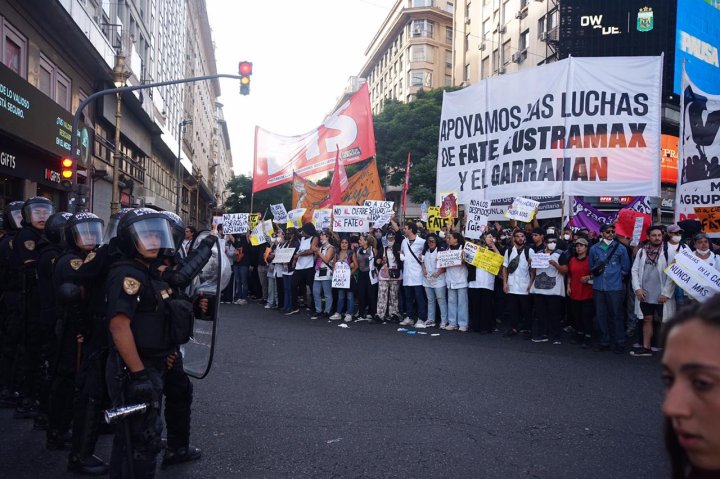
FITU deputies such as Myriam Bregman and Nicolás del Caño confronted these laws from their benches and the streets, along with a large number of teachers from 9 de Abril were at the obelisk protest and were part of the combative day before the second vote in the senate.
With this alone, it will not be enough, we must vote on a fight plan
The role of the celestial leadership of the CTERA and the provincial unions was one of total dedication to the government. Beyond sporadic calls for strikes without organizing them or FRESU mobilizations (which already have to their credit, a few days after being born, the sum of 3 marches where they did not want to enter the Plaza dos Congresos). In Formosa the celestial leadership went so far as to release a statement saying that they do not support the national strike that they themselves called. The GDA union did launch the strike, which will have good compliance. In Mendoza, the Azul Naranja leadership also does not call for a strike with the argument of joint negotiations underway with Cornejo’s repressive government. They are preparing to sign another pittance for the lowest paid education workers in the country, while hundreds of courses and degrees are closed by the government to adjust. The anger grows from below.
But teaching is beginning to find organization and resistance, as demonstrated by the mobilization that teachers from Rio Negro will do this March 2 on the Carretero bridge (border with Nequén and which connects both provinces) while the provincial ATEN leadership, which is part of the executive board of CTERA, refused to converge and instead mobilizes the government house. The teachers of Chaco come from weeks of enormous mobilizations with flags on the roads confronting the governor, who, upon seeing the determination of the teachers, in a criminalization campaign, warned “about the possible takeover of routes by the teachers.”
Also in Santa Fe where self-organized actions took place throughout the province, from the large cities to the smallest towns, in repudiation of the adjustment and permanent mistreatment of Pullaro. The governor can no longer walk calmly. Wherever he goes he encounters teachers who are mobilizing to get rid of him. Next Monday, a strike and a major mobilization are expected in Santa Fe. The response was to close the joint venture by decree. A fight opens with the union bureaucracy to give continuity to the fighting plan.
In the Province of Buenos Aires (the richest province in the country but where the teacher salary is at number 18 in the national ranking), the Multicolor opposition to Baradel voted for 48 hours of strike in a plenary session with mandates from 5,000 teachers who face Kicillof. In Jujuy, the CEDEMS union will also stop for 48 hours and will mobilize alongside the ADEP activism that continues to confront the CTERA Celeste fraud.
With the support for these processes and others that will be opened province by province, we insist again on the potential role that the entire national teaching opposition can play in the face of a leadership of CTERA that increasingly generates more anger and discontent. We need the triumph of each of the teaching struggles and join FATE, Garrahan and all the ongoing conflicts. We will take the strike into our hands and make a great call for the unity of the entire working class in defense of work, health and education.
We must start from the need to organize more and more colleagues, uniting with families and students in the face of a scenario of profound impoverishment of their lives, to collectively gather more and more forces and be able to impose on the union leaders the fighting plans that we need. Starting with the fight to increase teacher salaries and improve working conditions, against the closure of degrees and courses and the need to have greater resources for the mental health of our students, their nutrition and families with disabilities. For this we need maximum unity among all sectors opposed to bureaucratic union leadership and national coordination, with a program of struggle and defense of public schools. This may be the starting point to discuss the need to recover CTERA as a tool of struggle and organization for teachers and the entire educational community in the country.
Source: www.laizquierdadiario.com