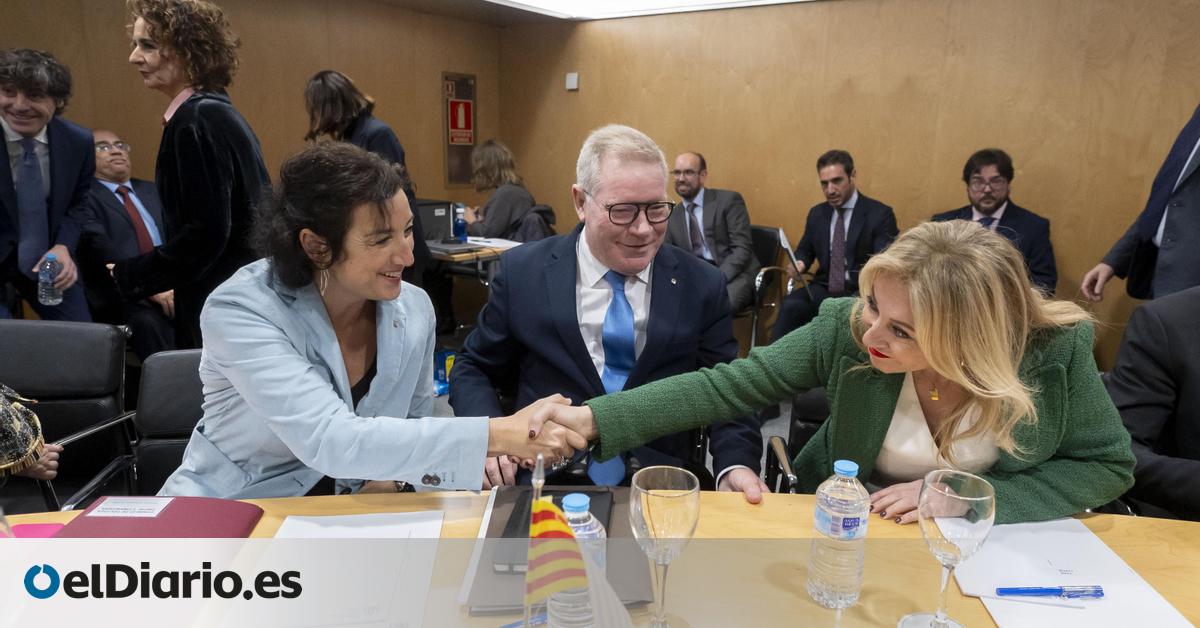
The autonomous communities left the meeting of the Fiscal and Financial Policy Council (CPFF) this week up in arms. The first vice president and Minister of Finance, María Jesús Montero, informed the councilors of her proposal to reform the regional financing system, which has been out of date for twelve years, and only received the explicit support of the Catalan representative, Alícia Romero (PSC). However, and even though Madrid spoke of “state corruption” and even the socialist Castilla-La Mancha called the model presented to them “blackmail,” the silences and evasions counted for much more than the bold words of the regional leaders.
Because the central government’s proposal, far from imposing a “solidarity concert”, a “Catalan quota” or a “singular financing” that has occupied so many headlines since the summer of 2024, represents an evolution of the current model with an injection of almost 21,000 million euros only in 2027, when it should come into force if the Treasury deadlines and the wishes of La Moncloa to tie up the majority of the investiture are met.
This figure, which represents around 1.2% of the Spanish gross domestic product (GDP), implies that the autonomous communities, which support the bulk of the State’s social spending, will have a total of 224,507 million coming from the financing system, around 13% of the GDP.
That is why councilors as relevant as Galicia’s, Miguel Corgos, left it up in the air whether they will adhere to the new model or continue with the current one, as Montero proposed, since it clearly harms them. “It is quite unlikely that this will be approved,” the Murcian official, Luis Alberto Marín, avoided.
The additional 20,975 million euros that the autonomous communities will have available – which come from a greater transfer of personal income tax and VAT collection, as well as transfers from the State – cover almost 40% of the expenditure on Education of the autonomous communities of the common regime (that is, except the Basque Country and Navarra, which have their own provincial treasuries) in 2024. The resources represent close to one in every four euros that the regional executives allocate to the Health. They are more than seven times their execution in terms of housing and more than six times what they dedicate to protecting the environment.
These data come from crossing the figures revealed by the Treasury in the presentation of the model with those from the database of the Functional Classification of Public Administration Expenditure (COFOG), a methodology designed by the United Nations that divides public spending into ten divisions depending on what they are intended for: health, education, housing… And, although the latest data are provisional and correspond to 2024, they show what this additional volume of resources means on the main items supported by regional governments.
Almost 60% of spending on Education in Murcia or Valencia
The Murcian counselor assured that Montero’s proposal “has been designed to satisfy the infinite desires of secessionism.” But Murcia, which would receive 1,188 million according to the central government’s estimates, would cover with this additional financing 58% of its spending on Education (2,051 million) or 35.5% of what it allocates to Health (3,347 million), as seen in the graph below these lines. The ‘extra’ from the State is double what the regional Executive allocates to housing or social protection policies, which reaches 583 million. It is also double what it invests in Economic Affairs (which includes transport or research items, for example) or ten times the resources allocated to protecting the environment.
The new Minister of Finance of the Valencian Community, José Antonio Rovira, avoided journalists when leaving the CPFF but, in statements to the regional television Á Punt, he called Montero’s proposal “blackmail.” He did so just a few days after saying that “it doesn’t look bad” and being corrected by the new president of the Generalitat Valenciana, Juanfran Pérez Llorca.
The Valencian Community, along with Murcia, the region most affected by the current model, would receive 3,669 million euros in additional resources. Or what is the same, 56.7% of what it spends annually on Education or 35.8% of what it allocates to Health. The ‘extra’ financing that this new system that the central government has proposed would entail would more than cover the joint expenditure on social protection and housing (2,372 million), as well as the investments that are included in the Economic Affairs items (2,033 million) or seven times what the region allocates to the Environment (502 million).
Montero points out the PP as “benefiting” from the financing
For Andalusia, counselor Carolina España described the “Montero financing model” as “champagne and caviar” for the independence movement and “the menu of the day, but without dessert” for the rest of the communities. The statements were made upon his arrival at the Ministry of Finance, since upon leaving the CPFF he did not want to respond to the journalists present.
The “menu of the day” for Andalusia is an additional 4,846 million euros, the community that benefits the most in absolute terms, which represents 43% of spending on Education or one in every three euros allocated to Health. With the ‘extra’ funds, the Government of Juanma Moreno would cover almost double the combined investments in Housing and Social Policies (2,645 million) or five times what they allocate to the Environment (862 million).
Vice President Montero dedicated special attention to the accounts for Andalusia, since in a few months she will compete in the territory as a PSOE candidate for the Board. At the press conference after the meeting he recalled that the region will receive more than what Moreno Bonilla claimed: “The president of the Andalusian Government asked for 4,000 million.” “It is false that this is a model designed to please Catalonia,” he insisted, recalling that 15,000 million will go directly to the PP communities (if they do not renounce these resources). “If there is a party that benefits from these measures, it is undoubtedly the PP,” concluded the vice president.
The “blackmail” to Castilla-La Mancha: 1,248 million
The vice president did not find greater support among her own ranks either. Asturias allowed itself to be loved, although without being very convinced. And Castilla-La Mancha joined the “blackmail” theory, but its advisor, Juan Alfonso Ruiz Molina, had a hard time trying to explain why the 1,248 million more they would receive if the new system was approved left their community in a bad position. “We have been suffering from a model that is harming us. With these data, Castilla-La Mancha would continue to be below average,” he assured.
How much do the extra funds mean for the Government led by Emiliano García-Page? It would allow you to pay 51.5% of Education or 29.7% of Health. It would more than cover the combined spending on housing and social protection (921 million) and also the environment (212 million).
Catalonia, despite Montero’s statements, will be one of the great beneficiaries of the new model. Not only because it will receive more resources through the greater proportion of VAT and Personal Income Tax, which being a larger economy guarantees higher collection, but because thanks to other adjustments (such as the possibility of receiving VAT from SMEs or the Climate Fund, which benefits Mediterranean communities) the proposal provides an additional 4,686 million to the region.
With these figures, the Generalitat could finance half of its spending on Education (49.2%), or a quarter (27.8%) of health spending; almost all of its spending on housing and social protection (4,776 million) and practically all of its economic investments (4,563 million).
Even Madrid, whose advisor, Rocío Albert, said that the proposal was “State corruption” and that “we are not going to accept what the independentists want, much less are we going to pay for it” will receive a notable injection of public money: 2,555 million. Enough to pay 35% of spending on education or 20% of what they invest in Health.
The large amounts go to these communities, while the rest will receive more modest amounts, but higher than what they will receive under the current model. In the case of Extremadura and Cantabria, the ones that benefit most from the current distribution, the Government has included a mechanism to guarantee that not only do they not lose, but they receive 216 and 46 million more, respectively.
Treasury opens to “finalist” financing
Although the comparisons show the magnitude of the resources that the Government has put on the table, the distribution of the financing system is not “finalist”, as Vice President Montero recalled, after the leader of the PP, Alberto Núñez Feijóo, proposed that part of the funds be allocated to housing construction.
“Within the CPFF it has been made very clear that the autonomous communities do not want to lose political or financial autonomy. Curiously, the communities say this based on the limits on fiscal dumping that the proposal poses when it was explained. However, they do not say it when the president of their party states that they are finalists,” ironically stated the ‘number two’ of the Executive. “If the PP proposes that the money go to housing, or a part, okay. And the rest of the money should go to publicly owned public health, publicly owned public education,” he stressed.
Expert reactions to the new system have been mixed. Some, like Ángel de la Fuente, from Fedea, celebrate the existence of “promising elements”, but warn of other “frankly negative” ones. The professor of Financial and Tax Law at the Carlos III University of Madrid, Violeta Ruiz Almendral, pointed out through a publication on LinkedIn that, although the proposal “surely has points for improvement,” “it seems to follow the basic scheme or formula of regional financing that has been endorsed by the Constitutional Court.” And a rating agency as relevant in the recent economic history of our country as Standard & Poor’s endorsed the proposal, although with doubts that it would prosper in Congress.
However, a large part of the doubts raised by the Ministry of Finance’s proposal have to do with the role of the State. The almost 21,000 million euros reduce the central government’s room for maneuver at a time when spending pressures on its powers are going to increase significantly, as Diego Martínez-López, professor of Applied Economics at the Pablo Olavide University of Seville, warns. Aging is going to increase pension spending, which is already largely covered by transfers to Social Security. And the Executive has committed to allocating 2% of GDP to Defense, a reference that will increase in nominal terms as the economy grows.
Starting next week, the Government will begin a series of bilateral meetings with the autonomous communities, with the aim of drafting the Draft Law with the reform of the system. Once it is approved by the Council of Ministers and goes through the public hearing procedures, it should go through a new plenary session of the CPFF to, this time, be voted on by the regional Executives. The Ministry of Finance is confident that the law will be in Congress before June and that it can be approved before the end of the year, so that it will be in force for the 2027 financial year.
Source: www.eldiario.es